
Vandaag of morgen in huis

Kwaliteit gegarandeerd

Welkomstaanbiedingen ontgrendelen: GRATIS bezorging | Tot 80% korting | Gratis 30 dagen JoyPlus-proefperiode
Download de app
A shoe rack seems like a simple purchase, until you discover that it is too narrow for larger shoes, wobbles on an uneven floor or does not offer enough space for a household with several occupants. Product titles can also be confusing: a model with lots of shelves does not automatically hold lots of pairs, and an open rack works differently from a shoe cabinet.
With this guide, you can compare a shoe rack for the hallway, bedroom, corridor or walk-in wardrobe based on its dimensions, capacity, material and ease of use. This helps you avoid paying mainly for an attractive design that does not work in practice.
A shoe rack with several shelves may look spacious, but its actual capacity depends on the width and depth of each level. Tall boots, wide trainers and children’s shoes also take up different amounts of space. So do not just check the number of shelves: also look at the overall dimensions and stated capacity.
A narrow shoe rack is useful in a small hallway, but a tall construction may be less stable when its footprint is small. Measure the available width, depth and height. Also take skirting boards, doors and walkways into account. A freestanding shoe rack should stand on a flat, stable surface.
A metal shoe rack is generally easy to wipe clean, while plastic can be lightweight and MDF components may be susceptible to prolonged exposure to moisture. Open racks provide ventilation, but leave shoes on display. A shoe cabinet conceals its contents more effectively, but often requires more space and assembly.
Start with the space where the shoe rack will be placed. Note down:
A shoe rack for 30 pairs may be suitable for a family, but check that the stated capacity matches your types of footwear. Tall shoes may require you to leave a shelf empty, reducing the practical capacity.
Steel and metal are logical choices if you are looking for a sturdy, open construction. Polypropylene is lightweight and can be useful if you want to move the rack occasionally. A combination of metal and wooden board often also gives you a top shelf for bags or accessories.
Pay attention to how the rack is assembled. Check whether self-assembly is required, whether fixings are included and whether wall anchoring is recommended. Do not use a shoe rack as a bench or step stool unless this is stated in the product description.
An open shoe rack makes it easy to grab your everyday shoes and supports air circulation. A shoe cabinet creates a tidier look in the hallway, but may be less suitable for large or tall shoes. A hanging shoe organiser makes use of vertical space and may be useful for a wardrobe door or unused corner.
For wall-mounted solutions, you can also browse the range of wall-mounted shoe storage.
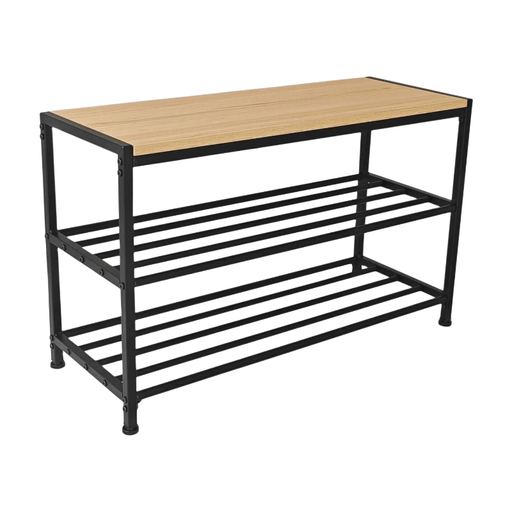
Why it suits this profile: Its compact size and capacity of 6 pairs make it suitable for a small hallway, bedroom or entrance where you only want to store your most frequently worn shoes.
The stated dimensions and capacity make it clear in advance how much space and how many shoes you can expect it to hold.
Metal with a wooden top shelf; open design; 80 x 30 x 49,2 cm.
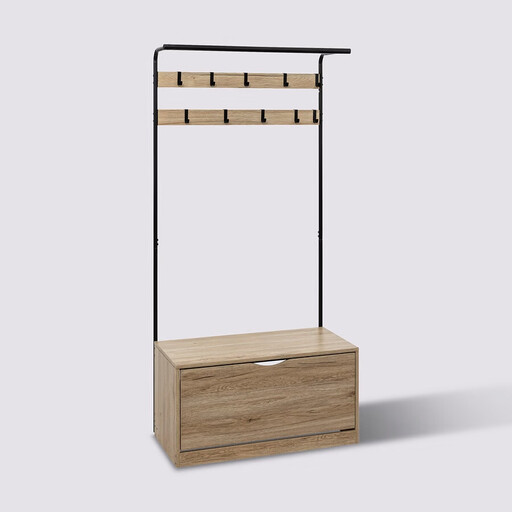
Why it suits this profile: This tall model combines a steel structure with two shelves, MDF components and a clothes rail. It is ideal for anyone looking for several functions in one hallway unit.
The construction and materials are clearly specified, so you do not have to rely solely on a general marketing claim about sturdiness.
Steel frame; 80 x 35 x 175 cm; two shelves and a rail; suitable for indoor use.

Why it suits this profile: Its stated capacity of 30 pairs is designed for households with a larger collection. The depth of 24.5 cm can be practical in a narrower hallway, but measure the available space carefully.
The capacity is stated clearly. However, check that your shoes will fit on the shelves comfortably.
Metal construction; space for 30 pairs according to the product description; 65.5 x 24.5 x 138 cm; self-assembly.

Why it suits this profile: This hanging shoe organiser makes use of a door or vertical wardrobe storage. That makes it suitable for small spaces where a freestanding shoe rack would not fit well.
You do not need to free up any floor space. However, check beforehand that the door can open and close freely and that the weight limit for each pocket will not be exceeded.
24 pockets; metal frame with mesh; foldable design; dimensions of approximately 48 x 7 x 171 cm according to the product information.
After assembly, check that all the connections are securely fastened. Do not place a tall shoe rack on a sloping floor, and follow the instructions regarding any wall fixing. For a model with plastic or mesh, you can use a soft, dry cloth. Metal parts can be wiped with a slightly damp cloth; dry them afterwards to help prevent moisture marks.
Do not leave wet shoes in a closed shoe cabinet for long periods. Allow them to dry first, and check wooden components to make sure no water is left standing on them. An open shoe rack is often easier to access, but requires more attention to dust and keeping things looking tidy.
We have compiled a complete, up-to-date list of products that fully meet these strict selection criteria and the applicable European safety regulations.
First, measure the clear space between the wall, door and furniture. In addition to the product dimensions, allow a few centimetres of clearance for movement. In a narrow corridor, depth is particularly important; for a tall unit, also check that the top shelf remains within reach.
This depends on the design and shoe sizes. A rack for 6 pairs is suitable for a limited selection, while a shoe rack for 30 pairs offers more capacity for families. Tall boots and wide shoes may reduce the practical capacity.
A metal shoe rack can be practical thanks to its wipe-clean surface and open construction. However, check its stability, the quality of the connections and the maximum load if this is specified by the manufacturer. Use the rack only for its intended purpose.
