
Vandaag of morgen in huis

Kwaliteit gegarandeerd

Welkomstaanbiedingen ontgrendelen: GRATIS bezorging | Tot 80% korting | Gratis 30 dagen JoyPlus-proefperiode
Download de app
A shoe rack may seem like a simple purchase, until you find that the model is too deep for the hallway, topples over when a shelf is full or holds fewer shoes than expected. For households and families, the balance between capacity, size and stability is particularly important. A shoe organiser should also suit the way you use the space: every day in the hallway, temporarily in a cloakroom or as extra storage in the bedroom.
A description such as “shoe rack for 30 pairs” sounds clear, but does not always say much about the practical layout. High-top trainers, boots and children’s shoes take up different amounts of space. So check whether the stated capacity suits your shoe collection and whether there is enough room between the shelves.
A slim shoe rack may seem suitable for a small hallway, but its depth and height also determine whether doors, skirting boards and walkways remain clear. Measure the space at three points and take skirting boards, a radiator and the room needed to open a door into account.
A freestanding shoe rack should stand on a level surface. With a tall model, wall fixing may be advisable if children or pets are likely to be nearby. Also pay attention to the assembly method: “easy to assemble” usually still means that connections need to be tightened and checked properly.
First decide how many pairs of shoes you actually want to store. For a one-person household, a compact shoe storage rack with space for six pairs may be sufficient. Families often benefit more from several tiers or a shoe cabinet with adjustable shelves.
Pay attention to these points:
A slim shoe rack is not automatically space-saving if it is very deep. An over-the-door hanger or shoe organiser makes use of vertical space and generally takes up no floor area. With a door model, however, check that the door can still close properly and that the hook construction is suitable for the door’s thickness.
For a hallway shoe rack, these dimensions are particularly relevant:
Metal generally provides an open, lightweight construction. Polypropylene and steel are often combined in practical racks with several shelves. A wooden top shelf can provide additional room for decoration or small items, but requires more care around moisture. Clean materials with a soft cloth and dry surfaces immediately if they become damp.
Also check the product information for the maximum load per shelf. If this information is not provided, do not place heavy boxes or other objects on the rack. A shoe rack is not a seat or step.

Why it suits this profile: This model uses the back of a door, making it suitable for a hallway, cupboard or bedroom with limited floor space. The organiser has 24 pockets and can be folded away.
You do not need to free up any floor space. However, check the door thickness beforehand and make sure the weight per pocket remains within the product limit.
24 pockets; metal frame; mesh fabric; tool-free assembly and foldable design.
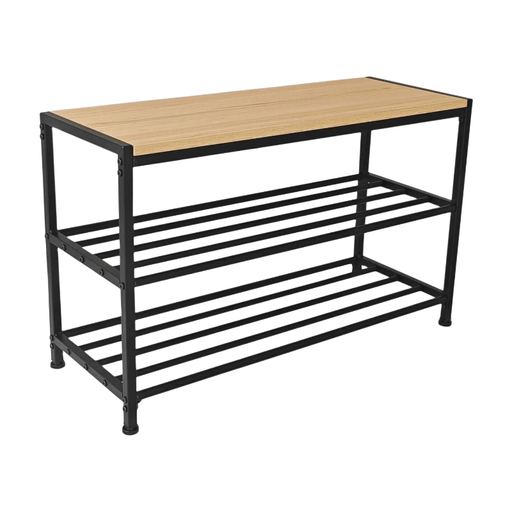
Why it suits this profile: This freestanding shoe rack combines a black metal frame with a wooden top shelf. It is ideal for buyers looking for compact storage that can also hold accessories or decorative items.
The dimensions are clearly stated: 80 x 30 x 49,2 cm. This allows you to check in advance that the rack will not obstruct the walkway.
Space for 6 pairs; product weight of 5,7 kg; wooden top shelf; open construction.

Why it suits this profile: This tall shoe storage rack is designed for households that want to keep many pairs of shoes in one place. The product details state that it holds 30 pairs and measures 24,5 x 65,5 x 138 cm.
The capacity and dimensions are listed separately, so you do not have to rely on the number of pairs alone. Place the rack on a level surface and consider wall fixing if there is a risk of it toppling over.
Capacity for 30 pairs; metal construction; white finish; minimum statutory guarantee of 2 years according to the product information.
A shoe cabinet suits a tidy hallway where you want to keep shoes out of sight. A model with adjustable shelves can also hold boxes, books or small items. The Halup eit Narrow Shoe Cabinet, for example, has two doors, four adjustable shelves, a drawer and a stated capacity of up to 12 pairs. Always check the supplied instructions during assembly and use the anti-tip device in accordance with the product information.
An over-the-door hanger or shoe organiser is more practical when you need to keep the floor clear. An over-the-door hanger for bags, towels or clothing is not automatically suitable for shoes, so check the pockets, load capacity and the way the weight is supported by the door.
For long-term use by a family, a sturdy freestanding model, several shelves and an easily accessible layout are generally more important than a decorative finish. Check screws and connections regularly, particularly if the rack is used frequently.
We have put together a complete, up-to-date list of products that fully meet these strict selection criteria and the applicable European safety regulations.
That depends on the number of shoes and the available walkway space. Measure the width, depth and height before placing your order. With a door model, also take the door thickness and the space behind the door into account.
An open rack provides quick access and ventilation, while a shoe cabinet keeps shoes out of sight. Choose open shoe storage for everyday use, or a cabinet when you want the hallway to have a calmer, tidier appearance.
Its lifespan depends on the material, load, assembly and moisture levels. Use the rack in accordance with the product instructions, do not exceed the maximum load and check the connections regularly. Products with metal components may be suitable for everyday use, but this does not replace correct assembly and stable placement.
