
Vandaag of morgen in huis

Kwaliteit gegarandeerd

Welkomstaanbiedingen ontgrendelen: GRATIS bezorging | Tot 80% korting | Gratis 30 dagen JoyPlus-proefperiode
Download de app
Shoes left scattered in the hallway, pairs that keep falling over and a rack that starts wobbling after a few weeks: a shoe rack may seem simple, but the wrong choice can quickly become a source of frustration. In Dutch flats and narrow entrances in particular, width, stability and storage space all matter.
Be wary of marketing claims, too. A rack that “holds lots of shoes” may not be suitable for high-top trainers or ankle boots in practice. And a shoe cabinet that looks compact may need extra clearance in front for its doors or flaps. A few checks beforehand can help you avoid a costly mistake.
The stated shoe capacity is usually a guide. The actual capacity depends on shoe size, width and type. Women’s boots, wide-fit trainers and children’s shoes don’t all take up the same amount of space.
Storage for 18 to 25 pairs may sound generous, but always check:
A narrow shoe rack for the hallway needs to fit between the wall and the door, but that’s not all. Measure the walking space too, and check which way the door opens. In a wardrobe, depth is especially important: a rack that is 30 cm deep won’t necessarily fit behind every wardrobe door.
For a closed shoe cabinet, allow extra space for its flaps or doors. In a living room, a taller model can make better use of the space, as long as it doesn’t look out of place or block a walkway.
Metal isn’t automatically more stable than wood. The construction, joints, legs and floor surface all affect how sturdy a rack is. So check the maximum static load capacity and distribute heavier shoes evenly.
Plastic connectors are often part of the design of an open metal shoe rack. With a wooden shoe cabinet, hinges, back panels and the quality of the assembly matter more. Place any model on a level surface and follow the manufacturer’s safety instructions.
Before you buy, make a note of how many pairs you use every day and how much extra space you’d like to have. A shoe rack with 3 tiers is suitable for a simple, tidy set-up, but three wide shelves may offer more practical space than five narrow compartments.
Consider the proportions of width, depth and height:
A metal shoe rack is generally lightweight and easy to move. With a modular or stackable shoe rack, check that the connectors are properly secured and that the set-up remains safe if you turn the sections around or stack them.
A wooden shoe cabinet or one made from chipboard often works better in a living room or bedroom. Doors create a tidier look, but assembly usually takes longer. Bamboo is a lightweight material with a natural look. With a folding model, make sure the folding mechanism is fully locked before use.
“Tool-free” doesn’t mean you can skip assembly. Check that all connectors, shelves and legs are fitted correctly. Also check the stated load capacity per level as well as for the whole rack. For example, a load capacity of 10 kg per level and 30 kg in total is clearer than a general claim such as “strong”.
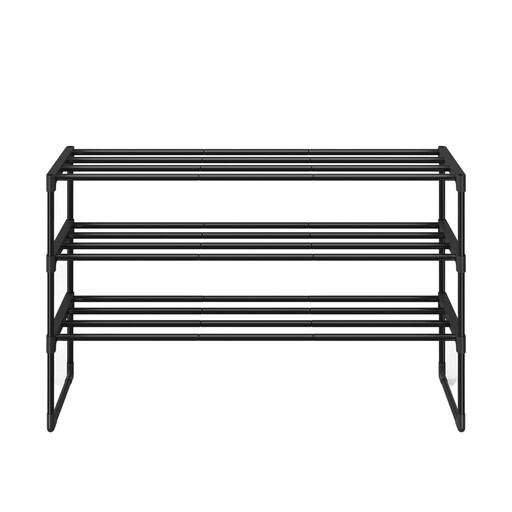
Why it suits this type of shopper: This open rack is designed for anyone looking for a practical shoe storage solution for their hallway, wardrobe or living room. It measures 30 x 92 x 55 cm and has a stated capacity of 16 to 20 pairs.
The product information gives both the dimensions and load capacity: up to 10 kg per level and 30 kg in total. This makes it easier to assess the space and load in advance.
Metal tubes, plastic connectors, tool-free assembly and a design that can be set up upright, upside down or stacked.

Why it suits this type of shopper: This closed shoe cabinet is ideal for households that want to keep shoes out of sight. It measures 60 x 23,3 x 119,5 cm, has six shelves and is listed as holding 18 pairs of shoes.
The depth of 23,3 cm is clearly stated, along with the capacity, number of shelves and type of flaps. This helps when planning where to put it in a narrow hallway.
Chipboard shelves, doors and frame, a drawer and an FSC statement in the product information. Assembly is required.

Why it suits this type of shopper: This model is designed for larger households looking for a closed shoe storage solution. The product description lists five levels, space for 22 to 25 pairs, doors, an open bottom shelf and a top surface.
The capacity and layout are described for the whole cabinet: five levels, closed doors and an open section at the bottom. This makes it clearer which shoes will be kept out of sight.
Wooden frame, metal legs and hinges, plus a top surface for decorative items. According to the product information, assembly instructions and the tools needed are included.
We’ve put together a complete, up-to-date list of products that meet these strict selection criteria and the applicable European safety regulations.
It depends on the width of the shelves and the type of shoes. A rack for 18 pairs may be enough for a small household, while families often benefit from a model that holds 22 to 25 pairs. Leave extra room if you want to store wide trainers or boots.
Place the rack on a level surface, spread heavier shoes across several levels and follow the assembly and safety instructions. For a tall shoe rack, it’s worth checking whether wall fixing is possible or recommended. Only use a stackable model in the configuration specified.
An open shoe rack gives you quick access and is handy for shoes you wear every day. A shoe cabinet keeps shoes out of sight and often works better in a living room or bedroom. Choose based on ventilation, available depth, the number of pairs you have and how much room the doors or flaps need.
