
Vandaag of morgen in huis

Kwaliteit gegarandeerd

Welkomstaanbiedingen ontgrendelen: GRATIS bezorging | Tot 80% korting | Gratis 30 dagen JoyPlus-proefperiode
Download de app
Loose shoes in the hallway, pairs disappearing under the bed and trainers gathering dust: a good shoe rack can eliminate a lot of everyday frustration. However, it is easy to buy a model that soon no longer suits your home or shoe collection.
The biggest buying mistakes usually arise from three common pitfalls:
Do not just measure the available recess. Also take into account the movement of a door and the space you need to take shoes out of the rack. For a narrow hallway, a narrow shoe rack with limited depth is often more practical than a tall cabinet that blocks the walkway.
An open model may be suitable for shoes you wear every day. If you want to keep shoes out of sight, it is better to consider a shoe cabinet, stackable boxes or shoe storage for a wardrobe.
A shoe rack for 30 pairs sounds spacious, but check how the shelves are arranged. A pair of high-top trainers or ankle boots may partially block several compartments. So count your current collection and allow extra room for seasonal footwear.
Pay attention to the following details:
A shoe rack for 30 pairs is particularly useful for families or households with lots of shoes in everyday use. For a smaller collection, a shoe bench with storage may be sufficient.
Metal generally provides an open design and is easy to wipe clean. Polypropylene, also known as PP, is lightweight and suitable for modular storage solutions. A combination of metal and plastic can be useful if you want a lightweight rack that is easy to move or assemble yourself.
Transparent shoe boxes make it easier to find pairs without opening every compartment. Ventilation openings can improve air circulation, but shoes should always be stored when dry. A closed shoe organiser is therefore no substitute for allowing wet footwear to air properly.
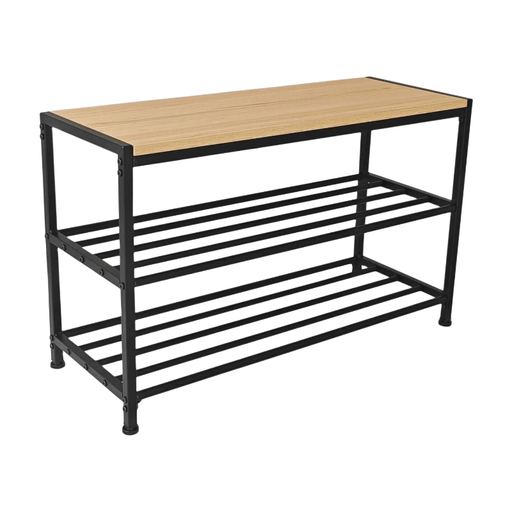
Why it suits this profile: This compact rack holds 6 pairs and, measuring approximately 80 x 30 x 49,2 cm, fits in a hallway, bedroom or corridor where space is limited.
The stated capacity and external dimensions are clear, allowing you to check in advance whether the rack suits your collection and available space.
Black powder-coated metal, a wooden top shelf and an open design with air circulation.
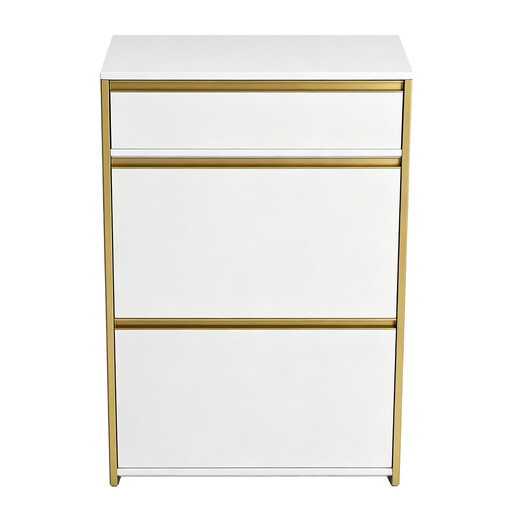
Why it suits this profile: The combination of enclosed storage, a drawer and adjustable shelves is ideal for households that want to keep shoes and small hallway essentials out of sight.
The adjustable, removable shelves reduce the risk of fixed compartment heights being unsuitable for boots or high-top trainers.
Dimensions of 60 x 24 x 104,5 cm, space for up to 12 pairs according to the product description, and an anti-tip feature for wall mounting.
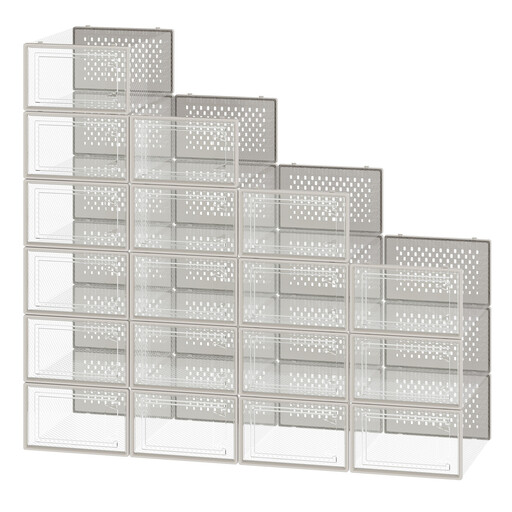
Why it suits this profile: Sneaker enthusiasts and households with limited floor space can stack pairs vertically and quickly find a particular style through the transparent doors.
The internal dimensions of 31,2 x 22,5 x 13,5 cm are specified; measure your shoes in advance, particularly with wider styles or larger sizes.
18 PP/PS boxes, transparent fronts, ventilation openings and a stackable design.
Before assembly, check that all panels, connectors and fixings are included. Place a freestanding shoe rack on a level surface and tighten all connections securely. A tall shoe cabinet or a rack in a household with children may benefit from wall mounting for extra stability. Never use a rack or cabinet as a step.
Open metal racks can usually be wiped clean with a soft, slightly damp cloth. Dry metal parts immediately and do not use abrasive products. Clean plastic shoe boxes with a soft cloth and allow wet shoes to dry before putting them inside.
An over-the-door shoe organiser is useful when floor space is limited, but check that the door still closes properly and that it can support the weight. For a wardrobe, shoe storage designed for wardrobes can be more efficient than a freestanding rack in the room.
We have put together a complete, up-to-date list of products that fully meet these strict selection criteria and the applicable European safety regulations.
Measure the available width, depth and height, and leave a few extra centimetres for skirting boards and doors. Also consider the length of your largest shoes. A narrow model is not automatically suitable if the compartments are too short.
Allow wet or muddy shoes to dry first. Open racks provide better air circulation, while closed boxes offer better protection from dust. With transparent shoe boxes, ventilation openings and the internal dimensions are important points to check.
A shoe rack gives you quick access and often uses less material. A shoe cabinet keeps shoes more out of sight and may provide additional storage space. Choose based on the space available, the number of pairs you own and whether you wear your shoes every day.
