
Vandaag of morgen in huis

Kwaliteit gegarandeerd

Welkomstaanbiedingen ontgrendelen: GRATIS bezorging | Tot 80% korting | Gratis 30 dagen JoyPlus-proefperiode
Download de app
A shoe rack may seem like a simple purchase, but the wrong size or an inconvenient layout can quickly cause frustration. Your shoes may not fit properly, the rack may block the walkway or the construction may prove less stable than expected. If you look at the price or appearance first and only check the dimensions afterwards, you may end up buying a solution that does not suit your space.
Use these checkpoints to compare a shoe rack, shoe cabinet or shoe organiser based on practical features. You will then see which models suit different households and usage scenarios.
A description such as “for 30 pairs of shoes” provides an indication, but not every pair takes up the same amount of space. Tall boots, wide trainers and shoes with thick soles may not fit in the same way as low-cut women’s shoes. As well as the number of pairs, check the height, depth and clear space between the tiers.
The same applies to stackable shoe boxes. A box may be suitable for a particular shoe size, while a high-top trainer or boot may not fit. Measure one or two larger shoes before ordering a set of transparent shoe boxes.
A narrow shoe rack for the hallway saves floor space, but a tall model has a relatively small base. Pay attention to the ratio between height and depth and check whether wall mounting is recommended or included. Stable positioning is particularly important in a busy hallway.
A shoe cabinet with doors may look neat, but opening the doors requires additional space. So measure not only the area where the unit will stand, but also the space in front of the doors or flaps.
“Metal”, “plastic” or “wood effect” does not automatically describe how a shoe organiser will perform in your home. Look at the complete construction: are the shelves made from the same material as the frame, is assembly required and how should the surface be maintained?
A metal shoe rack with open compartments generally provides direct access and ventilation, according to the product description. A plastic shoe rack may be lighter, but check whether it is intended for indoor use and whether the connections need to be secured firmly.
Measure the available space in the hallway, corridor, bedroom or cupboard in three ways:
For small spaces, a shoe rack for 6 to 30 pairs of shoes may be more practical than one large model. A low rack is often easy to access, while a tall column makes better use of vertical space. When choosing a shoe rack for 30 pairs, check in particular whether a height of 138 or 155 cm is practical in your hallway.
First decide how many pairs you want to store on a daily basis. Also include seasonal footwear if the rack will be placed in a bedroom or storage cupboard. Take the following into account:
An open rack keeps everyday footwear clearly organised. A shoe cabinet with storage space is more suitable if you want to keep shoes out of sight while storing accessories, keys or decorations on top.
Before buying, check whether self-assembly is required, whether fixings are included and what type of surface the unit should stand on. A level, stable surface is important for a freestanding model. Tighten the connections properly after assembly and check them periodically.
For metal surfaces, a soft, slightly damp cloth is generally suitable according to the product information. Wood-effect or chipboard components should not be exposed to moisture for prolonged periods. For plastic boxes, the dimensions, ventilation openings and closure are important points to check.
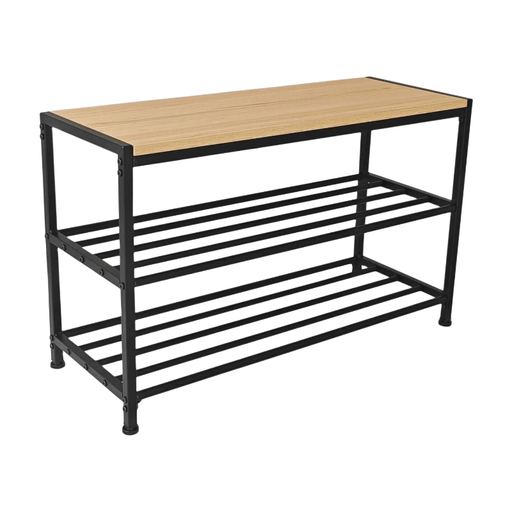
Why it suits this profile: This compact model is designed for up to 6 pairs of shoes and, measuring approximately 80 x 30 x 49,2 cm, fits in a hallway, corridor or bedroom.
The capacity and dimensions are clearly stated, so you can match the model to a small collection instead of reserving more space than necessary.
Black metal frame, wooden top shelf and open design; the top shelf provides extra space for small items.
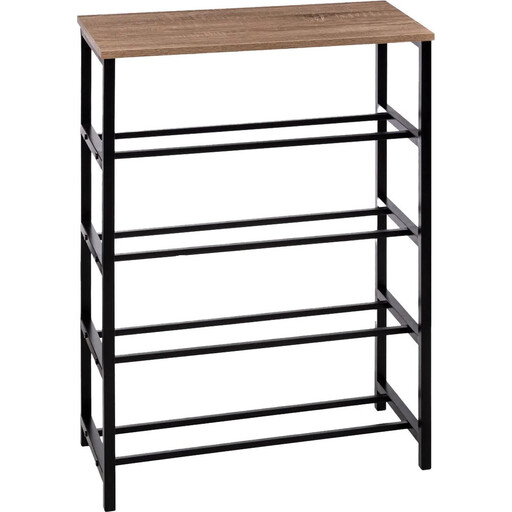
Why it suits this profile: The combination of shoe storage and a tabletop is ideal for households that want to use a hallway unit for shoes and everyday accessories.
The stated capacity of 12 pairs and depth of 30 cm make it easier to compare the unit with the available hallway space. Wall anchoring is recommended in the product information.
63 x 30 x 90 cm, storage for 12 pairs of shoes and a top shelf; made from steel and chipboard.

Why it suits this profile: This tall freestanding shoe rack is designed for households that want to store many pairs of shoes in one vertical solution.
The depth of 24,5 cm takes up relatively little floor space, but the height of 138 cm must be measured in advance. Place the rack on a level surface.
Stated capacity of 30 pairs, metal construction, white finish and self-assembly; wall mounting is recommended where there is a risk of tipping.
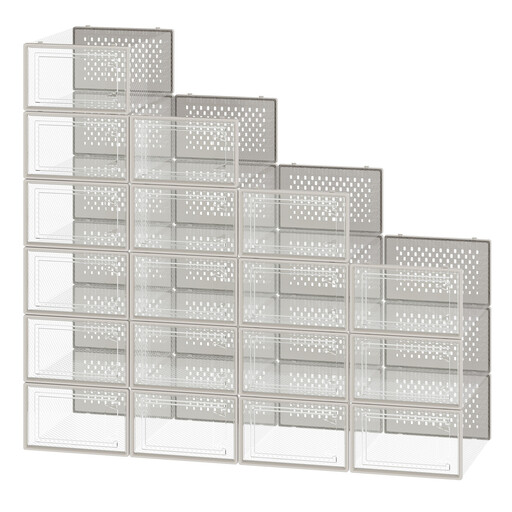
Why it suits this profile: These transparent shoe boxes are ideal if you want to store shoes visibly, stack them and keep them dust-free in a cupboard, hallway or on a shelf.
The internal dimensions of 31,2 x 22,5 x 13,5 cm are stated; measure your shoes before ordering. The boxes consist of three parts and can be stacked.
Set of 18 boxes, transparent doors, PP and PS materials, and ventilation openings according to the product description.
We have put together a complete, up-to-date list of products that fully meet these strict selection criteria and the applicable European safety regulations.
Ideally, place an open shoe rack somewhere you can easily put on and put away your shoes. In a narrow hallway, a model with limited depth can keep the walkway clear. A tall organiser makes use of wall space, but place heavier shoes at the bottom and check that the unit cannot tip over.
A shoe cabinet with doors is useful when you want to create a tidy, uncluttered look. Bear ventilation and moisture in mind: allow wet shoes to dry before storing them in a closed cabinet for extended periods. Stackable shoe boxes are useful in a wardrobe or storage area because they allow you to make flexible use of the available height.
This depends on the stated capacity and the type of shoes. A compact model such as the Practo rack is listed for 6 pairs, while the white 5five model is listed for 30 pairs. Wide shoes and boots may fit less efficiently. So check the shelf spacing and dimensions as well as the number of pairs.
A metal shoe rack can be suitable for the hallway if its dimensions, stability and finish are right for the space. Check whether the rack requires self-assembly, needs to stand on a level surface and can be secured to the wall if necessary. Also bear in mind moisture from wet shoes and dry metal parts after cleaning.
Yes, stackable boxes can make use of vertical space in a cupboard or on a shelf. They are particularly practical if you want to keep your shoes visible without having to open every box. Measure the available shelf space and your shoes in advance; the external dimensions of a box may be larger than its internal dimensions.
