
Vandaag of morgen in huis

Kwaliteit gegarandeerd

Welkomstaanbiedingen ontgrendelen: GRATIS bezorging | Tot 80% korting | Gratis 30 dagen JoyPlus-proefperiode
Download de app
A shoe rack may seem like a straightforward purchase, until you discover that it is too deep in practice, wobbles or holds fewer shoes than expected. Every centimetre counts, especially in a narrow hallway. Even an attractive hallway shoe rack can be impractical if boots do not fit or you are constantly tripping over loose shoes.
Before buying, watch out for these three common pitfalls:
Do not just measure the area where the shoe rack will stand; also check the clearance for doors and cupboards. In a hallway, allow room for coats, a doormat and comfortable movement. For a small entrance, a narrow shoe rack around 25 to 30 cm deep could be a good choice. A taller model makes use of wall space, but may need to be secured to the wall.
A hallway shoe rack does not always need to be low. A model measuring 138 to 155 cm in height offers plenty of storage while taking up little floor space. However, check that it will fit beneath a coat rack, mirror or shelf.
Think about how many shoes you want to store each day. For one person or a student, a shoe rack for 12 pairs may be sufficient. Families are more likely to need a shoe rack for 30 pairs, or a combination of open shelves and closed compartments.
Also consider the space between the shelves. Low-profile trainers and flip-flops will usually fit easily, but ankle boots and taller shoes need more vertical clearance. Adjustable shelves offer greater flexibility in this situation.
A metal shoe rack generally has an open design and is easy to wipe clean. Steel tubes or metal frames make the support structure clear, but always check the stated maximum load. Plastic shelves are lightweight and practical for everyday use. Particleboard has a more cabinet-like appearance, but requires extra care around moisture and mud.
Whatever the material, do not leave wet or muddy shoes unattended for too long, and dry surfaces after cleaning. Do not place a shoe rack directly on a wet floor. The stated load capacity takes priority; do not exceed the specified limit.
An open shoe organiser is useful when shoes are worn frequently and need to be easy to reach. A shoe cabinet with a bench combines storage with somewhere to sit while putting on your shoes. This is particularly practical for families, older people or hallways where there is no room for a separate chair.
Would you also like to organise coats, bags and accessories? A hallway unit with hooks, a seat and shoe shelves is more efficient than a shoe rack on its own. For a living room or bedroom, a console-style model may be more suitable, as its top surface provides extra space for items such as keys or ornaments.
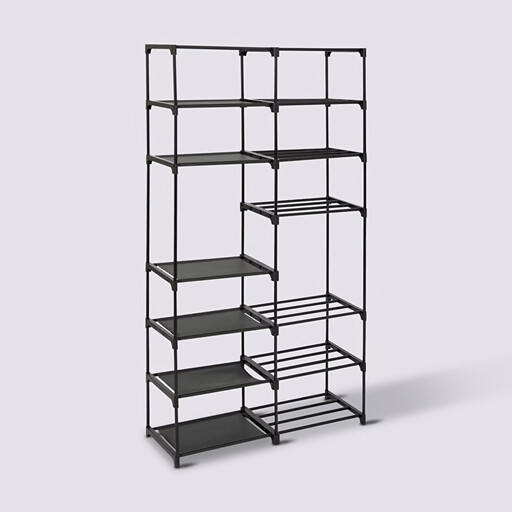
Why it suits this profile: With 16 shelves and a footprint of 87 x 30 cm, this rack provides ample vertical storage for a household that wants to keep loose shoes neatly organised.
The dimensions, number of shelves and materials are clearly stated. This allows you to check in advance whether the height and depth will suit your hallway.
16 shelves; polypropylene and steel construction; suitable for indoor use; weight of 2.59 kg.
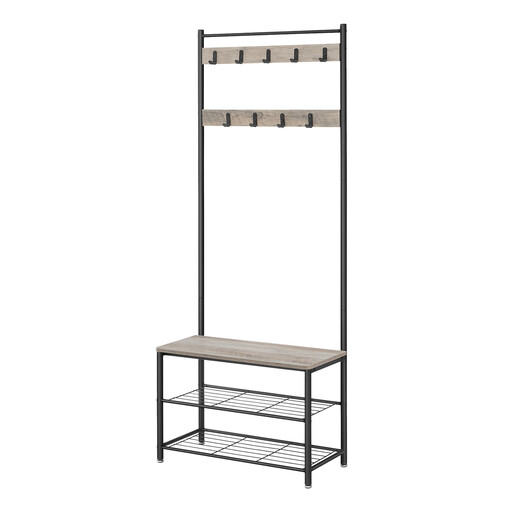
Why it suits this profile: This 3-in-1 hallway unit combines a shoe rack with storage space, a bench and hooks for coats and bags.
The specifications state the load capacities: up to 136 kg for the bench, 3 kg per hook and 10 kg per mesh shelf. The anti-tip kit must be secured to the wall.
9 metal hooks; bench; adjustable feet; integrated anti-tip feature; dimensions of 32 x 70 x 177 cm.

Why it suits this profile: With a stated capacity of 30 pairs, this model is designed for larger households or people with an extensive shoe collection.
The product description explicitly states that this is a freestanding rack and is not intended to be used as a seat. This helps prevent the structure from being used incorrectly.
Capacity for 30 pairs; metal construction; product width of 24.5 cm according to the stated specifications; self-assembly required.
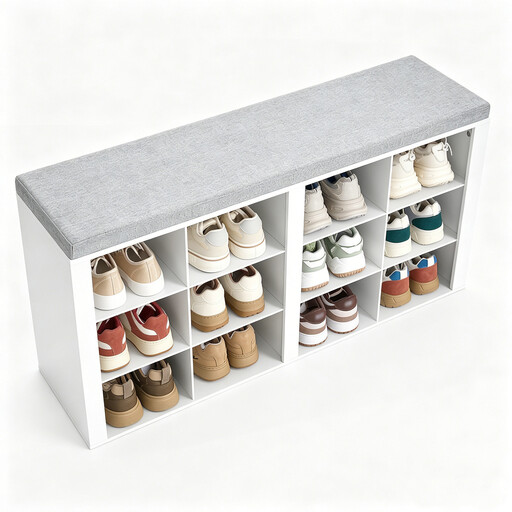
Why it suits this profile: This shoe cabinet with bench has 12 compartments and adjustable shelves for different types of footwear, from trainers to boots.
The adjustable shelves reduce the risk of taller shoes being left unused because they do not fit. The removable upholstery can be cleaned separately.
12 compartments; seat; dimensions of 30.5 x 104.5 x 49.5 cm; stated load capacity of 150 kg.
Before assembly, check that all parts and fixing materials are included. Place the rack on a level surface and tighten the connections evenly. For a tall or narrow model, wall mounting is advisable when recommended in the product information.
Use the bottom shelves for heavier shoes. Do not leave wet shoes in a closed shoe cabinet for long periods, and keep ventilation space clear. With an open rack, check the connections from time to time, particularly if it is moved frequently or there are children in the home.
We have put together a complete, up-to-date list of products that fully meet these strict selection criteria and the applicable European safety regulations.
Measure the available width, depth and height, and also check the doorway and walking route. A model measuring 24.5 to 30 cm deep may be suitable for a narrow hallway, but always check the exact product specifications and allow space for shoes that protrude.
An open shoe rack keeps frequently worn shoes within easy reach and is generally lightweight. A shoe cabinet keeps shoes out of sight and can create a tidier appearance. A model with a bench combines both functions with a dedicated place to sit while putting on your shoes.
Its lifespan depends on the material, assembly, load and usage. Position the rack securely, do not exceed the stated load capacity and check screws or connections regularly. According to the product information, the products mentioned are covered by a minimum two-year statutory guarantee under European consumer law; additional rights may apply under Dutch law.
