
Vandaag of morgen in huis

Kwaliteit gegarandeerd

Welkomstaanbiedingen ontgrendelen: GRATIS bezorging | Tot 80% korting | Gratis 30 dagen JoyPlus-proefperiode
Download de app
A shoe rack may seem like a simple purchase, until you discover that the model wobbles, offers too little space or does not fit in your hallway. Product photos alone are rarely enough, especially when shopping online. For example, a narrow shoe rack may look convenient but not be deep enough for high-top trainers. A shoe cabinet may look neat, but fixed shelves can make it unsuitable for boots.
So be sure to watch out for these three common pitfalls:
Misinterpreting the dimensions
Width, depth and height are not always shown in the same order. Also check whether the stated measurement refers to the external dimensions. Measure the available space at home and leave room for skirting boards, doors and opening the cabinet.
Treating capacity as a fixed promise
‘For 30 pairs of shoes’ does not automatically mean that 30 pairs of large trainers or ankle boots will fit. The available space depends on shoe size, shape and the distance between the shelves.
Overlooking load capacity and stability
A lightweight metal shoe rack may be sufficient for everyday footwear, but less suitable for heavy boxes or intensive use. With a tall shoe cabinet, securing it to the wall is also sensible if there is a risk of it tipping over.
For a hallway shoe rack, depth and clearance for movement are particularly important. A model approximately 24 to 30 cm deep may fit in a narrow passageway, but check that the shoes sit fully on the shelf. In a bedroom or dressing area, a taller model is often practical, provided it does not stand in front of doors, radiators or sockets.
Also consider the total height. A rack measuring 138 or 155 cm makes good use of wall space, but it must stand securely. A low model, such as a shoe bench with storage, takes up more floor space but also provides somewhere to sit.
A metal shoe rack is often suitable if you are looking for an open solution that is easy to clean. Check the connections between the tubes and fittings. For a model with plastic components, it is useful to check the maximum load capacity per shelf and for the unit as a whole.
A wooden shoe rack or bamboo shoe bench is more suited to a warm, natural interior. Pay attention to the finish, maintenance requirements and stated load capacity. If the bench is designed for sitting on, check its maximum load capacity rather than only that of the shoe shelves.
A closed shoe cabinet keeps shoes out of sight and can also store loose items. In this case, ventilation, adjustable shelves and secure fixing are key considerations. According to the product descriptions of some models, the shelves can be removed or adjusted in height; check the product page to see how many adjustment options are actually included.
An adjustable shoe cabinet is useful for households with different types of footwear. After all, tall boots, low-top trainers and children’s shoes do not require the same shelf height. With an open shoe organiser, the number of tiers is more important than the total stated number of pairs.
Also check:
Clear assembly instructions save time, but check regularly after assembly that the connections are still secure. Ideally, do not place a tall rack somewhere children can pull on it.
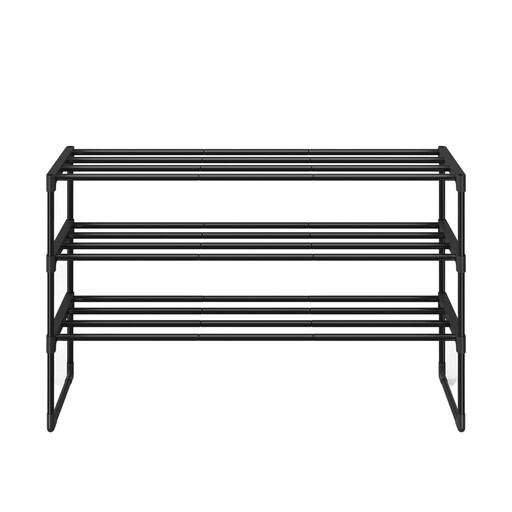
Why it suits this profile: This open rack is 30 cm deep and 92 cm wide. That means it fits in many hallways, cupboards or living rooms without the need for a closed cabinet.
The dimensions and load capacity are clearly specified: 10 kg per tier and 30 kg in total. This helps you assess the load in advance.
Metal tubes, three tiers, stackable or reversible configuration according to the product description, and tool-free assembly.

Why it suits this profile: A shoe bench with storage combines shoe storage with somewhere to sit while putting on your shoes. The bamboo design complements a natural interior.
The product information states a maximum load of 110 kg and clearly gives the external dimensions. This helps you check the available seating space and positioning.
Bamboo frame and shelves, 90 cm wide, 34 cm deep, seating function and FSC certification mentioned in the product details.
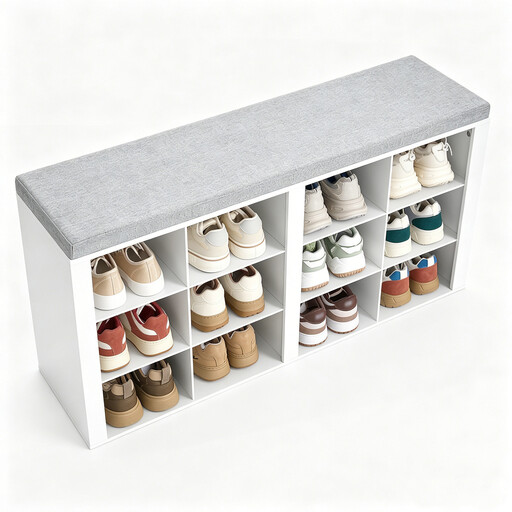
Why it suits this profile: This model is designed for families who want to combine seating with several storage compartments in the hallway. The stated dimensions are 104.5 x 30.5 x 49.5 cm.
According to the product description, the shelves can be adjusted for different types of footwear and the seat upholstery can be removed for cleaning.
The manufacturer states a load capacity of 150 kg, adjustable shelves and 12 compartments. Check the assembly and positioning instructions in the manual.

Why it suits this profile: If you want to store lots of pairs neatly, the 16 shelves and stated capacity of 30 pairs provide plenty of storage in a compact format.
The product details specify the capacity, 16 shelves and dimensions of 65.5 x 24.5 x 138 cm. In particular, measure the height beforehand and check the shapes of your shoes.
Suitable for up to 30 pairs according to the product description, with a metal construction and plastic shelves. Self-assembly is required.
We have put together a complete, up-to-date list of products that fully meet these strict selection criteria and the applicable European safety regulations.
First measure the available space and compare it with the product’s external dimensions. Take skirting boards and walking space into account. A narrow shoe rack around 24 to 30 cm deep can be useful in a hallway, but check that your shoes do not stick out.
Place the cabinet on a level surface and follow the assembly instructions. Use the anti-tip device supplied if one is included. With a tall or narrow model, securing it to the wall is sensible if children or pets can reach it.
An open shoe organiser gives you a clear overview and allows ventilation. A closed shoe cabinet keeps shoes out of sight and can create a calmer look in the living room. Choose based on the available space, the number of pairs and whether you need adjustable shelves. With either option, remember to clean it regularly and ensure it is assembled securely.
