
Vandaag of morgen in huis

Kwaliteit gegarandeerd

Welkomstaanbiedingen ontgrendelen: GRATIS bezorging | Tot 80% korting | Gratis 30 dagen JoyPlus-proefperiode
Download de app
A tidy entryway instantly creates a sense of calm and welcome. Yet, the hallway is often the very place where shoes pile up. A good shoe rack isn't a luxury, but a practical necessity. However, the selection is vast, and not every rack is equally functional. Many models look great online but prove to be impractical or of subpar quality in reality. As a Joybuy Product Recommendation Officer, I'm here to help you make the right choice by highlighting the most common pitfalls.
Before you make a purchase, it's wise to know what often goes wrong. Many shoe racks lead to frustration due to design flaws that only become apparent after a few weeks of use.
wooden shoe rack but turns out to be made of cheap particleboard with a paper-thin veneer that starts to peel after a few damp autumn days. Or a metal shoe rack that shows rust spots after a winter of wet shoes. The material and finish determine its longevity.To avoid the pitfalls above, focus on a few concrete specifications. These will determine whether a shoe organiser becomes a long-lasting investment or a source of frustration.
The choice of material affects both the aesthetic and the sturdiness.
metal shoe rack is often sleek, modern, and relatively lightweight. Powder coating helps prevent rust, which is essential for wet shoes. Its sturdiness depends on the thickness of the tubes and the quality of the connectors.wooden shoe rack provides a warm, natural aesthetic. Solid wood is very robust, but also heavier and more expensive. MDF or particleboard is a more budget-friendly alternative, but pay close attention to the finish on the edges and its water resistance.More isn't always better. Consider how many pairs of shoes you truly need to store and measure the available space accurately.
shoe rack for the entryway, a narrow shoe rack (less than 25 cm deep) is often the only option. A stackable shoe rack is a smart solution to build vertically without taking up extra floor space.The way you store shoes depends on your needs.
shoe cabinet provides a tidy and dust-free solution. However, ventilation is less effective, which can be a disadvantage for damp shoes.shoe bench is multifunctional. It offers storage space and a convenient seat for putting on and taking off your shoes. Ideal for families or the elderly.To help you with your decision, we've highlighted a few products that suit specific living situations and needs.

Why This Fits Their Persona: Perfect for a dorm room or first apartment. This rack is compact, budget-friendly, and provides just enough space for a daily shoe collection without taking up much floor space.
This is a textbook example of a narrow shoe rack. With a depth of just 18.5 cm, it avoids the 'doesn't quite fit' mistake in the narrowest of hallways. The construction is simple and honest for its price, without any pretence.
Extremely narrow and lightweight, allowing it to fit in almost any small space or closet. Simple, tool-free assembly.

Why This Fits Their Persona: Families need capacity and flexibility. This rack offers space for 15-18 pairs of shoes and is stackable, so it can grow with the children's shoe collection.
It tackles the 'wobbly tower' pitfall with a sturdy metal frame and a stated load capacity of 15 kg per shelf. It's designed to be stable, even when loaded with heavier shoes.
The stackable design allows for vertical expansion. Assembly is simple and tool-free, which is convenient for busy parents.

Why This Fits Their Persona: For those who want a clutter-free look, a closed cabinet is ideal. This model combines a large capacity (22-25 pairs) with a sleek, modern design that fits into many interiors.
This shoe cabinet completely solves the 'cluttered look' of an open rack. Its sturdy wooden construction and metal legs counter the 'looks good from a distance' illusion by providing a solid and durable piece of furniture.
The closed design keeps shoes out of sight and dust-free. The top surface and open shelf provide extra space for decor or keys.
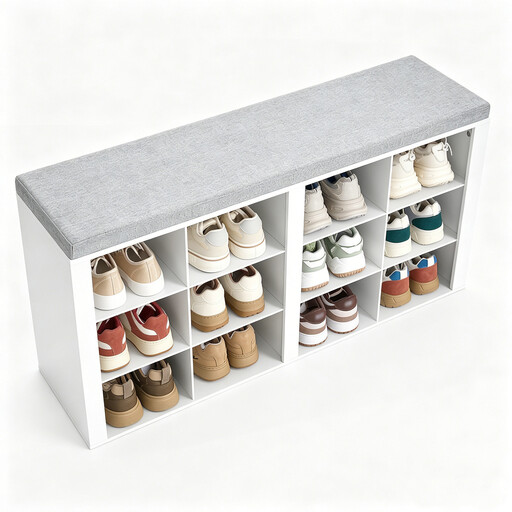
Why This Fits Their Persona: Why just store when it can also be a seat? This shoe bench is ideal for those seeking practical convenience in the hallway. It's perfect for sitting down to put on shoes and storing them immediately.
It solves an often-overlooked problem: the discomfort of putting on shoes while standing or bending over. The adjustable shelves prevent the frustration of taller shoes or ankle boots not fitting into the compartments.
Combines storage with a comfortable seat (load capacity 150 kg). The removable cushion cover is easy to clean.
We have compiled a complete, up-to-date list of products that meet these strict selection criteria and local regulations.
The capacity stated by manufacturers is often an optimistic estimate based on narrow shoes. For men's shoes (size 42+ / US 8.5+), wide sneakers, or boots, it's best to assume about 70% to 80% of the advertised number. A good tip is to compare the internal width of a shelf with the width of your own shoes to make a realistic assessment.
Not necessarily better, just different. A metal shoe rack is often lighter, has a more modern look, and is sometimes stackable. A wooden shoe rack often feels more robust and provides a warmer, classic vibe. The choice largely depends on your personal taste and interior decor. With metal, look for a rust-resistant coating, and with wood, check the quality of the finish to prevent wear.
