
Vandaag of morgen in huis

Kwaliteit gegarandeerd

Welkomstaanbiedingen ontgrendelen: GRATIS bezorging | Tot 80% korting | Gratis 30 dagen JoyPlus-proefperiode
Download de app
A hallway full of scattered shoes is a familiar sight in many households. A good shoe rack seems like a simple solution, but reality is often more challenging. Many racks turn out to be wobbly after purchase, don't offer the promised space, or turn assembly into a frustrating project. Before you invest in a new shoe organizer, it's wise to know where the pitfalls lie.
Common problems can often be traced back to a few key points:
An informed choice not only saves you money but also a great deal of frustration.
To avoid a bad purchase, it's helpful to look beyond just the appearance. Three key factors determine whether a shoe rack or shoe cabinet is right for your situation.
The material determines the sturdiness and lifespan of your shoe rack.
A crucial specification is the load capacity per shelf. A shelf that can only support 5 kg will struggle with three pairs of heavy winter boots. Always check this specification to prevent sagging.
Before making a purchase, measure your available space accurately. A narrow shoe rack can be a great solution for a tight hallway, but check if the depth is sufficient for larger shoe sizes.
Think realistically about capacity. Count the number of pairs you want to store and consider different types: boots take up more vertical and horizontal space than sneakers. A rack with adjustable shelves offers more flexibility. Proper shoe storage starts with a realistic assessment of the required space.
The choice between an open or closed system depends on your preference for accessibility and aesthetics.
Based on functionality, material, and practicality, we have selected a few options that suit different living situations.
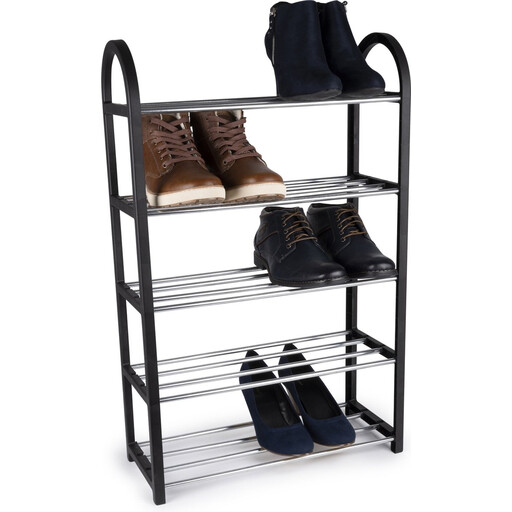
Why This Fits Their Persona: Compact, affordable, and assembles without tools. Ideal for a student dorm or first apartment where space and budget are limited, and a simple shoe storage solution is all that's needed.
This rack is designed for simplicity and function, not for heavy boots. Its capacity is realistic for lighter footwear, so you get exactly what you expect for a low price.
Very fast, tool-free assembly; fits in the smallest spaces thanks to its narrow design.

Why This Fits Their Persona: With space for 15-18 pairs of shoes and a high load capacity, this offers a robust solution for the mountain of shoes in the hallway. The stackable feature allows for future expansion.
The metal frame construction and high load capacity of up to 15 kg per shelf prevent the rack from sagging under the weight of boots or multiple pairs of shoes. The capacity is generous and practical.
High capacity and load-bearing strength; this stackable shoe rack allows for vertical expansion.

Why This Fits Their Persona: This isn't just a rack, but a stylish shoe cabinet that keeps shoes neatly out of sight. The white finish with subtle accents fits well in a modern and uncluttered interior.
Instead of an open, cluttered rack, this cabinet offers a closed storage solution. It's a piece of furniture that combines stability and aesthetics, making it a durable addition to your home.
Shoes are completely out of sight for a clean look; functions as an elegant piece of furniture.
We've compiled a complete, up-to-date list of products that meet these selection criteria and practical requirements.
The advertised capacity is often optimistic. A good rule of thumb is to assume 70-80% of the advertised number, especially if you have many boots, hiking shoes, or large-sized men's shoes. Measure the width of the shelf and divide it by the average width of your shoes (about 20-25 cm per pair) for a realistic estimate.
There's no single answer; it depends on your priorities. A metal shoe rack is generally stronger, easier to clean, and more resistant to moisture from wet shoes. A wooden shoe rack offers a warmer look and fits well in a classic or rustic interior, but it can be more susceptible to scratches and moisture if not properly finished.
A wobbly rack is often the result of a lightweight construction, an uneven floor, or incorrect assembly. Ensure all screws and connections are securely tightened. Place the rack on a flat surface. Many models come with adjustable feet to correct for minor floor unevenness. For tall, narrow racks, it may be wise to anchor them to the wall for extra safety, if recommended by the manufacturer.
