
Vandaag of morgen in huis

Kwaliteit gegarandeerd

Welkomstaanbiedingen ontgrendelen: GRATIS bezorging | Tot 80% korting | Gratis 30 dagen JoyPlus-proefperiode
Download de app
Shoes scattered around the hallway, boots that will not fit beneath a shelf and a rack that starts wobbling after a few weeks: a shoe rack may seem simple, but there are major differences in size, material and stability. A low price means little if the rack does not fit the available space or cannot support enough weight.
So do not just consider the number of tiers or the appearance. Check the dimensions, construction and how you plan to use the shoe rack. Below, you will find the key points to consider, along with suitable options for different households.
A description such as “for 16 to 30 pairs of shoes” is only a guideline. Trainers take up less space than ankle boots, high-top trainers or children’s shoes. The width of the shoes also determines how many pairs will actually fit next to one another.
So measure not only your shoe collection, but also the available space. A shoe rack for the hallway should leave enough room to walk past. In a wardrobe, depth is particularly important; a narrow shoe rack may be more practical there than a wide model with more tiers.
A metal shoe rack can be sturdy, but the joints, legs and plastic connectors also determine how stable it is. A tall, lightweight rack may be more prone to wobbling or tipping over, especially when used by children or when shoes are distributed unevenly.
With a tall model, a level surface is important. Follow the assembly instructions and use the anti-tip kit supplied, if indicated. It is best to place heavier shoes on the lower tiers.
A shoe bench with storage is useful in a spacious entrance hall, but may be too deep for a narrow hallway. A stackable shoe rack offers flexibility, but requires extra attention to how the modules connect. An open shoe storage rack provides quick access to your shoes, while a closed shoe rack for a wardrobe or living room keeps your collection out of sight.
So first decide whether you mainly need seating comfort, maximum capacity, flexibility or a compact design.
Measure the space in three ways:
A rack that is 30 cm deep may be suitable for a hallway or cloakroom, while a 35 cm model may take up more space because of protruding toes or boots. Leave a few centimetres of clearance around it so that the rack does not become wedged in place.
A metal shoe rack generally has an open frame and is easy to clean. However, check whether the shelves are made of metal, plastic or a combination of materials. Polypropylene is lightweight and easy to maintain, while steel and other metal components can provide additional support.
Pay attention to the connectors as well. On some stackable models, the connectors are made of plastic. The product description should clearly state whether the rack is freestanding, stackable or adjustable. For heavier shoes, also check the stated maximum load per tier.
A multi-tier shoe rack makes good use of the room’s height. A model with 16 shelves may be suitable for a family or a household with several pairs of everyday shoes. For larger collections, a shoe rack for 16 to 30 pairs of shoes may be the more logical choice, but check that the stated capacity suits the type of shoes you own.
An adjustable shelf layout is practical for heels, high-top trainers and ankle boots. A fixed layout is often simpler, but less flexible. If you want to expand the rack later, check whether the product is genuinely stackable or extendable. “Multiple tiers” does not automatically mean that modules can be safely combined.
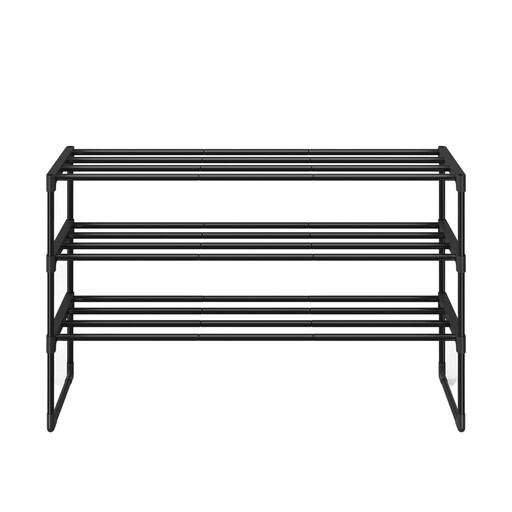
Why it suits this profile: Measuring 30 x 92 x 55 cm, it fits in many hallways, wardrobes and living rooms. According to the product specifications, the three tiers can hold approximately 16–20 pairs of shoes.
The dimensions and stated load capacity are clearly specified. The model is stackable and can be positioned upright, upside down or combined with another unit; however, check your preferred configuration in advance.
Metal tubes, plastic connectors, tool-free assembly and a maximum static load of 10 kg per tier and 30 kg in total.
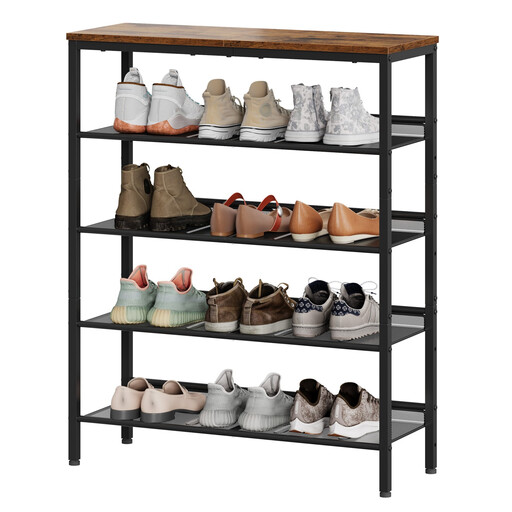
Why it suits this profile: This model combines five mesh tiers with a top shelf and, measuring 28 x 75 x 93 cm, is ideal for an organised entrance hall.
The shelves can be adjusted to create a flat or angled layout. An anti-tip kit is included; according to the product information, securing the rack to the wall is part of safe installation.
Steel frame with chipboard, a maximum load of 11 kg per mesh shelf and 27 kg for the top shelf. The raised edges help limit contact with the wall.

Why it suits this profile: The stated capacity of 30 pairs is appealing for families or households with a larger collection. The rack measures 65.5 x 24.5 x 138 cm.
Its slim depth makes use of vertical space without projecting too far into the room. As assembly is required and no fixings are supplied, make sure the connections are firmly secured and choose a stable location.
Metal construction, a modern white finish, space for up to 30 pairs according to the product information and an open layout for quick access.
We have put together a complete, up-to-date list of products that fully meet these strict selection criteria and the applicable European safety regulations.
Before assembly, check that all the parts are present. Place the frame on a level surface and tighten the connections evenly. With a tall shoe rack, it is advisable to check whether wall mounting is recommended or included.
These habits will help with everyday use:
A model with a steel frame and chipboard, such as the five-tier option above, has different properties from a lightweight rack made of steel and plastic. Always compare the construction with the space available and how you intend to use it at home.
Measure the width, depth and height of the available space. Leave additional room for doors and foot traffic. A model that is approximately 30 cm deep is often suitable for a compact hallway, but shoes with protruding toes may require more space.
Assemble all the connectors according to the instructions and place the rack on a level surface. Put heavy shoes on the bottom. Tall models may require wall mounting or an anti-tip kit. Only use fixings that are suitable for your type of wall.
That depends on the construction and the stated load capacity. Check the material, connectors and maximum load per tier. A metal frame is easy to clean, but stability is also determined by the shape of the frame, the legs and the surface it stands on.
