
Vandaag of morgen in huis

Kwaliteit gegarandeerd

Welkomstaanbiedingen ontgrendelen: GRATIS bezorging | Tot 80% korting | Gratis 30 dagen JoyPlus-proefperiode
Download de app
Loose shoes in the hallway, trainers under the bed and boots that keep toppling over: a shoe rack may seem simple, but the wrong design can quickly become impractical. A rack may not fit under a coat stand, offer less space than expected or be unstable enough for everyday use.
So don’t just look at the number of shoes a product is said to hold on the packaging. Pay particular attention to the external dimensions, internal dimensions, load capacity, choice of materials and assembly method. This will help you avoid having to buy another shoe cabinet or shoe organiser shortly afterwards.
A description such as “holds 30 pairs” sounds clear, but the actual capacity depends on the type of shoes. Low trainers take up less space than tall boots. Wide sports shoes or shoes with a sturdy sole can also fill a compartment more quickly.
So check:
When choosing a shoe rack for the hallway, people often focus mainly on the width. The depth is just as important, especially in a narrow corridor. Measure the available space from the wall to the walkway, and take skirting boards, doors and any radiators into account.
A hanging shoe organiser mainly uses vertical space, while a narrow shoe rack or shoe stacker may be suitable for a wardrobe, under the bed or in a small bedroom.
Stackable shoe boxes and racks save space, but only when the connections fit together properly and the surface is level. Check whether a product is designed to be stacked and whether it has ventilation openings. With tall models, additional wall fixing may be advisable if there is a risk of them toppling over.
Claims about freshness, odour or protection should also be read as product information provided by the seller. A brand’s own research may indicate that a design can contribute to ventilation, but the actual experience also depends on moisture, usage and where you store your shoes.
Measure not only the available space, but also your shoes. With transparent shoe boxes, the internal dimensions are decisive. According to the product information, the JOYFURNOS boxes, supplied as a set of 18, have internal dimensions of 31.2 x 22.5 x 13.5 cm and are described as suitable for shoes up to UK size 11. The external dimensions of each box are approximately 33.3 x 23.2 x 14.3 cm.
For larger trainers, walking shoes and tall styles, always check the length, width and height. A shoe organiser that fits on paper may be too cramped in practice.
A closed shoe cabinet keeps shoes out of sight, while an open rack provides better ventilation and makes shoes quicker to access.
Check whether self-assembly is required, whether tools are included and whether the product needs to stand on a level surface. With tall racks, it’s sensible to look for an anti-tip feature or wall fixing. Never use a shoe rack as a step stool unless the manufacturer expressly permits this.
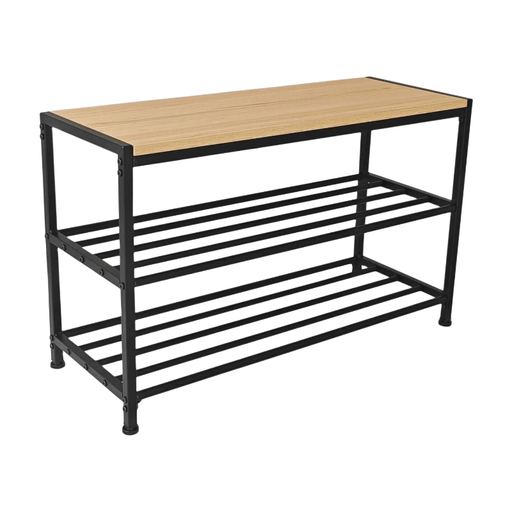
Why it suits this profile: This compact shoe rack holds 6 pairs and has a wooden top shelf for small accessories. It is suitable for a first home, bedroom or modest hallway.
The dimensions of approximately 80 x 30 x 49.2 cm make it easy to assess the required space in advance. The open design prevents shoes from disappearing into a deep, disorganised pile.
Room for 6 pairs, black metal frame, wooden top shelf and open ventilation.
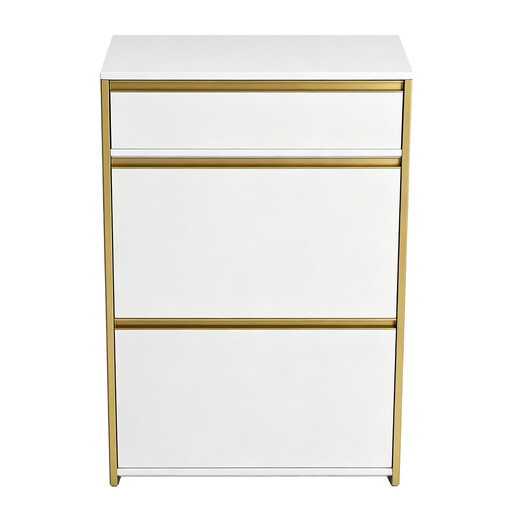
Why it suits this profile: If you want to keep shoes out of sight, this closed shoe cabinet has 4 adjustable shelves, a drawer and a top surface. The model measures 60 x 24 x 104.5 cm.
The adjustable, removable shelves make the layout suitable for different shoe heights. According to the product description, an anti-tip feature is included; secure the cabinet according to the supplied instructions.
Enclosed storage, 4 adjustable shelves, a drawer and a multifunctional top surface.

Why it suits this profile: For families and trainer enthusiasts who want to store many pairs in one place, this freestanding shoe rack is described as holding 30 pairs according to the product information.
The capacity and external dimensions of 65.5 x 24.5 x 138 cm can be compared with the available wall space in advance. The rack is freestanding and requires self-assembly; check all connections after assembly.
Room for 30 pairs, white metal design and a height of 138 cm for vertical storage.
We’ve put together a complete, up-to-date list of products that fully meet these strict selection criteria and the applicable European safety regulations.
With stackable boxes, check that there is enough space at the front to open them. With a narrow shoe rack, the depth is particularly important. A smaller model may be sufficient for children’s shoes, while wide men’s shoes or high-top trainers need more room.
Measure the width, depth and height of the available space. Leave extra room for doors, drawers and taking shoes out. In a narrow hallway, a shallow shoe cabinet or hanging organiser may be more practical than a wide rack.
Place the rack on a level surface, follow the assembly instructions and tighten all connections securely. With a tall model, wall fixing can help reduce the risk of tipping. Never exceed the stated load capacity and do not use the shelves as a seat or step.
Its lifespan depends on the material, load, assembly, moisture and everyday use. Clean it with a soft cloth, avoid prolonged contact with water and check metal connections regularly. With plastic boxes, it’s important not to force shoes inside when the fit is tight.
