
Vandaag of morgen in huis

Kwaliteit gegarandeerd

Welkomstaanbiedingen ontgrendelen: GRATIS bezorging | Tot 80% korting | Gratis 30 dagen JoyPlus-proefperiode
Download de app
A shoe rack seems like a simple purchase, until you discover that it does not fit in the hallway, there is too little space between the shelves or it wobbles as soon as several pairs of shoes are placed on it. In flats, student rooms and narrow hallways, every centimetre counts. The right hallway shoe rack must therefore not only hold enough pairs of shoes, but also suit the available width, height and flooring.
A statement such as “for 12 to 30 pairs of shoes” does not always explain how that capacity has been calculated. Tall boots, wide trainers and shoes with thick soles take up more space than low-profile shoes. So check:
A shoe organiser with lots of compartments may be less practical in reality if those compartments are narrow.
A narrow shoe rack is useful in a hallway or wardrobe, but a tall, shallow construction can be more prone to tipping over. Place this type of model on a level surface and check whether wall mounting is recommended or included. For a shoe cabinet with doors, an anti-tip device is particularly important when drawers or flaps are opened.
For some models, self-assembly means that tools and fixings are required. Other racks use plastic connectors and can be assembled without tools. Check in advance:
This helps you avoid a cheap shoe rack that ultimately requires extra costs or a great deal of assembly time.
First measure the space where you intend to place the shoe rack. Take skirting boards, doors and walking space into account. For a hallway, a depth of around 24 to 30 cm is often practical, but always check the actual shoe size and shape.
A low shoe rack with shelves may fit beneath a coat rack or windowsill. A tall cabinet makes use of vertical space, while a stackable shoe rack can grow with your collection. When stacking, check that the connection remains stable and that the manufacturer supports this arrangement.
A metal shoe rack generally has an open structure, allowing air to circulate around your shoes. As well as checking the material, look at the load capacity. The JOYFURNOS model, for example, specifies a maximum static load of 10 kg per tier and 30 kg in total. Place heavier shoes at the bottom where possible and do not exceed the stated load.
Models made from steel, plastic or board each require different care. Metal surfaces can usually be cleaned with a soft, slightly damp cloth. Wooden or board components should be dried promptly after coming into contact with mud or moisture.
An open shoe storage rack gives you an instant overview and is practical for shoes you wear every day. A closed shoe cabinet creates a tidier look and often provides additional storage for accessories. On the other hand, you cannot see as easily where each pair is stored, and tall boots may not fit in every compartment.
Also consider ventilation. A closed cabinet is not automatically suitable for damp shoes. Allow wet footwear to dry before storing it.
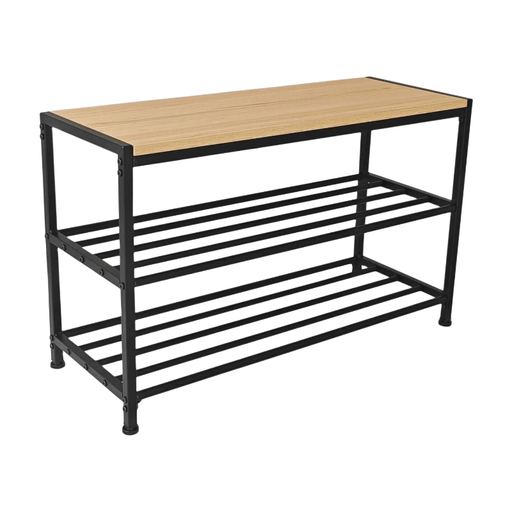
Why it suits this profile: This compact model is ideal for a small collection, measuring 80 cm wide and 30 cm deep. The wooden top shelf provides extra space for keys, a bag or accessories.
The capacity is clearly specified as 6 pairs, making it less likely that you will buy a model that is too small or too large. The open design makes the layout easy to see.
Space for 6 pairs, black powder-coated metal frame, wooden top shelf and compact dimensions.
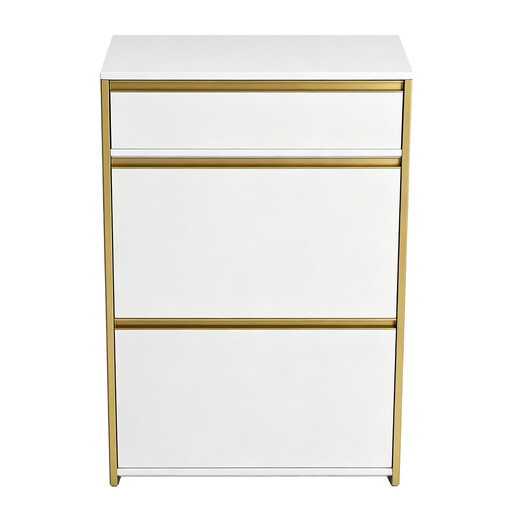
Why it suits this profile: Measuring 60 x 24 x 104,5 cm, this shoe cabinet combines enclosed storage with a drawer and a top surface. It is ideal for households that want to keep their hallway looking uncluttered while also storing smaller items.
The adjustable, removable shelves allow you to customise the layout. The included anti-tip device can be secured to the wall.
Capacity for up to 12 pairs, four adjustable shelves, two doors, a drawer and a top surface.
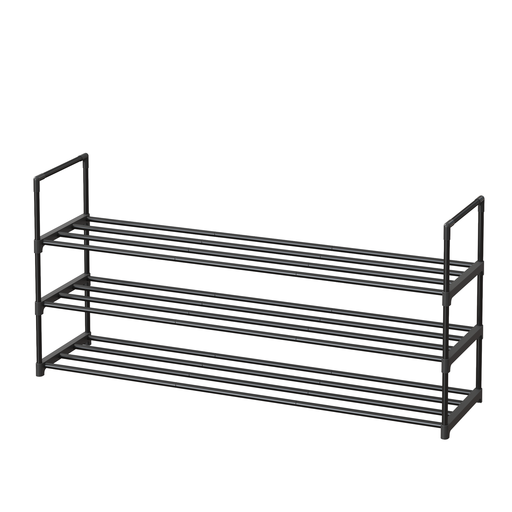
Why it suits this profile: With a width of 117 cm and space for up to 18 pairs, this metal shoe rack is designed for households with several users or a larger shoe collection.
The stated load capacity of 10 kg per tier and 30 kg in total makes comparisons easier. However, check that the rack remains stable if you stack it.
Three tiers, metal tubes, plastic connectors, tool-free assembly and a stated capacity of up to 18 pairs.

Why it suits this profile: Measuring 65,5 x 24,5 x 138 cm, this tall rack holds up to 30 pairs of shoes and makes especially good use of the vertical space in a hallway, bedroom or wardrobe.
The capacity and dimensions are clearly stated. Place the rack on a level surface, tighten the connections securely and consider wall mounting if there is a risk of tipping.
Space for 30 pairs, metal construction, white finish and a slim depth of 24,5 cm.
We have put together a complete, up-to-date list of products that fully meet these strict selection criteria and the applicable European safety regulations.
Measure not only the space itself, but also the room needed for doors and drawers to open. When choosing a hallway shoe rack, take the walking route into account. Also check whether the skirting board prevents the rack from standing fully against the wall. With a tall model, sufficient stability is more important than keeping the gap from the wall to a minimum.
Its lifespan depends on the material, load, moisture levels and assembly. A metal shoe rack may be suitable for everyday use, but its connections can loosen over time. Check screws or fittings regularly and distribute heavier shoes across the bottom shelves. Board materials generally stay looking good for longer when mud and moisture are removed straight away.
That depends on how you use it. An open shoe rack is accessible, easy to see at a glance and often simple to assemble. A shoe cabinet is a better choice if you want to keep your shoes out of sight or create a calmer-looking interior. For wet shoes, drying them first is important, whichever type of shoe storage you choose.
