
Vandaag of morgen in huis

Kwaliteit gegarandeerd

Welkomstaanbiedingen ontgrendelen: GRATIS bezorging | Tot 80% korting | Gratis 30 dagen JoyPlus-proefperiode
Download de app
Shoes scattered in the hallway, a cupboard that isn’t deep enough or a rack that starts wobbling after a few weeks: a shoe rack may seem simple, but there are big differences in size, material and stability. If you focus only on the number of shoes it holds or an attractive product photo, you could quickly end up with an impractical purchase.
Look out for these three common pitfalls:
Check the details in advance to find a shoe storage solution that suits your household, interior and everyday needs.
Measure not only the available width, but also:
An open rack is often easier to access, while a shoe cupboard keeps shoes out of sight. A closed shoe cupboard may therefore be a better choice than a metal shoe rack in a calm living room.
A metal shoe rack with tubes or wire shelves is generally lightweight and easy to move. Check the maximum weight per shelf and the quality of the joints. A wooden shoe rack or a model made from chipboard often looks more like a piece of furniture, but you’ll need to pay extra attention to wet shoes and the finish.
With plastic or PP models, resistance to moisture and easy cleaning are practical advantages. Bear in mind that a stated weight capacity doesn’t automatically mean the rack is suitable for sitting or standing on. Use a shoe rack only for its intended purpose.
Self-assembly is common, so check that:
For tall models, such as multi-tier shoe racks, wall fixings are a sensible precaution if the product is designed for them. Don’t let children climb on the shelves or hang from a cupboard.
When choosing a stackable shoe rack, always check how the modules connect. “Stackable” doesn’t mean that every combination will automatically be stable.
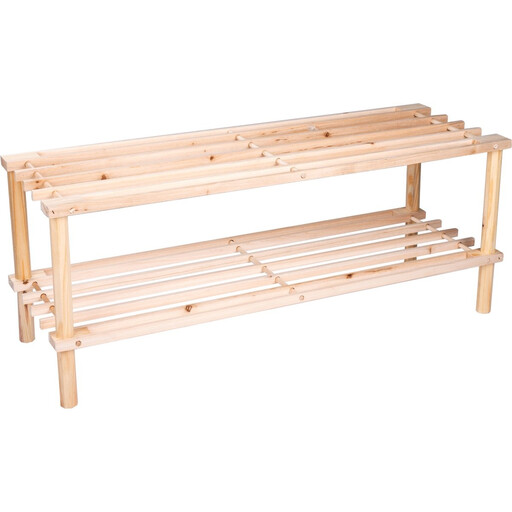
Why it suits this need: This compact wooden model is ideal for a smaller collection. At 26 cm wide, it fits in many hallways, bedrooms and cupboards. According to the product information, it has space for around 6 pairs of shoes.
The dimensions and number of tiers are clearly stated, so you can check in advance whether the capacity will be enough.
Wooden construction, two tiers and a compact depth of 26 cm. The product information states that it is FSC-certified.
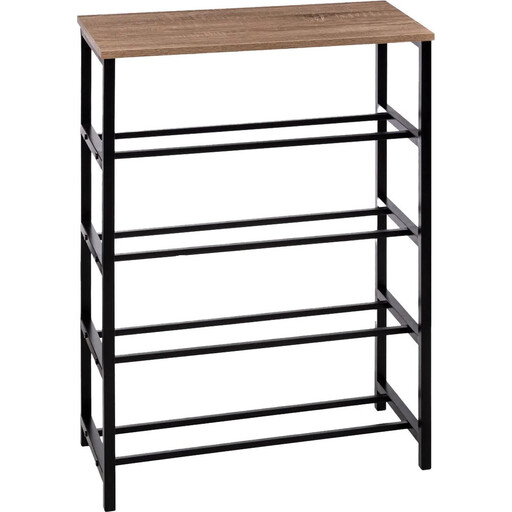
Why it suits this need: With its steel frame, two storage tiers and top surface, this model is ideal if you want to keep shoes tidy while making room for hallway accessories.
The product information gives the dimensions, material and capacity of 12 pairs. At 90 cm tall, it should be used with the anti-tip device supplied.
63 x 30 x 90 cm, steel frame, top surface and space for both low-cut and taller shoes.
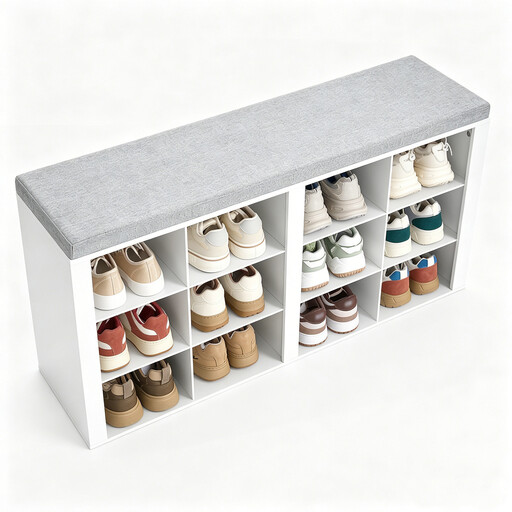
Why it suits this need: This shoe bench combines storage with a seat, making it practical for families or households where several pairs of shoes are changed in the hallway every day.
According to the product information, the compartments are adjustable, so you can arrange them to suit trainers, shoes and taller styles.
12 compartments, dimensions of 30,5 x 104,5 x 49,5 cm and a removable cover, according to the product description.
We’ve put together a complete, up-to-date list of products that meet these strict selection criteria and the applicable European safety regulations.
Measure the available space in three directions: width, depth and height. Make sure there’s also enough room to open doors, drawers or the front door. With a narrow shoe rack, depth is especially important, as shoes sticking out could block the way.
An open rack gives you quick access and allows air to circulate. A shoe cupboard keeps shoes out of sight and offers better protection from dust. Choose a cupboard if the furniture will be in the living room or a visible part of the hallway. An open shoe rack is often easier to access for everyday footwear.
Place the rack on a level surface, put heavier shoes at the bottom and use the anti-tip device supplied, if there is one. Check all the connections after assembly. A shoe rack isn’t a step stool and shouldn’t be loaded beyond its stated weight capacity.
