
Vandaag of morgen in huis

Kwaliteit gegarandeerd

Welkomstaanbiedingen ontgrendelen: GRATIS bezorging | Tot 80% korting | Gratis 30 dagen JoyPlus-proefperiode
Download de app
A shoe rack may seem like a simple piece of furniture, but you’ll quickly notice if you choose the wrong one. A rack might look as though it can hold plenty of pairs on paper, but boots, wide trainers or children’s shoes may not fit properly. Product photos can also make dimensions look different from how they are in real life. If you focus only on price or appearance, you could end up with a shoe storage solution that’s too large, unstable or impractical.
A manufacturer may state that a rack holds a certain number of pairs of shoes, but that doesn’t mean every type of shoe will fit equally well. High-top trainers, ankle boots and shoes with thick soles take up more room than low-cut slip-ons. So check not only the number of pairs, but also the height, width and depth of each compartment.
A shoe rack for 6 to 30 pairs may suit different households, but its practical capacity depends on your collection. If you have larger shoes, allow a little extra space.
A narrow shoe rack saves floor space, but it may be relatively tall or long. Measure the whole area carefully, including the skirting board, door swing, walkway and any radiator. Check the order of the dimensions too. A model measuring 65,5 x 24,5 x 138 cm will take up a different amount of space depending on whether the deeper side faces the front.
For a small entrance, a hallway shoe rack with a shallow depth can be useful. In a wardrobe, a stackable shoe rack or plastic shoe stacker may make better use of the space.
Open racks are easy to access, but a tall model needs to stand on a level surface. Check that the joints are secure and follow the assembly instructions. If there’s a risk of it tipping over, it may be sensible to secure a tall shoe rack to the wall. Check the maximum load too. A lightweight frame won’t necessarily be suitable for heavy boots or fully loaded shelves.
First, note how much space you have and how many pairs of shoes you want to store each day. Then allow for seasonal footwear. A shoe cabinet with doors or drawers keeps shoes out of sight and can create a tidier look in the living room. An open metal shoe rack, on the other hand, makes it easy to see your shoes and lets air circulate.
Look out for these points:
A metal shoe rack is often a practical choice for an open hallway or wardrobe. Metal is easy to wipe clean, and a tubular frame can be relatively lightweight. Check that the joints are sturdy, though, and avoid leaving the rack in a damp environment for long periods unless the product information says it’s suitable.
A wooden shoe rack or shoe cabinet made from engineered wood often suits interiors with wood-toned furniture. A closed cabinet keeps shoes out of sight and helps reduce clutter in the hallway, but it’s heavier and usually requires more assembly.
Bamboo is another option if you’re looking for a natural finish and a foldable shoe rack. Whatever model you choose, check its maximum load and use it only on a stable surface.
A stackable shoe rack offers flexibility if your collection grows. Check in advance that the model is designed to be stacked; stacking separate racks can affect stability and load capacity. A foldable shoe rack is handy if you need extra storage temporarily or want to put the rack away.
A shoe rack with drawers or doors is a good choice for a wardrobe or hallway where you’d prefer to keep shoes out of sight. Check that there’s enough room to open the doors and that the compartments are large enough inside.
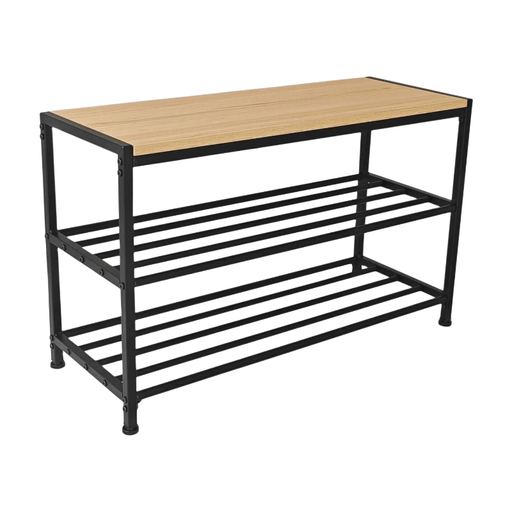
Why it suits you: Its capacity of 6 pairs and compact dimensions make it a good fit for a small household, bedroom or modest hallway.
The stated capacity and dimensions are clearly specified, making it easier to judge whether the rack will fit your available space.
Black powder-coated metal, a wooden top and an open design. The top provides space for accessories or decorations.

Why it suits you: This closed shoe cabinet is ideal if keeping your hallway tidy matters to you and you’d rather keep your shoes out of sight.
The six shelves, flap doors and drawer give you a clear idea of the layout. Check the internal dimensions if you plan to store taller shoes.
Engineered wood, 6 shelves, flap doors, a drawer and FSC certification, according to the product information. Holds up to 18 pairs.

Why it suits you: This tall, freestanding rack is designed for households with a larger shoe collection and a need for open storage in a wardrobe or hallway.
The full height and footprint are specified. Place it on a level surface, check the joints and consider securing it to the wall if there’s a risk of it tipping over.
Holds up to 30 pairs, with a metal frame, a modern white finish and easy open access. Self-assembly is required; according to the product information, assembly materials are not included.
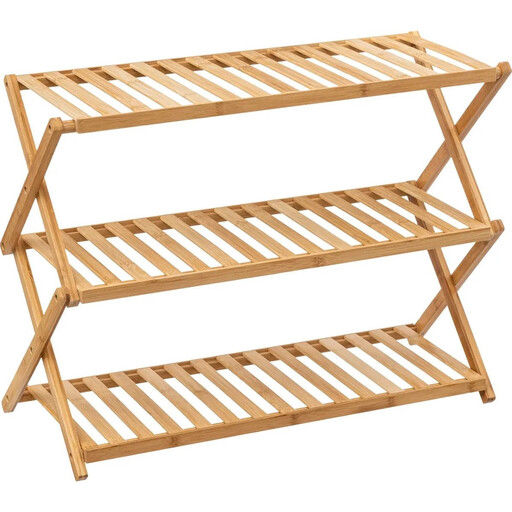
Why it suits you: This model is a good choice if you’re looking for a natural material and want to be able to move or fold away your shoe storage from time to time.
Its foldable design makes it easy to put away temporarily. Bear in mind the stated total load capacity of 15 kg and make sure the rack is stable.
Bamboo construction, three tiers, a foldable design and dimensions of 70,5 x 28,5 x 52,5 cm. The product information states that it holds 12 pairs.
We’ve put together a complete, up-to-date list of products that meet these strict selection criteria and the applicable European safety regulations.
Use this quick checklist before ordering a model:
It depends on the layout you choose. Measure not only the width of the wall, but also the depth of the rack and the clearance needed for doors or walkways. For a small hallway, a model around 24 to 30 cm deep may work well, while a larger wardrobe offers more options.
It can be, but always check the stated load capacity and the construction. A metal frame with plastic joints may be suitable for everyday shoes, while heavy boots put more strain on the shelves and joints. Distribute the weight evenly and don’t exceed the stated load.
Group shoes by season or how often you wear them. Keep everyday shoes at the front and check regularly that the rack isn’t overloaded. You can wipe an open shoe rack with a soft, slightly damp cloth. For engineered wood or bamboo, it’s best to avoid prolonged exposure to moisture.
