
Vandaag of morgen in huis

Kwaliteit gegarandeerd

Welkomstaanbiedingen ontgrendelen: GRATIS bezorging | Tot 80% korting | Gratis 30 dagen JoyPlus-proefperiode
Download de app
Shoes left loose in the hallway can quickly make your entrance look untidy. But buying a shoe rack isn’t as straightforward as it might seem. A model may look spacious in photos, yet be too shallow for boots, wobble in use or not have enough room for everyone’s shoes.
So don’t focus only on colour and price. The dimensions, load capacity, layout and fixing method are what determine whether a shoe storage unit will be practical for everyday use.
A description such as “holds 8 pairs of shoes” is a guide. Trainers, high-top trainers and heeled shoes take up more room than low-cut shoes. So check the width and height of each compartment. A shoe rack for 30 pairs, for example, may offer plenty of capacity, but at 138 cm tall it also takes up a significant amount of vertical space.
A shallow model is useful in a narrow hallway, but a tall, lightweight rack can move more easily when you take shoes off it. Check its weight, construction and whether it can be fixed to the wall. A freestanding shoe rack in a busy hallway needs particular attention.
Metal is usually easy to wipe clean, while wooden or MDF parts are less suited to prolonged exposure to moisture. So don’t place a shoe rack against a wet external wall, and dry off mud or rainwater as soon as possible. An open design can also help prevent shoes from being stored in an enclosed space, but it won’t prevent moisture problems if you put wet footwear away straight away.
Measure the space in your hallway, corridor, bedroom or wardrobe before ordering a model. Make a note of:
A shoe rack for a hallway is often most practical when it has a limited depth. For a compact space, a model around 18.5 to 30 cm deep may be enough. If you want to store more shoes, make better use of the height or choose a model with several tiers.
Work out how many shoes you really want to store. A shoe rack for 8 pairs of shoes may be enough for a small household. A model holding 16 to 20 pairs is a better fit for a family or a wardrobe with several pairs of everyday shoes. If you have a large collection, a shoe rack for 30 pairs is worth considering, provided its height and stability suit the space.
Also consider the shape of the shelves. A flat shelf works well for trainers and shoes with low soles. Adjustable or angled shelves may be more convenient for taller shoes, but can sometimes reduce the space available on each tier.
A metal shoe rack with a powder-coated finish is practical if you want an easy-to-clean surface and a modern look. Models combining metal and board often include a top shelf for bags, keys or accessories.
Always check the stated maximum load. This may vary from shelf to shelf. If you’re choosing a shoe rack with a bench, check the bench’s load capacity separately too. An anti-tip restraint is important for tall models. Follow the assembly instructions and use the wall fixings supplied if required.

Why it suits this need: This compact model is ideal for a small hallway, student room or bedroom where floor space is limited. It holds up to 8 pairs of shoes.
The stated dimensions make it clear how much floor space you’ll need. Bear in mind that the maximum load is 1 kg.
Steel shelves, a black finish, a height of 64 cm and a relatively shallow depth of 18.5 cm.
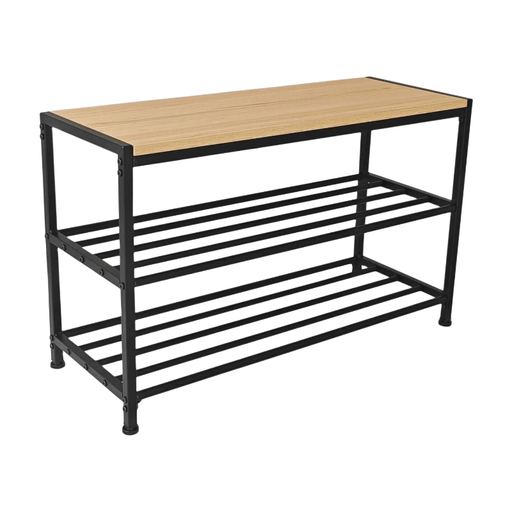
Why it suits this need: This freestanding shoe rack combines a black metal frame with a wooden top shelf. It’s a good choice if you want to combine shoe storage with a place for accessories.
Its open design and clear dimensions make it easy to see how much storage space the rack offers.
Space for 6 pairs of shoes, an engineered wood top shelf and a powder-coated metal frame.

Why it suits this need: This tall model is designed for households with a larger shoe collection. Its slim depth makes good use of the height available in a wardrobe or hallway.
The 30-pair capacity and dimensions are clearly stated. Before assembly, check that it will be stable and fix it to the wall if there’s a risk of it tipping over.
Space for up to 30 pairs, a metal construction, a white finish and a depth of 24.5 cm.
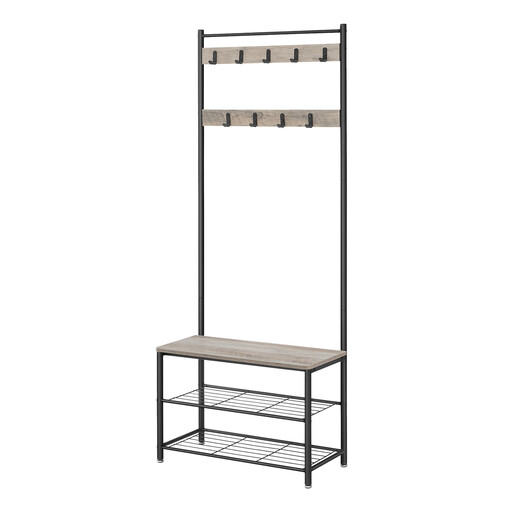
Why it suits this need: This shoe rack with bench combines shoe storage, hooks and a place to sit. It’s a practical choice for a family home where the hallway serves several purposes.
The product details state the load capacities for the bench, hooks and shelves. Use the anti-tip kit supplied, following the instructions.
9 hooks, a bench with a stated static load capacity of 136 kg, adjustable feet and an overall height of 177 cm.
We’ve put together a complete, up-to-date list of products that meet these strict selection criteria and the applicable European safety requirements.
Measure the available width, depth and height first. Leave enough space around the rack for doors and a comfortable walkway. For a narrow corridor, a model around 18 to 30 cm deep is often more practical than a wide unit.
An open shoe rack makes it easy to see what you have and access your shoes. A shoe cabinet keeps them more out of sight and may suit a tidy entrance better. Choose based on ventilation, appearance, available space and how often you wear the shoes.
Its lifespan depends on assembly, load, moisture and everyday use. Check the joints regularly and tighten them if needed. Clean with a soft, slightly damp cloth, then dry any metal and wooden parts. Never exceed the stated load capacity.
