
Vandaag of morgen in huis

Kwaliteit gegarandeerd

Welkomstaanbiedingen ontgrendelen: GRATIS bezorging | Tot 80% korting | Gratis 30 dagen JoyPlus-proefperiode
Download de app
A shoe rack seems like a simple purchase until it does not fit in the hallway, wobbles or holds fewer shoes than expected. Especially in compact Dutch homes, the right dimensions, stability and layout matter. A shoe organiser should not only look tidy, but also suit your available space and everyday needs.
A description such as “for 30 pairs” does not always indicate how practical the layout is. Tall boots, wide trainers and children’s shoes each require a different amount of space. So also check the height between the tiers, as well as the overall width and depth.
A shoe rack for 16 to 30 pairs may be suitable for a large household, but it could take up a lot of vertical or horizontal space. For a small hallway, a narrow shoe rack is often more practical than a tall model with a large capacity.
Product dimensions are not always listed in the same order. Check the width, depth and height separately. At home, measure not only the area where the rack will stand, but also the access route, skirting board and any wardrobe doors.
A shoe rack for a wardrobe or under a bed usually needs to be shallower than a freestanding shoe rack for the hallway. Also allow enough room to remove shoes easily from the rack.
A lightweight metal shoe rack may be easy to move, but the weight of several pairs of shoes can quickly add up. Check the maximum static load per tier and for the rack as a whole. Place the rack on a level surface and tighten all connections securely after assembly.
For tall models, wall fixing may be advisable if there is a risk of tipping. According to the product information for some models, wall-fixing hardware is not supplied as standard. Never use a rack as a step or seat unless this is expressly permitted.
First decide where the shoe rack will go:
A metal shoe rack with open tiers generally provides a clear layout. A plastic shoe organiser or shoe stacker is often more suitable for a few pairs in a wardrobe or under the bed.
Metal is often used for the tubes and frames of shoe racks. It can create a slimline construction and is easy to wipe clean. However, check that the connections are sturdy and that the rack is designed for the intended load.
Plastic is lightweight and can be useful for individual shoe stackers. Check the maximum load and how several elements may be combined, if applicable. Not every model is designed to be placed on top of another.
For a rack with a wooden or wood-effect top shelf, it is important to avoid moisture. Wet shoes should be dried first before being placed on or against such components.
Check whether tools are required, whether assembly hardware is included and whether the product needs to be assembled at home. Tool-free assembly can be convenient, but still check all connections after putting the rack together.
A soft, slightly damp cloth is usually sufficient for maintenance. Dry metal components immediately and do not use abrasive cleaners. With a freestanding shoe rack, regularly check that all connections remain securely fastened.
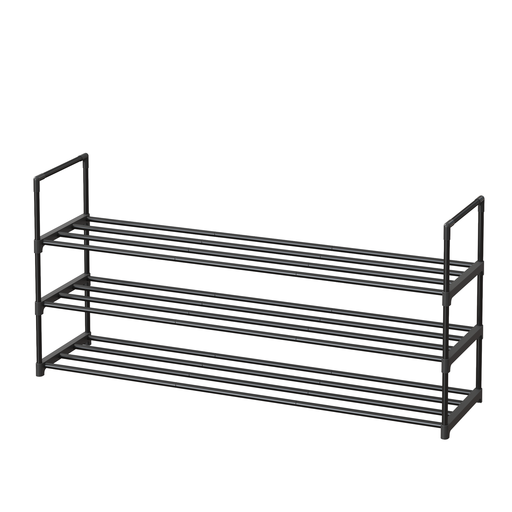
Why it suits this profile: This black metal shoe rack has three tiers and, according to the product information, can hold up to 18 pairs of shoes. Measuring 117 x 30 x 55 cm, it is suitable for a hallway, wardrobe or living room where width is limited.
The product information states both the overall dimensions and a load capacity of 10 kg per tier and 30 kg in total. This lets you compare capacity and load limits in advance.
Metal tubes, plastic connectors, three tiers and tool-free assembly according to the product description.
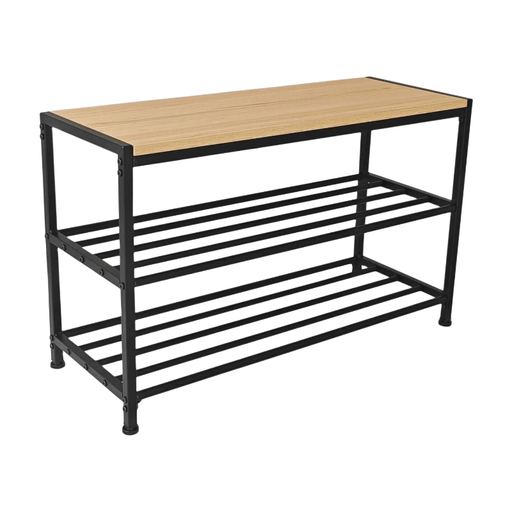
Why it suits this profile: This freestanding shoe rack is designed to hold up to six pairs and has an engineered wood top shelf. It is suitable for a smaller collection in the hallway, entrance hall or bedroom.
The capacity is clearly stated: six pairs of shoes. You therefore avoid buying a large rack when you only need to store everyday footwear.
Black powder-coated metal frame, wooden top shelf and open design according to the product description.

Why it suits this profile: If you want to organise lots of shoes in one rack, the product information states that it can hold 30 pairs. Measuring 65.5 x 24.5 x 138 cm, it is particularly suitable when vertical space is available.
The tall design makes the available capacity clear, while the stated depth of just 24.5 cm may be useful in a narrow space. However, check the stability and positioning beforehand.
Suitable for 30 pairs, metal construction, white finish and self-assembly according to the product specifications.
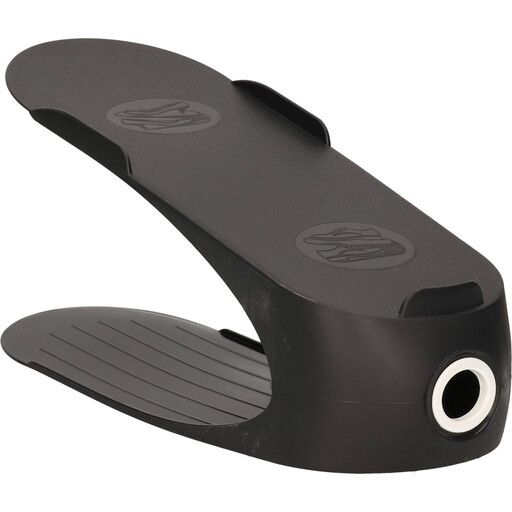
Why it suits this profile: This compact plastic shoe stacker measures 29.5 x 11.1 x 14 cm and is designed to hold up to three pairs of shoes. It fits under a bed, at the bottom of a wardrobe or against a wall.
The small capacity and precise dimensions make it clear that this is not a complete shoe rack for a household, but a solution for a few pairs.
Plastic construction, a handle for easy moving and a raised edge according to the product information.
We have compiled a complete, up-to-date list of products that fully meet these strict selection criteria and the applicable European safety regulations.
It depends on the type of footwear and the layout. Low-top trainers need less height than ankle boots. Measure a representative pair of shoes and compare this with the distance between the tiers. Also allow a few centimetres of clearance so that shoes can be removed easily.
A metal shoe rack can be suitable for everyday use when the construction, connections and surface are appropriate for the job. Check the stated load capacity per tier, assemble all components according to the instructions and make sure the rack is level. With a tall model, additional wall fixing may be advisable if there is a risk of tipping.
For a small hallway, a narrow shoe rack, a low freestanding model or a stackable shoe organiser are practical options. Do not look only at the width; also consider the depth and the space needed to open the front door. A three-tier model can offer a good balance between capacity and accessibility.
