
Vandaag of morgen in huis

Kwaliteit gegarandeerd

Welkomstaanbiedingen ontgrendelen: GRATIS bezorging | Tot 80% korting | Gratis 30 dagen JoyPlus-proefperiode
Download de app
Shoes scattered in the hallway, pairs falling over in the wardrobe and nowhere to put your boots: a shoe rack can quickly bring some order. However, not every design suits every home. A slim shoe rack, for example, may be practical in a flat but too small for a family. A tall shoe cabinet makes better use of wall space, but needs extra attention to stability.
As Joybuy Product Recommendation Officer, I focus on verifiable details such as dimensions, materials, capacity and assembly. This helps you avoid choosing a shoe organiser that looks appealing in the product photo but doesn’t fit properly at home.
A claim such as “holds 18 or 24 pairs” is a guide. Shoes with high tops, thick soles, heels or a wide fit take up more room than low-top trainers. So check the space between the shelves and the overall width too.
For stackable shoe boxes, the internal dimensions matter more than the external ones. Measure a large pair of shoes before you order.
A shoe rack for the hallway needs to fit not only in terms of width, but also provide enough depth for your shoes. A cabinet around 23 to 26 cm deep saves space, but not every pair will fit straight in. Check that doors, skirting boards and walkways won’t be blocked either.
A tall shoe rack is more likely to tip over than a low one. If you have a shoe cabinet with several compartments, wall fixing is sensible when the manufacturer recommends using an anti-tip kit. Never use a shoe rack as a seat or step stool unless it is explicitly designed for this.
Look out for conflicting or missing information too. For example, the Alpina model doesn’t list a useful maximum load capacity. It’s suitable for storing shoes as normal, but not for heavy items.
Measure the space in three places:
A shoe rack with several tiers makes use of vertical space. A 138 cm-high model can hold many pairs while taking up relatively little floor space, but it needs to stand securely. For a small hallway, a low metal shoe rack or an over-the-door organiser may be more practical.
Treat the stated capacity as a guide. A model for 30 pairs is best suited to a collection made up mostly of low shoes. For ankle boots, high-top trainers and children’s shoes, a combination of open compartments and separate boxes is often more flexible.
For a shoe cabinet with six compartments and stated space for 24 pairs, check how many shoes fit side by side in each compartment. According to the product description, this model has a load capacity of 5 kg per shelf.
A metal shoe rack is usually open and easy to clean. Make sure the connections are secure and that the rack is standing on a level surface. Metal isn’t automatically rust-proof, so avoid prolonged contact with wet shoes and wipe the rack dry.
A plastic shoe cabinet is lightweight, washable and less susceptible to moisture. PP panels can be useful in a utility room or hallway, but check the quality of the connectors and whether wall fixing is required. Wooden models, such as an FSC-certified rack, work well in a warm, welcoming interior. Certification tells you about the material’s origins, not its maximum load capacity.
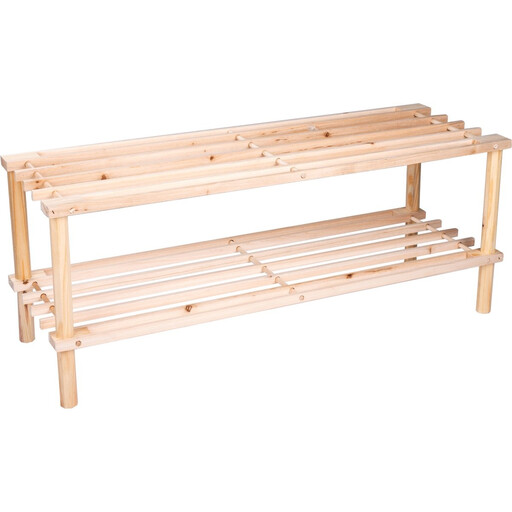
Why it suits this profile: This low wooden rack is a good fit for a compact hallway or bedroom. According to the product description, it holds around 6 pairs of shoes.
The external dimensions are clearly stated, so you can check in advance whether 74 x 26 x 29.5 cm will fit in your chosen spot.
Wooden design, 2 tiers and FSC certification according to the product information. It has no wheels or adjustable parts.

Why it suits this profile: The closed design is ideal if you want to keep shoes out of sight in a hallway, wardrobe or living room.
The stated capacity is 18 pairs and the depth is 23.3 cm. Check in advance that your shoes will fit these dimensions.
6 shelves, drop-down doors and an FSC reference in the product details. The unit is designed for indoor use and requires self-assembly.
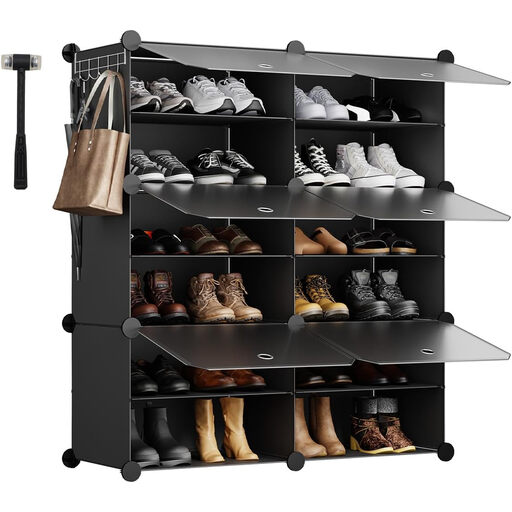
Why it suits this profile: This model is designed for families and larger shoe collections in the hallway, walk-in wardrobe or utility room.
The product description mentions anti-tip features and advises securing the tall cabinet to the wall. Keep this in mind during assembly.
PP panels, moisture resistance according to the product description and a load capacity of 5 kg per shelf. Assembly hammer included.
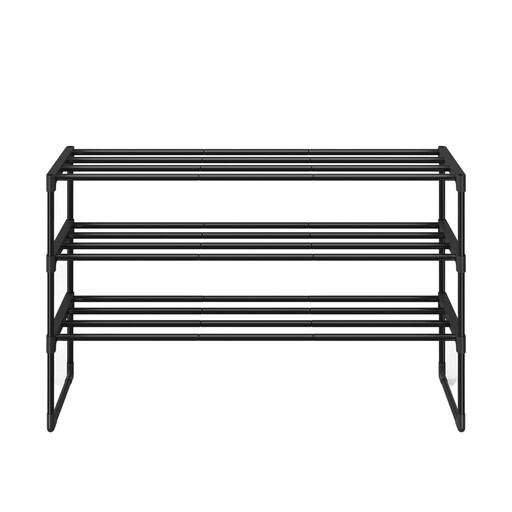
Why it suits this profile: At 92 cm wide and 30 cm deep, this rack is suitable for a hallway, wardrobe or living room where you want an open shoe organiser.
The product details state a capacity of 10 kg per tier and 30 kg in total. This gives you a clearer idea of the load limit than models without a stated capacity.
Metal tubes, plastic connectors, 3 tiers and tool-free assembly according to the product description. The rack can be stacked or positioned the other way round.
We’ve put together a complete, up-to-date list of products that meet these strict selection criteria and current European safety regulations.
Stackable shoe boxes are especially handy for trainers, flats and shoes you want to keep free from dust. Transparent doors let you see what’s inside without opening each box. Check the internal dimensions, ventilation openings and how stable the stack is.
Some sets contain 18 boxes with internal dimensions suitable for shoes up to size 44. According to the product information, this varies by model. So measure your longest pair, especially if you have high-top trainers or shoes with a wide sole.
First measure the available width, depth and height. Leave extra room for doors and walkways. A low rack works well under a coat stand; a slim, tall model makes better use of wall space, but needs to stand securely and may require additional wall fixing.
Start by removing dust and grit. For wood, metal and plastic, use a slightly damp cloth, then dry the surface. Don’t leave wet shoes in a closed shoe cabinet for long periods. If you use shoe boxes, make sure the ventilation openings are clear.
Its lifespan depends on the material, assembly, load and exposure to moisture. Check the screws, connectors and shelves regularly. Don’t exceed the stated load capacity, and only use a tall shoe cabinet with the recommended anti-tip protection.
