
Vandaag of morgen in huis

Kwaliteit gegarandeerd

Welkomstaanbiedingen ontgrendelen: GRATIS bezorging | Tot 80% korting | Gratis 30 dagen JoyPlus-proefperiode
Download de app
Loose shoes in the hallway, pairs toppling over in the wardrobe, or boots that never seem to have a home – a shoe rack can create plenty of storage space without you needing a full-sized shoe cabinet straight away. However, not every model will automatically suit your home. The available width, the weight capacity, and the way you use your shoes all determine which choice makes sense.
A claim like “holds 30 pairs of shoes” sounds clear enough, but the actual layout can vary depending on the shoe. Low trainers take up less room than ankle boots or wide walking shoes. So always check the number of shelves, the height between levels, and the overall dimensions.
A space-saving shoe rack is handy in a narrow hallway, but a tall, lightweight model can be more prone to tipping over. Place it on a level surface and check whether wall fixing is recommended. With a tall shoe cabinet or a shoe rack for a wardrobe, this is especially important if there are children in the house.
A closed cabinet keeps shoes out of sight but restricts air circulation. An open metal shoe rack or a model with mesh allows more air to flow between the shoes. That doesn’t automatically mean shoes will stay dry in all conditions. Only put wet shoes back once they have dried thoroughly, and follow the manufacturer’s care instructions.
Measure the spot where the shoe rack will go. Pay attention to:
A shoe rack for the hallway doesn’t have to be large. In a small entrance, a narrow shoe rack with multiple tiers can be more efficient than a wide shoe cabinet.
Make a realistic assessment of your collection. For a student or single-person household, a rack for 12 pairs may be enough. Families may need a shoe rack for 12 to 30 pairs of shoes. Also look at the sizing of the shelves. A model that works for trainers may be less practical for high boots.
A metal shoe rack usually offers an open construction and is easy to clean. On models with metal tubes, check the stated weight capacity per level and in total. With plastic components, the joints and correct tightening are important.
Also pay attention to assembly:
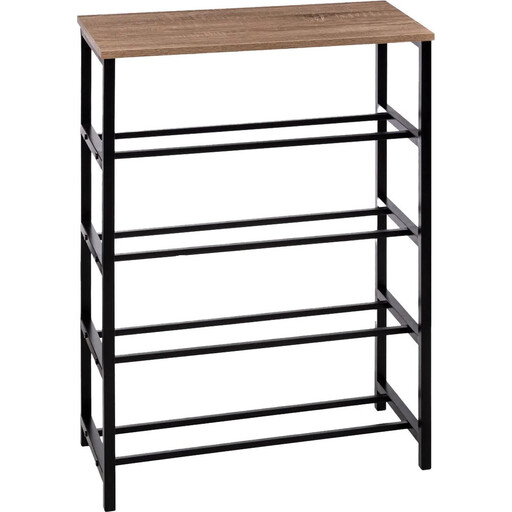
Why this fits the profile: According to the product information, this model holds 12 pairs of shoes and has a top surface for hallway items. With dimensions of 63 x 30 x 90 cm, it fits into various entrances and wardrobes.
The capacity, dimensions and materials are clearly stated. Thanks to the open design, you can see the shoes straight away and don’t have to rely solely on a general capacity claim.
Steel construction, two tiers, top surface and stated capacity of 12 pairs. Wall fixing and placement against a wall are mentioned in the instructions.

Why this fits the profile: This vertical model is designed for doors, cupboards or unused corners. The dimensions are approximately 18.9 inches wide and 67.2 inches high, with a shallow depth of around 2.76 inches.
The product description mentions a foldable design, tool-free assembly and 24 pockets. Check beforehand whether your door can handle the weight and the mounting method.
Metal frame, breathable mesh fabric, vertical layout and foldable design. The manufacturer recommends a flat, stable placement and states a maximum load per level.

Why this fits the profile: With 16 shelves and a stated capacity of 30 pairs, this model is aimed at households with a larger collection. The height is 138 cm and the width is 65.5 cm.
The capacity is linked to a specific number of shelves and dimensions. Because the rack is tall and lightweight, a level surface remains important; wall fixing is recommended if tipping is a risk.
Space for 30 pairs, metal construction, 16 shelves and suitable for indoor use. The rack is self-assembly.
We have put together a full, up-to-date list of products that fully meet these strict selection criteria and comply with current European safety regulations.
That depends on the width, the number of tiers and the type of shoes. A compact model can hold around 12 pairs, while a tall rack may offer space for 30 pairs according to the product information. Wide shoes and boots take up more room than low trainers.
Yes, a metal shoe rack with a shallow depth can fit well in a narrow hallway. Just pay attention to stability and the passageway. With a tall model, it is wise to follow the instructions for wall fixing, especially in a household with children.
Use a fixed layout per level, for example everyday wear, sports and seasonal shoes. Group pairs of similar height together and leave enough space between the shoes. A shoe organiser with separate pockets can be practical if you also want to sort small accessories or loose slippers.
