
Vandaag of morgen in huis

Kwaliteit gegarandeerd

Welkomstaanbiedingen ontgrendelen: GRATIS bezorging | Tot 80% korting | Gratis 30 dagen JoyPlus-proefperiode
Download de app
A shoe rack may seem like a simple purchase, until it wobbles, does not fit beneath the coat rack or holds fewer shoes than expected. Problems are particularly common when ordering online due to unclear dimensions, optimistic capacity claims and materials that are not suited to the intended use.
With this practical buying guide, you can compare a shoe rack based on capacity, dimensions, material, stability and assembly. This makes it easier to choose the right shoe rack for the hallway, a shoe cabinet for everyday use or a space-saving shoe organiser for a small home.
A description such as “for 18 pairs” or “for 30 pairs” does not tell you everything. Winter shoes, high-top trainers and ankle boots take up more room than low-cut shoes. You should therefore also check:
A shoe rack for 30 pairs may be practical for a family, but at 138 cm tall it takes up considerably more vertical space.
A narrow shoe rack is useful in a flat or narrow entrance hall, but the available width is only one part of the equation. Also measure skirting boards, doors and the space around the rack. For example, a model that is 30 cm deep may still obstruct a hallway door that opens inwards.
A lightweight metal shoe rack is easy to move, but it must stand on a level surface. With taller models, it is advisable to check whether wall mounting is possible or recommended. A shoe cabinet with flap doors must also be assembled correctly; if the cabinet is not level, the doors may not open as smoothly.
Pay attention to what is included in the packaging. According to the product information, no assembly materials are included with the 5five metal rack for 30 pairs. Suitable tools and properly tightened connections are therefore important when assembling it yourself.
Before ordering, make a note of:
For underneath the bed or at the bottom of a wardrobe, a low shoe rack or separate shoe organiser is often more practical than a tall freestanding solution. According to the product information, the 5five Plastic Shoe Rack Spacy measures 29.5 x 11.1 x 14 cm and is intended for use in a wardrobe, beneath the bed or against a wall. Its maximum capacity is three pairs of shoes.
A metal shoe rack often has an open design, making it suitable for everyday use in a hallway or cloakroom. However, check that the connections are sturdy and that the rack is not too lightweight for the number of shoes it will hold.
A wooden shoe rack often complements a warm interior. The Alpina version has two levels, is made of wood and, according to the product description, holds approximately six pairs of shoes. The stated maximum load capacity is 0 kg, so you should not assume that it can safely support heavy footwear without supporting evidence.
A shoe cabinet made from chipboard keeps shoes out of sight and helps protect the hallway from visual clutter. On the other hand, assembly and opening the flaps require more space. The 5five model, measuring 60 x 23.3 x 119.5 cm, has six shelves and, according to the product information, is suitable for 18 pairs of shoes.
For metal models, check the stated load capacity per shelf. The JOYFURNOS model for up to 18 pairs states a static load capacity of 10 kg per level and 30 kg in total. This is a verifiable product specification, but its actual suitability also depends on level placement and correct assembly.
Stackable models offer flexibility, but only stack them when the product description permits this. Also check whether the structure remains stable when assembled at a greater height.
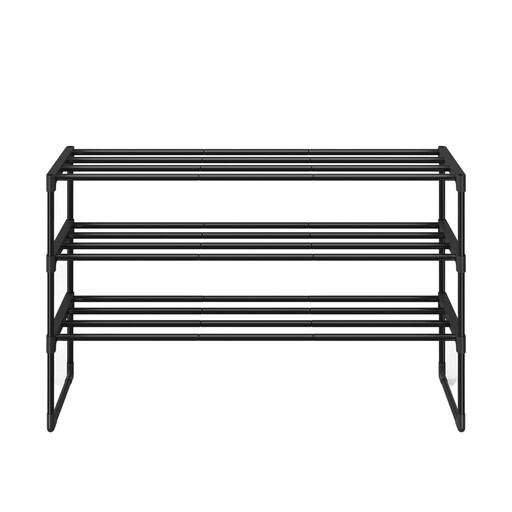
Why it suits this profile: Measuring 30 x 92 x 55 cm, this is a compact option for a hallway, wardrobe or living room with limited space. According to the product information, the rack can be turned around or stacked.
The external dimensions and load capacities are clearly stated. This means you can compare the available space and expected load in advance.
Metal tubes, plastic connectors, tool-free assembly and a maximum of 10 kg per level according to the product specifications.

Why it suits this profile: This closed shoe cabinet is ideal for anyone who wants to keep shoes out of sight in a hallway, cloakroom or bedroom. The cabinet has six shelves, flap doors and a drawer.
The capacity of 18 pairs and dimensions of 60 x 23.3 x 119.5 cm can be checked before purchase. However, allow for self-assembly and the space required to open the flaps.
Chipboard construction, six shelves, flap doors and an FSC statement according to the product information.

Why it suits this profile: This tall freestanding rack is designed for households with a larger shoe collection. The product information states that it holds 30 pairs and measures 65.5 x 24.5 x 138 cm.
The high capacity is linked to specific external dimensions. Place the rack on a level surface and consider wall mounting if there is a risk of it tipping over.
Metal construction, white colour, modern design and capacity for up to 30 pairs according to the product description.
We have put together a complete, up-to-date list of products that fully meet these strict selection criteria and the applicable European safety regulations.
A longer service life starts with correct placement. Put the rack on a level, stable surface and distribute heavy shoes evenly across the shelves. Tighten screws or connectors securely after assembly and check them again from time to time.
Clean metal and plastic with a soft, slightly damp cloth. Dry metal surfaces afterwards to help prevent moisture marks. Do not use abrasive cleaners. Check plastic components for cracks and stop using a damaged shoe organiser.
A shoe rack is generally designed for storing shoes, not for sitting on. Therefore, check whether the product description mentions a seating function. The 5five freestanding metal rack is explicitly stated as unsuitable for sitting on.
Measure the width, depth and height of the available space, allowing for doors, skirting boards and walking space. For a narrow entrance hall, a model around 30 cm deep may be a better fit than a deep shoe cabinet. For underneath the bed, height is particularly important.
It depends on how you plan to use it. Metal is suitable for an open rack in the hallway and makes vertical storage possible. Wood often works better in an interior where the rack remains visible. As well as the material, consider the load capacity, stability, finish and assembly instructions.
Its lifespan depends on the load, moisture, assembly and everyday use. Keep a shoe rack indoors, do not exceed the stated load capacity and check the connections regularly. According to the product information, the products mentioned are covered by a minimum two-year legal guarantee under EU consumer law; additional rights may apply under national regulations.
