
Vandaag of morgen in huis

Kwaliteit gegarandeerd

Welkomstaanbiedingen ontgrendelen: GRATIS bezorging | Tot 80% korting | Gratis 30 dagen JoyPlus-proefperiode
Download de app
A shoe rack may seem straightforward, but the wrong choice can quickly lead to sagging shelves, too little space or a piece of furniture that won’t fit in your hallway. When shopping online, it’s easy to pay less attention to dimensions and load capacity than to colour and price.
Look out for these three common pitfalls:
First, measure the space where you plan to put your shoe storage. In a hallway, take doors, skirting boards and walking space into account. Then check these three dimensions:
If you’re looking for a shoe rack for 30 pairs, check how that capacity is calculated. A rack with several open shelves usually gives you easy access, while a closed shoe cabinet keeps shoes out of sight. Adjustable shelves are handy for households with a mix of shoe styles, as trainers, ankle boots and taller shoes don’t all need the same amount of clearance.
The right style depends on your space and how you’ll use it.
Look at the construction as well as the material. Metal can work well for an open, lightweight design; plastic is practical for compact shoe stackers; and engineered wood is more common in closed furniture.
Check the product specifications for:
A product description that only says “sturdy” doesn’t give you much you can verify. A stated load capacity, such as 10 kg per level or 30 kg in total, makes products easier to compare. Don’t use a shoe rack as a step or seat unless it’s specifically designed to be a bench. If you’re assembling it yourself, tighten all the connections securely and place the rack on a level, stable surface.

Why it suits this profile: According to the product specifications, this tall, open model holds 30 pairs of shoes and is 24.5 cm deep. It’s a good option if you want to keep lots of shoes neatly organised without choosing a closed cabinet.
The capacity and dimensions are clearly stated. Check that a height of 138 cm will fit in your hallway, and tighten the connections securely after assembly.
Open metal construction, white finish, capacity for 30 pairs and a relatively shallow depth of 24.5 cm.
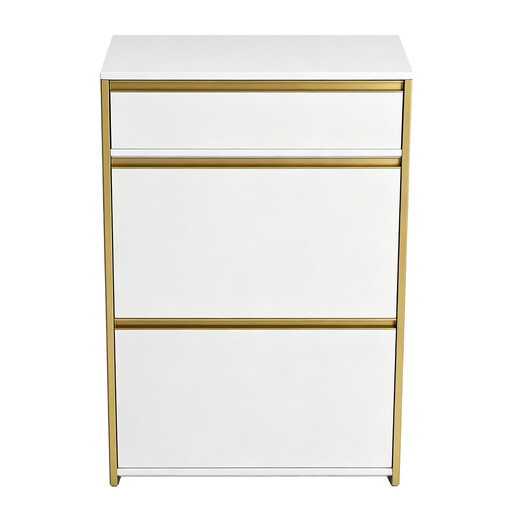
Why it suits this profile: This piece combines closed shoe storage with a drawer and a top surface. The adjustable, removable shelves let you tailor the layout to different shoes and smaller items.
The internal layout isn’t fixed: you can adjust the shelves. The product specifications also mention an anti-tip fitting for securing it to the wall.
Measures 60 x 24 x 104.5 cm, with adjustable shelves, two doors, a drawer and space for up to 12 pairs according to the product information.
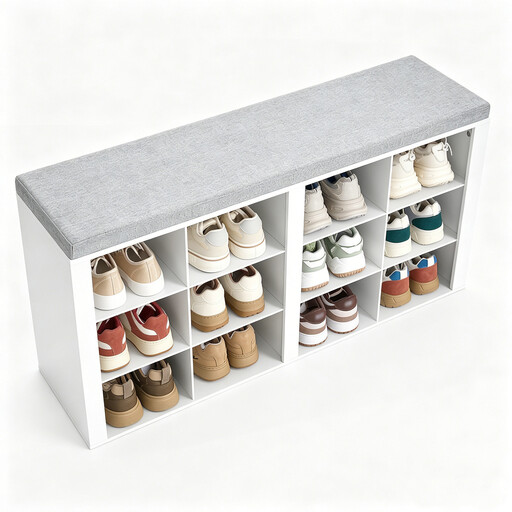
Why it suits this profile: This shoe bench is designed for households that want to put on and store their shoes in the same place. The adjustable compartments and removable cushion covers are practical for everyday use.
The seat is built into the design, so you don’t have to use an ordinary rack as a bench. The product information states a load capacity of 150 kg.
12 compartments, adjustable shelves, removable cushion covers and dimensions of 30.5 x 104.5 x 49.5 cm.
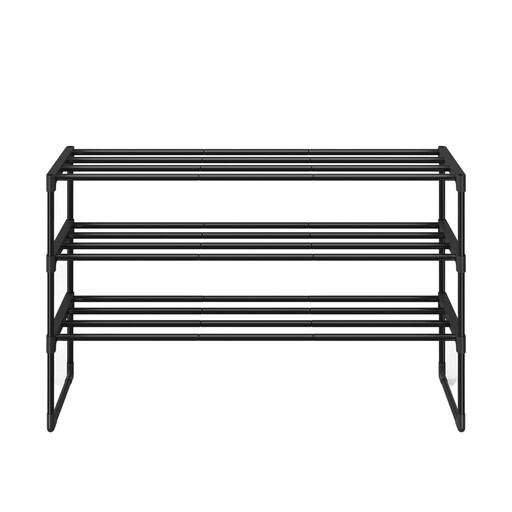
Why it suits this profile: Measuring 30 x 92 x 55 cm, it’s suited to a hallway, wardrobe or living room where floor space is limited. According to the product description, you can position this model upright, upside down or stacked.
The product specifications state a total static load capacity of 30 kg and 10 kg per level. This makes it easier to match the load to your shoe collection.
Metal tubes, three levels, tool-free assembly according to the product description and a compact design.
We’ve put together a complete, up-to-date list of products that meet these strict selection criteria and current European safety regulations.
It depends on the model and how many shoes you have. Measure the available width, depth and height, then allow a few extra centimetres for skirting boards, doors and placing your shoes on the rack. In a narrow hallway, depth is especially important.
Not necessarily. An open rack keeps shoes within easy reach and allows air to circulate, while a shoe cabinet keeps them out of sight. Choose an open metal shoe rack for everyday use and easy organisation; choose a closed cabinet if the appearance of your hallway or living room is more important.
Place the rack on a level surface, distribute heavier shoes evenly and follow the assembly instructions. Check whether wall mounting is recommended or included. Never use a shoe rack as a ladder or seat unless it’s designed for that purpose.
