
Vandaag of morgen in huis

Kwaliteit gegarandeerd

Welkomstaanbiedingen ontgrendelen: GRATIS bezorging | Tot 80% korting | Gratis 30 dagen JoyPlus-proefperiode
Download de app
A shoe rack seems like a straightforward purchase – until the unit turns out too shallow for boots, wobbles with daily use, or holds fewer pairs than the product title suggests. For a household with several people, a small shoe organiser can quickly become a cluttered mess.
Pay particular attention to these three common pitfalls:
Only looking at the number of pairs
A stated capacity often applies to low shoes neatly lined up side by side. Trainers, children’s shoes and ankle boots take up more room. So also check the width, depth and free height per shelf.
Buying a narrow shoe rack without checking its stability
A tall model takes up little floor space but can be more prone to tipping over. A shoe rack for the hallway needs to stand firmly, and if it’s a slim or tall design, it should ideally be fixed to the wall if the manufacturer advises this.
Confusing material with load capacity
A metal shoe rack doesn’t automatically have unlimited weight-bearing ability. Look at the stated maximum load per shelf and for the whole unit. With a shoe cabinet or shoe bench with storage, the quality of the panels, hinges and fixings also matters.
Don’t just measure the width of the spot – also measure the depth and height. Allow for skirting boards, an outward-opening front door and enough walking space. A shoe rack for a narrow hallway is often practical when the depth stays around 30 cm, but check that larger shoes don’t overhang.
A tall console cabinet can offer extra storage without taking up much floor area. With a model measuring 63 × 30 × 90 cm, it’s important that the unit sits flush against the wall and that the supplied anti-tip device is used according to the instructions.
A shoe rack for 12 to 20 pairs of shoes might be suitable for a flat, family or wardrobe, but the actual layout depends on the type of footwear. Look out for:
With a stackable shoe rack, you also need to check whether the parts are designed to be safely placed on top of each other. “Stackable” doesn’t automatically mean every configuration is stable.
A metal shoe rack often consists of tubes with plastic connectors. This can be a lightweight and flexible solution, but check the maximum static load. For one of the models below, the product description states 10 kg per shelf and 30 kg in total. Place heavy shoes at the bottom where possible.
A shoe cabinet with a seat or a shoe rack with a bench requires extra attention to the seat and the construction. According to the product description of the HaluPeit model, the stated load capacity is 150 kg. This is a specification from the product supplier; always follow the assembly and usage instructions and check that all fixings are properly tightened.
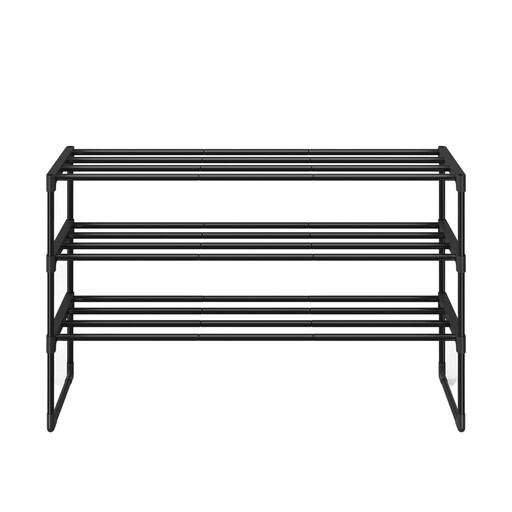
Why this fits the profile: This metal shoe rack is ideal for anyone looking for a straightforward, tidy basic solution for the hallway, cupboard or living room. The dimensions are 30 × 92 × 55 cm and the product description states space for up to 18 pairs of shoes.
The product information lists both the dimensions and the maximum load of 10 kg per shelf and 30 kg total. This helps you assess the available space and loading in advance.
Metal tubes, plastic connectors, three tiers and tool-free assembly according to the product description.
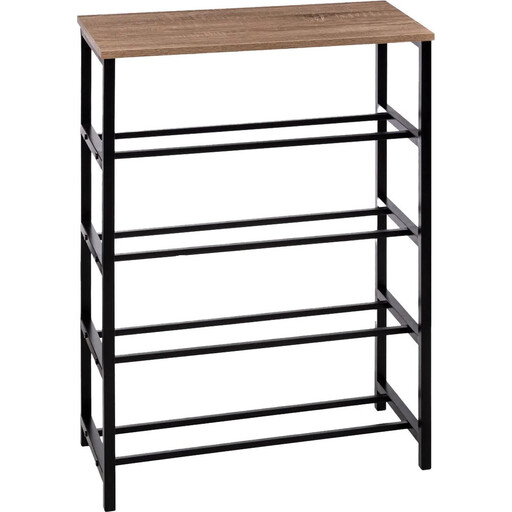
Why this fits the profile: This model combines open shoe storage with a tabletop. At 63 × 30 × 90 cm, it fits in a narrow hallway where you also want to place keys or small accessories.
The capacity of 12 pairs, the dimensions and the materials are stated in the product details. The tall, slim design must be anchored to the wall according to the instructions.
Steel structure, chipboard shelves, tabletop and FSC mention in the product information.
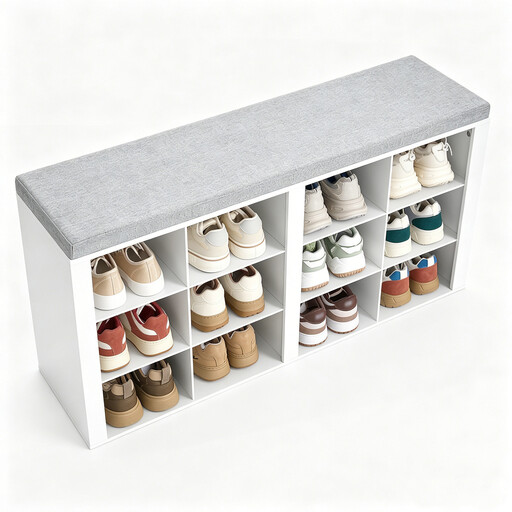
Why this fits the profile: A family can benefit from the combination of seating and closed storage. The adjustable shelves are suitable for different types of shoes, according to the product description.
The adjustable layout prevents all compartments from having the same height. Before buying, do check whether the dimensions of 30.5 × 104.5 × 49.5 cm fit in your hallway.
Seat with removable upholstery, 12 compartments and adjustable shelves according to the product details.
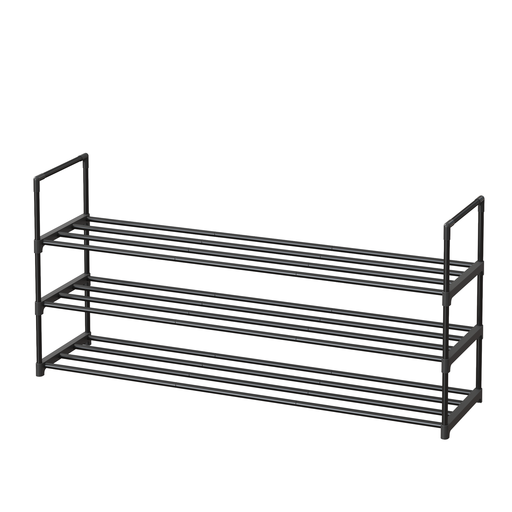
Why this fits the profile: This model is designed for those who want to adapt the layout. The product description mentions a reversible and stackable configuration, with dimensions of 30 × 117 × 55 cm.
The stated load of 10 kg per shelf and 30 kg total makes it easier to avoid concentrating heavy shoes in one spot. When stacking, always check the supplied instructions.
Metal tubes, plastic connectors, tool-free assembly according to the product description and an adaptable configuration.
We’ve put together a full, up-to-date list of products that fully meet these strict selection criteria and comply with current European safety regulations.
Measure the entire spot and add a few centimetres of margin for skirting boards and doors. A narrow shoe rack around 30 cm deep can be suitable for a hallway, but check that shoes don’t overhang and that the walking route stays clear.
That depends on the stated load capacity. Compare the weight of your shoes with the maximum load per shelf and for the whole rack. Place heavy walking boots or boots at the bottom where possible and distribute the weight evenly.
An open shoe rack offers quick access and makes ventilation easier. A shoe cabinet keeps shoes more out of sight and gives the hallway a calmer look. Choose a shoe cabinet with a seat when you want a fixed spot to put your shoes on; choose an open rack when quick access and a flexible layout are more important.
