
Vandaag of morgen in huis

Kwaliteit gegarandeerd

Welkomstaanbiedingen ontgrendelen: GRATIS bezorging | Tot 80% korting | Gratis 30 dagen JoyPlus-proefperiode
Download de app
A shoe rack may seem like a simple purchase, but you’ll soon notice if you choose the wrong one. It might be too deep for your hallway, the shelves may be too low for ankle boots, or the stated capacity may only apply to low-top trainers. Some models are also described as stable without clear information about their load capacity, wall fixing or assembly.
So look out for these three common pitfalls:
Measure not only the width, but also the depth and height. Take skirting boards, doors and walking space into account. For a hallway shoe rack, a shallow depth is often more important than having lots of tiers.
For example, a model measuring 60 cm wide and around 23 cm deep could fit in a narrow hallway, while a shoe bench with storage will usually need more depth. Also check that cabinet doors or flaps can open fully.
First, work out how many pairs of shoes you need to keep close at hand each day. A shoe rack for 6 or 8 pairs may be enough for a small household. Families are more likely to need a shoe rack for 12, 18 or 24 pairs.
Think about the types of shoes you own:
A metal shoe rack often has an open design and is easy to wipe clean. A wooden shoe cabinet or a model made from chipboard looks more like a piece of furniture and keeps shoes out of sight. Plastic or polypropylene can be practical in a utility room or anywhere that’s easy to clean.
Always check:
A tall shoe cabinet should stand on a level surface. For models with doors, drawers or extra height, it’s sensible to secure the unit to the wall if the product information recommends it. Put heavier shoes on the lower shelves where possible, and never use a shoe rack as a step or seat unless it’s specifically designed as a shoe bench.

Why it suits this buyer: This compact model is ideal for a small entrance, bedroom or wardrobe where you mainly need to store the shoes you wear every day.
The dimensions are clearly stated: 50 x 18.5 x 64 cm. You can check in advance whether the rack will fit in a narrow space.
Space for 8 pairs of shoes, steel shelves and a freestanding design for indoor use.

Why it suits this buyer: Families or households with a larger shoe collection can opt for a closed shoe cabinet with a furniture-like look.
The product description states a capacity of around 22 to 25 pairs, with doors and an open bottom shelf. For larger shoes, check how much space is available for each pair.
Five storage tiers, doors to keep out dust and a top surface for decorations or small items.
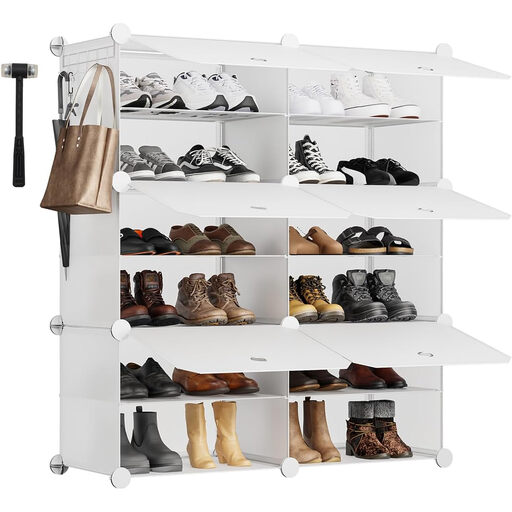
Why it suits this buyer: This model is designed for families and households looking to organise lots of shoes in a hallway, walk-in wardrobe or utility room.
The unit is made from PP panels with metal connectors and several anti-tip features. The manufacturer also states a load capacity of 5 kg per shelf.
Space for up to 24 pairs according to the product information, moisture-resistant PP panels and ventilation through the open compartments.
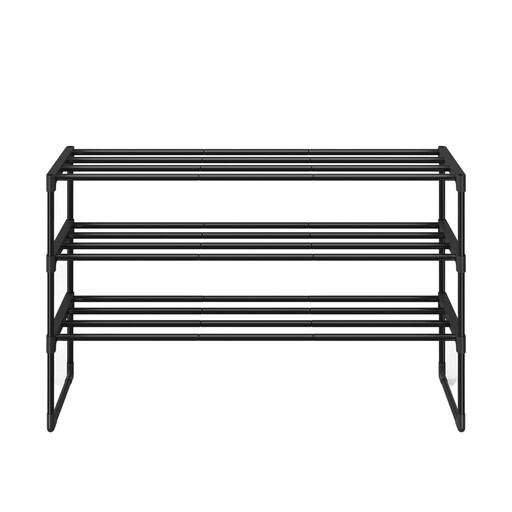
Why it suits this buyer: This narrow design is intended for a hallway, wardrobe or living room where you may want to change the layout regularly.
The product information gives a width of 92 cm and a depth of 30 cm, and says the rack can be stacked or reconfigured. Check your preferred layout and the unit’s stability before assembly.
Metal tubes, plastic connectors, tool-free assembly and a stated load capacity of 10 kg per tier.
We’ve put together a complete, up-to-date list of products that meet these strict selection criteria and the applicable European safety regulations.
Place the rack on a level surface, tighten all the fixings securely and distribute heavier shoes across the lower shelves. For a tall shoe cabinet or narrow model, wall fixing is advisable if required by the instructions or product information.
Measure the available width, depth and height. Allow extra room for doors or flaps to open. A narrow shoe rack for small spaces isn’t automatically suitable if there isn’t enough room to walk past it.
An open rack keeps shoes within easy reach and is simple to clean. A shoe cabinet with doors keeps shoes more out of sight and often offers extra storage. Choose according to ventilation, ease of use, capacity and the space available in your home.
