
Vandaag of morgen in huis

Kwaliteit gegarandeerd

Welkomstaanbiedingen ontgrendelen: GRATIS bezorging | Tot 80% korting | Gratis 30 dagen JoyPlus-proefperiode
Download de app
A shoe rack seems like a simple purchase – until the model wobbles, doesn’t fit in the hallway, or offers too little room for boots. In British homes, particularly those with a narrow entrance, limited cupboard space or a shared cloakroom, the wrong dimensions can quickly become a source of frustration.
When comparing a shoe storage unit, don’t just look at the number of pairs mentioned in the title. Also check the actual dimensions, weight capacity, ventilation and assembly method. That way, you’ll avoid buying a rack that proves impractical after just a few weeks.
A shoe rack for the hallway needs to be not only wide enough for your shoes, but also fit between the door, wall and coat stand. So check the width, depth and height of the unit, and remember to account for skirting boards and protruding door handles.
A multi-tier model may claim to hold lots of shoes on paper, but it could take up more floor space than you expect. For a small entrance, a narrow shoe rack or a vertical shoe organiser is often more practical.
“Holds up to 18 pairs” doesn’t automatically mean all types of shoes will fit comfortably. Trainers and low shoes need less height than ankle boots or high-top shoes. So look at the gap between the tiers and check whether the stated capacity matches your own collection.
When storing shoes in a wardrobe, the available shelf height and ventilation also come into play. Stacking shoes on top of each other without air circulation can be awkward, especially if they’re not completely dry after use.
A lightweight metal shoe rack is easy to move, but it must stand on a level surface. Check the maximum static load per tier and the total weight capacity. Don’t use a shoe rack as a step or seat unless the product is explicitly designed for that purpose.
With a shoe cabinet that includes a bench, the weight limit of the seating area is also important. Always follow the assembly instructions and use the furniture only as intended.
First, measure the space where the shoe storage unit will go. For a hallway, limited depth and enough clearance are often more important than an extra-wide design. A vertical model can save space, while a low shoe rack fits under a coat rack or clothes rail.
Also consider the layout:
A metal shoe rack is often made from metal tubes with plastic connectors. This combination is lightweight and suitable for flexible use. However, check that the rack stays stable when one tier is more heavily loaded.
With plastic shoe boxes, a sturdy front, good closure and ventilation holes are practical points to look for. According to the product description of the set mentioned, the boxes are suitable for shoes up to size 44 and have ventilation openings. Always check that the internal dimensions match your own shoes.
Tool-free assembly can be handy for students, tenants and households that want to move the rack regularly. However, “easy to assemble” still depends on the construction and how clear the instructions are. After assembly, check that all connections are fully tightened.
For safe use, follow these practical rules:
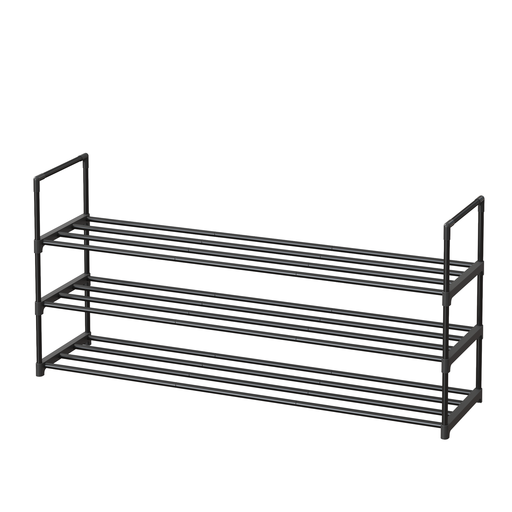
Why it fits this profile: This metal shoe rack works well as a first shoe storage unit for a hallway, wardrobe or living room. It measures 30 x 117 x 55 cm and, according to the product description, can be placed upright, upside down or stacked.
The dimensions and weight capacity are clearly stated: a maximum of 10 kg per tier and 30 kg total, according to the product information. This makes comparing much easier than relying on a capacity claim alone.
Metal tubes, three tiers, tool-free assembly and a stackable design, according to the product description.
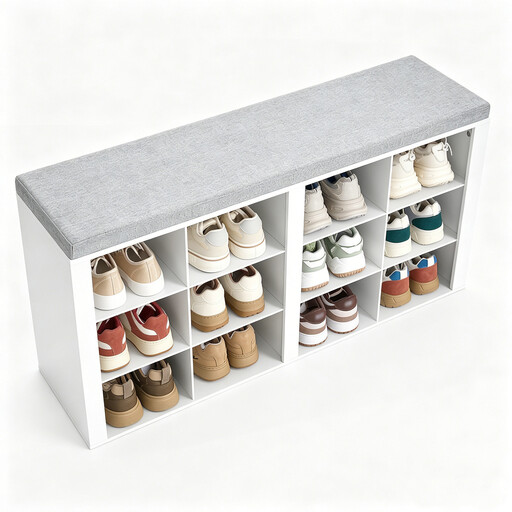
Why it fits this profile: This shoe cabinet with bench combines shoe storage with a seating area in the hallway. It measures 30.5 x 104.5 x 49.5 cm and has 12 compartments with adjustable shelves.
The adjustable shelves help you accommodate different heights, such as trainers and ankle boots, more effectively. The seating function is clearly part of the design, not just an extra storage space.
12 compartments, adjustable shelves, removable seat cushions and a stated weight capacity of 150 kg, according to the product description.

Why it fits this profile: This hanging model is designed for those who want to keep floor space clear. It measures 7 x 48 x 170.7 cm and uses the vertical space on a door or inside a wardrobe.
The shallow depth means you don’t need a large piece of furniture on the floor. Just check beforehand that the door can close freely and that the construction can support the weight of your shoes.
24 pockets, a metal frame, mesh panels and a foldable design, according to the product description.
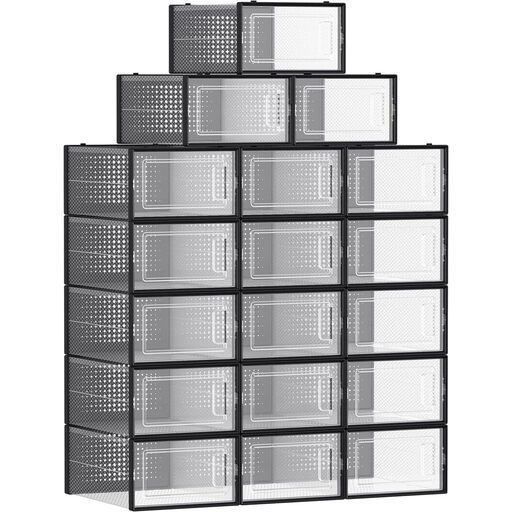
Why it fits this profile: These storage boxes are handy for a wardrobe, cupboard or wide wall shelf where multiple pairs can be kept neatly together. The internal dimensions are 31.2 x 22.5 x 13.5 cm.
The transparent front makes finding your shoes easier than with closed boxes. Check the shoe size and height beforehand, as the product information states suitability up to size 44.
18 stackable and foldable plastic boxes, front doors and ventilation openings, according to the product description.
We’ve put together a full, up-to-date list of products that fully meet these strict selection criteria and comply with current European safety regulations.
That depends on the width of the tiers, the shoe sizes and the type of shoes. Low trainers take up less space than boots. So look at the internal space and tier height rather than just the stated maximum number of pairs.
A narrow shoe rack with limited depth or a hanging shoe organiser uses very little floor space. Measure the clearance carefully. A vertical model can be practical, as long as it’s stable and the height isn’t an issue.
First, remove dust and sand with a soft brush or vacuum cleaner. Metal and plastic parts can usually be wiped down with a slightly damp cloth. Clean mesh carefully and let it dry completely. With shoe storage boxes, it’s important to keep the ventilation openings clear.
