
Vandaag of morgen in huis

Kwaliteit gegarandeerd

Welkomstaanbiedingen ontgrendelen: GRATIS bezorging | Tot 80% korting | Gratis 30 dagen JoyPlus-proefperiode
Download de app
A shoe rack seems like a simple purchase, until the model does not fit in the hallway, turns out to be unstable or holds fewer shoes than expected. Especially when ordering online, the dimensions, load capacity and assembly requirements are not always immediately clear. A tall cabinet can store plenty of shoes, but may be awkward in a narrow hallway. A cheap shoe rack may seem practical, but offer too little space for boots or high-top trainers.
So watch out for these three common pitfalls:
Measure the available space at three points. Also check skirting boards, doors and sockets. For a shoe rack in a hallway or wardrobe, depth is particularly important. A slim shoe rack measuring around 25 to 30 cm deep may be suitable for a hallway, while a wider model offers more room for larger shoe sizes.
Also consider the height. A tall rack makes good use of vertical space, but must stand securely and must not block a passageway. Always check the product dimensions in centimetres and compare them with the actual space available in your home.
A metal shoe rack is often practical for everyday use and can have a light, open appearance. Check the joints, the number of tiers and the stated load capacity per shelf. Metal with plastic connectors is lightweight and easy to assemble, but should be placed on a level surface.
A wooden shoe rack or bamboo model works well in a warm interior. Pay attention to the total maximum weight and the care instructions. An open wooden rack is particularly suitable when shoes are stored dry and relatively clean.
A shoe cabinet made from MDF, engineered wood or fitted with doors keeps shoes more out of sight. However, ventilation and the available internal space become more important. So do not just look at the exterior; also check the usable shelf height.
For a household with a few pairs of everyday shoes, a rack for 12 pairs may be sufficient. Families often benefit more from a shoe rack for 12 to 30 pairs of shoes. The actual capacity depends on the shoe size and type of footwear.
Pay attention to:
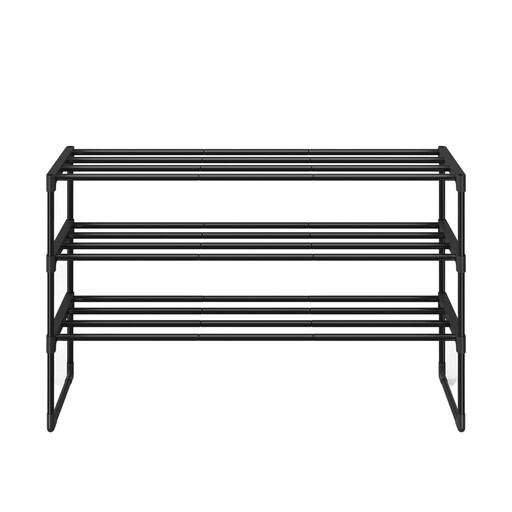
Why it suits this profile: With a width of 92 cm and a depth of 30 cm, this model is suitable for a hallway, wardrobe or living room where floor space is limited. The construction is designed to hold 16 to 20 pairs of shoes, depending on shoe size and arrangement.
The product information lists the external dimensions and a maximum static load of 10 kg per tier and 30 kg in total. This makes it easier to assess the available space and load capacity in advance.
Metal tubes, plastic connectors, tool-free assembly and a design that can be positioned upright, upside down or stacked.
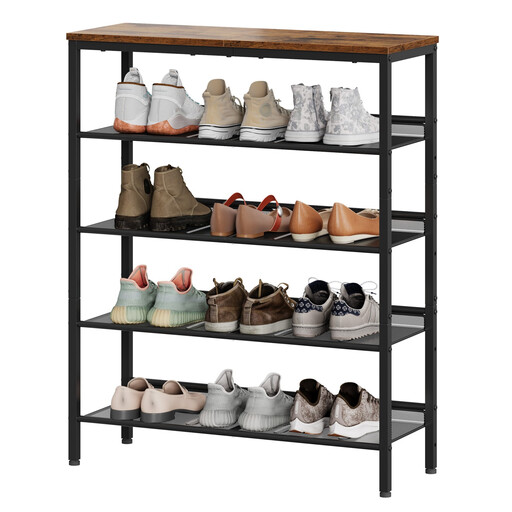
Why it suits this profile: This model combines five tiers with a spacious top shelf. Measuring 75 cm wide, 28 cm deep and 93 cm high, it provides extra storage for shoes and accessories in the hallway.
The adjustable mesh shelves can be positioned flat or at an angle. The included anti-tip kit is particularly useful when the rack is placed in a busy hallway or next to a wall.
The top shelf has a stated static load capacity of 27 kg; each mesh shelf supports 11 kg. The frame is made from steel and engineered wood.

Why it suits this profile: With space for up to 30 pairs of shoes, this freestanding rack is designed for larger households or a wardrobe with lots of footwear. It measures 65.5 x 24.5 x 138 cm.
The capacity and complete external dimensions are clearly stated. Place the rack on a level surface and consider wall mounting if there is a risk of it tipping over.
White metal construction, generous vertical capacity and an open layout that keeps shoes visible and easy to access.
For students, guest rooms or a bedroom wardrobe, a compact shoe organiser may be more convenient than a freestanding rack. The 5five Plastic Shoe Rack Spacy measures 29.5 x 11.1 x 14 cm and is designed to fit under a bed, at the bottom of a wardrobe or against a wall. The stated maximum load is three pairs of shoes per unit. View the shoe organiser product information before combining several units.
A bamboo version may be a better match for a natural interior. The 5five Bamboo Shoe Rack Sicela has three tiers, measures 70.5 x 28.5 x 52.5 cm and is foldable. The product information states a maximum total load of 15 kg. Check that the rack is fully locked in place and position it on a stable, level surface. View the bamboo shoe rack details.
We have compiled a complete, up-to-date list of products that fully meet these strict selection criteria and the applicable European safety regulations.
Measure the available width, depth and height, and leave extra space for doors and walkways. In a narrow hallway, also take the skirting board into account. The stated product dimensions are the external dimensions; the usable space on each shelf may be smaller.
Place the rack on a level surface, distribute heavy shoes across the tiers and tighten the connections securely. For tall models or locations with lots of movement, wall mounting is advisable if the manufacturer recommends an anti-tip kit or fixings.
Its lifespan depends on the material, load, moisture and assembly. Do not leave a metal rack in standing moisture for extended periods, clean bamboo and engineered wood with a slightly damp cloth, and check the connections regularly. Never exceed the stated load capacity.
