
Vandaag of morgen in huis

Kwaliteit gegarandeerd

Welkomstaanbiedingen ontgrendelen: GRATIS bezorging | Tot 80% korting | Gratis 30 dagen JoyPlus-proefperiode
Download de app
A shoe rack may seem like a simple piece of furniture, but the wrong size, an unstable build or an awkward layout can soon become frustrating. A rack that looks spacious in the product photo may be too deep for a typical Dutch hallway. And a shoe cabinet with lots of compartments is of little use if your taller shoes or boots won’t fit.
Before you buy, look out for these three common pitfalls:
Measure the spot where you plan to put your shoe storage in three directions: width, depth and height. If you’re choosing a shoe rack for the hallway, also allow for skirting boards, doors and walkway space. A slim shoe rack around 18 to 25 cm deep will often fit more easily beside a front door than a closed shoe cabinet.
A taller model can offer more capacity in a wardrobe, walk-in wardrobe or bedroom. Check that the doors or drop-down fronts can open freely. A model measuring 60 cm wide, 23,3 cm deep and 119,5 cm high, such as the 5five organiser, takes up little floor space but needs enough height.
Capacity figures are usually estimates. A shoe rack advertised as holding 18 pairs may fit fewer in practice if you’re storing wide trainers or taller shoes. So check:
An open metal shoe rack keeps shoes within easy reach and allows air to circulate between pairs. A cabinet with doors keeps shoes out of sight and helps protect them from dust, but may be less flexible.
A metal shoe rack with tubes and plastic connectors is generally easy to move. Check the stated load capacity for each shelf and for the rack as a whole. The JOYFURNOS model has a stated static load capacity of 10 kg per tier and 30 kg in total. This is verifiable product information; it doesn’t mean that every type of shoe or storage box will necessarily be suitable.
A bench made from engineered wood is heavier and can also be used as a seat. Check the stated seat capacity, the quality of the cushion and the assembly requirements. For tall shoe storage with plastic panels, an anti-tip device is important. Follow the assembly instructions and, according to the product information, secure a tall model to the wall.
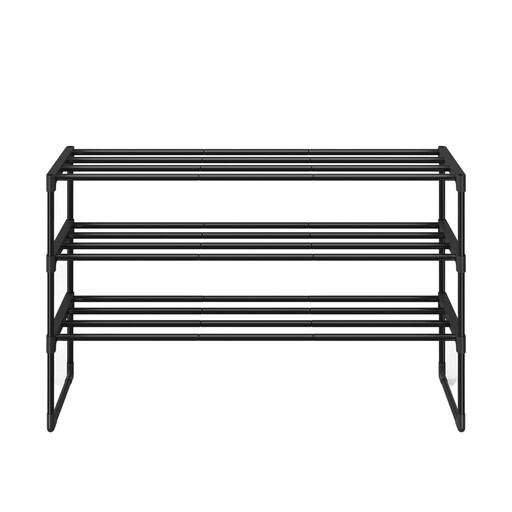
Why it suits this type of buyer: This open rack is ideal if you want to keep shoes neatly organised in the hallway, wardrobe or living room without spending a lot. The stated dimensions are 30 x 92 x 55 cm.
The open design makes the shelf space easy to see, so you can check whether larger shoes will fit and avoid an impractical layout.
Metal tubes, three tiers, tool-free assembly according to the product description and a stated total load capacity of 30 kg.

Why it suits this type of buyer: This closed cabinet is ideal for households that want to keep shoes out of sight in the hallway, bedroom or living room. According to the product description, it has five tiers and holds around 22 to 25 pairs.
The doors keep loose shoes out of sight and help keep dust away. Before you buy, check that the internal dimensions will fit your largest pair.
Wooden construction according to the product information, five storage tiers, doors and an open bottom shelf.
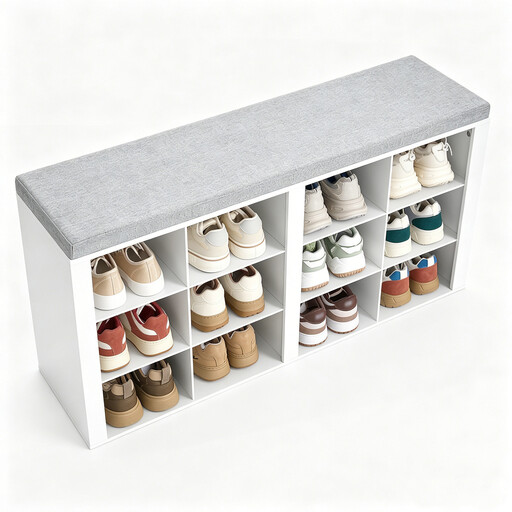
Why it suits this type of buyer: This shoe bench combines seating and storage, making it practical for families and for hallways where shoes are put on and taken off every day.
The adjustable shelves make room for different types of shoes. After assembly, check that the bench is level and follow the stated maximum load capacity.
Dimensions of 30,5 x 104,5 x 49,5 cm, twelve compartments according to the product description and a stated load capacity of 150 kg.
Choose a shoe rack for a wardrobe if you mainly want quick access and have limited floor depth. A shoe bench takes up more room but gives you a dedicated place to sit. For a large family, shoe storage with room for 24 pairs may be more practical than several smaller racks. The PP model with six compartments is listed as holding 24 pairs, with a load capacity of 5 kg per shelf and anti-tip devices. Wall fixing is important for a tall model.
We’ve put together a complete, up-to-date list of products that meet these strict selection criteria and the applicable European safety regulations.
It depends on the shelf width, shoe size and shape. A rack listed as holding 16 to 20 pairs may fit fewer if you’re storing wide trainers or boots. Treat the capacity as a guide and compare it with your own collection.
Place the cabinet on a level surface, spread heavier shoes across the lower compartments and use the supplied anti-tip device if there is one. Follow the product instructions to secure a tall shoe cabinet to the wall. Never climb on the furniture.
Its lifespan depends on the material, assembly, load and exposure to moisture. A metal rack will generally stay stable for longer if you don’t exceed its stated capacity. Wooden or plastic models should be used indoors and cleaned with a lightly damp cloth. After assembly, check regularly that the joints are still secure.
