
Vandaag of morgen in huis

Kwaliteit gegarandeerd

Welkomstaanbiedingen ontgrendelen: GRATIS bezorging | Tot 80% korting | Gratis 30 dagen JoyPlus-proefperiode
Download de app
A shoe rack might seem like a simple purchase, but the wrong model can quickly become a source of frustration. A rack that’s advertised as holding plenty of pairs may turn out to be too narrow for trainers or too short for boots. A tall shoe cabinet can also become unstable if it isn’t positioned or secured to the wall correctly.
As Joybuy Product Recommendation Officer, I review the key specifications of different models. This makes it easier for you to find a shoe rack that suits your home, household and storage needs.
A label such as “holds 20 pairs of shoes” doesn’t always tell you everything. The actual capacity depends on the type of footwear. Low-profile trainers take up less room than wide sports shoes, ankle boots or high heels. So check:
A shoe rack for 30 pairs, for example, may take up a lot of vertical space. That’s useful for a large household, but less suitable under a coat rack or inside a low cupboard.
A narrow shoe rack can work well in a compact hallway, but even a few centimetres can make the difference between walking past freely and bumping into shoes that stick out. Measure not only the available width, but also the maximum depth and height.
For a shoe rack in a small space, check for skirting boards, doors and plug sockets too. A model that’s 24 cm deep might fit in a straight alcove, but still stop a door from opening fully.
A metal shoe rack isn’t automatically more stable than a cabinet made from board. Stability also depends on the height, feet, joints and floor surface. For tall models, it’s worth checking whether wall fixing is recommended.
For a shoe cabinet or tall shoe storage unit, also look for:
Start by measuring the space where you’ll put the shoe rack. Note the maximum width, depth and height, and leave a little room for assembly and ventilation.
A shoe rack for 20 pairs is generally suitable for a household with an average-sized shoe collection. Larger families may find a shoe rack for 30 pairs or a model for 24 pairs more practical. Don’t just look at the number of tiers: check the usable width of each shelf too.
A stackable shoe rack gives you extra flexibility. According to the product description, the 92 cm-wide, 55 cm-high JOYFURNOS model can be arranged upright, upside down or stacked. If you stack a rack, always check that it’s designed for this and put heavier shoes on the bottom.
A metal shoe rack with plastic connectors is often lightweight and easy to clean. Check that the tubes are joined securely and the feet sit firmly on the floor. Metal is practical in a hallway, but it’s best to let wet shoes dry before storing them for long periods.
Board materials such as particleboard often give a cabinet a more enclosed look. They keep shoes out of sight, but need more care around moisture. Wipe wet surfaces dry straight away and avoid overloading the shelves.
An open shoe rack offers better ventilation and is easy to use every day. A closed shoe cabinet gives the hallway a tidier look, but often takes longer to assemble.
Always check the difference between the maximum load per shelf and the total load capacity. For example, the JOYFURNOS rack lists a static load of 10 kg per tier and 30 kg in total. This is a clear product specification, but it doesn’t mean you should sit or climb on the rack.
For tall cabinets, wall fixing is important if the instructions recommend it. Place a tall shoe storage unit on a level surface and check that all the joints are secure after assembly.
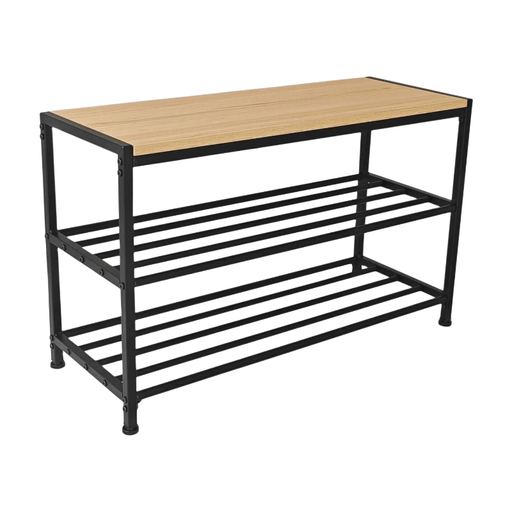
Why it suits this profile: This compact model holds around six pairs of shoes and fits in a hallway, bedroom or corridor where space is limited.
The capacity is clearly stated, and the dimensions of 80 x 30 x 49,5 cm make it easier to measure your space in advance.
Powder-coated metal frame, wooden top shelf and an open design that allows air to circulate.
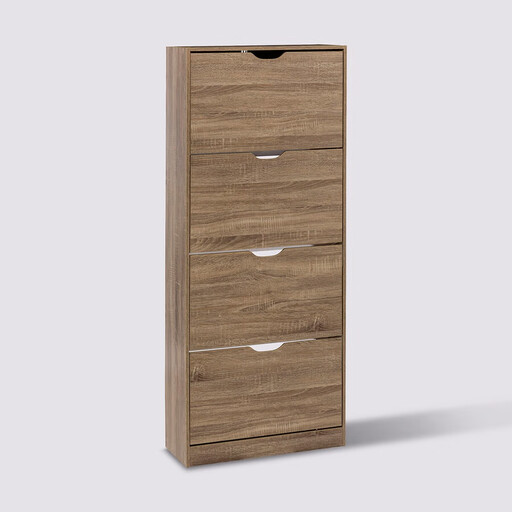
Why it suits this profile: The tall, enclosed design is ideal if you want to keep shoes out of sight and have a dedicated storage space in your hallway or wardrobe.
The dimensions and eight shelves are specified in advance. Place the cabinet on a level surface and avoid overloading the particleboard.
FSC-labelled material, eight shelves and a height of 155.4 cm for vertical storage.
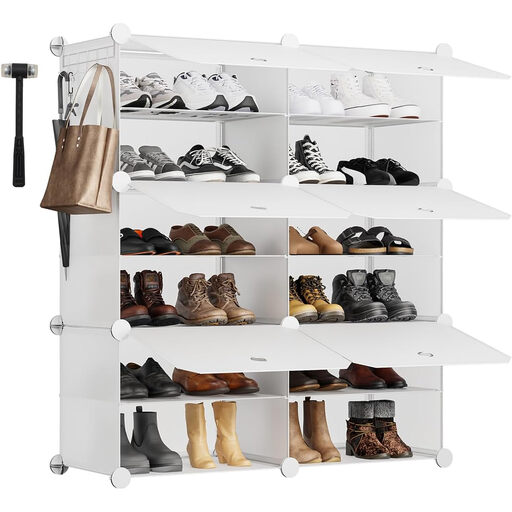
Why it suits this profile: This model is designed for families with a larger shoe collection and, according to the product information, holds 24 pairs of shoes.
The six compartments, ventilation and stated load of 5 kg per shelf give you more to go on than a general capacity claim alone.
The PP panels are moisture-resistant according to the product description; take care with the anti-tip features and wall fixing during assembly.
We’ve put together a complete, up-to-date list of products that meet these strict selection criteria and current European safety regulations.
It depends on the width, depth and layout. Compact models often hold around six to eight pairs. Larger racks and cabinets may, according to their product specifications, hold 18, 20, 24 or 30 pairs. Allow extra room for wide shoes and boots.
Place the rack on a level surface, spread heavier shoes across the lower tiers and tighten all the joints securely. It’s best to fix a tall shoe cabinet to the wall if the manufacturer recommends it. Check the assembly again after a few weeks.
An open shoe rack is easy to use every day and lets air circulate around your shoes. A closed shoe cabinet keeps shoes out of sight and gives the hallway a tidier look. Choose open storage for easy access and good ventilation; choose a cabinet if appearance and keeping shoes hidden matter more.
