
Vandaag of morgen in huis

Kwaliteit gegarandeerd

Welkomstaanbiedingen ontgrendelen: GRATIS bezorging | Tot 80% korting | Gratis 30 dagen JoyPlus-proefperiode
Download de app
A shoe rack may seem like a simple piece of furniture, until you bring home a model that does not fit in the hallway, wobbles during everyday use or holds fewer shoes than expected. An open rack can also quickly look untidy, while a flip-door shoe cabinet is not always suitable for high-top shoes or boots.
When buying a shoe rack, it is therefore best not to focus solely on colour and price. The key differences lie in the dimensions, layout, load capacity, ventilation and assembly method. Below, you will find out which pitfalls are often overlooked and which models suit different households.
A retailer may estimate the number of pairs generously. Trainers, wide women's shoes and boots take up more space than low-cut men's shoes. So check whether the shelves are adjustable and whether the internal dimensions are suitable for your shoe size.
A shoe rack for 6 to 30 pairs may hold fewer in practice if you mainly have high-top or wide styles. Treat the capacity as a guideline, rather than a guarantee for every shoe collection.
A narrow shoe rack for the hallway saves floor space, but a tall, shallow model is more prone to tipping over. Check whether the product has an anti-tip device and whether attaching it to the wall is possible or recommended. Always place the rack on a level surface and follow the assembly instructions.
A flip-door shoe cabinet keeps shoes out of sight, but restricts air circulation. Do not place heavily worn shoes straight into a closed cabinet while they are damp. An open metal shoe rack generally provides better ventilation. With a closed model, it is sensible to let shoes air first.
Do not just measure the width of the space, but also its depth and height. Take skirting boards, doors and walking space into account. For a narrow hallway, a cabinet approximately 24 cm deep may be more practical than a wide shoe rack that is 30 to 34 cm deep.
Also consider the position of the shoes. A tall model makes use of wall space, while a low shoe bench can also provide somewhere to sit. Check whether the stated dimensions include protruding handles or feet.
An FSC statement can provide information about the origin of the wood or bamboo. Also check the statutory guarantee and the assembly and safety information.
Adjustable shelves are useful when a household owns different types of shoes. They provide space for trainers, ankle boots and taller styles. With a shoe rack with a bench, check the maximum load of the seat separately from that of the shelves.
Pay attention to the difference between static load capacity and everyday use. A maximum load only applies when the weight is distributed evenly and the components have been assembled correctly. Do not use a rack as a step stool and do not exceed the stated limit.
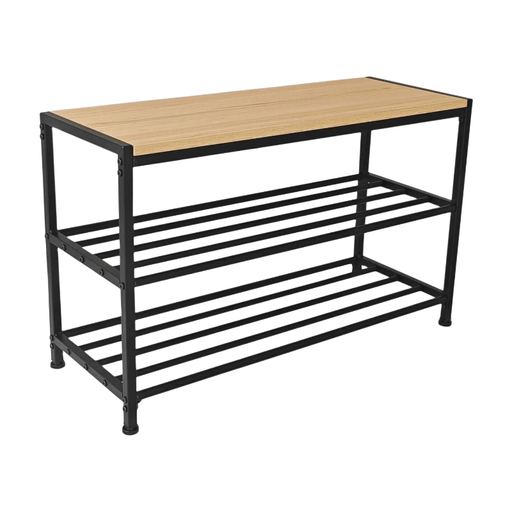
Why it suits this profile: This compact rack is designed for households with a small shoe collection and limited space. The wooden top shelf provides extra room for a bag, keys or decorations.
The capacity is clearly stated as 6 pairs and the dimensions are 80 x 30 x 49,2 cm. This allows you to check in advance whether it will fit in your hallway.
Powder-coated metal frame, wooden top shelf and open construction for air circulation. According to the product description, assembly is straightforward.
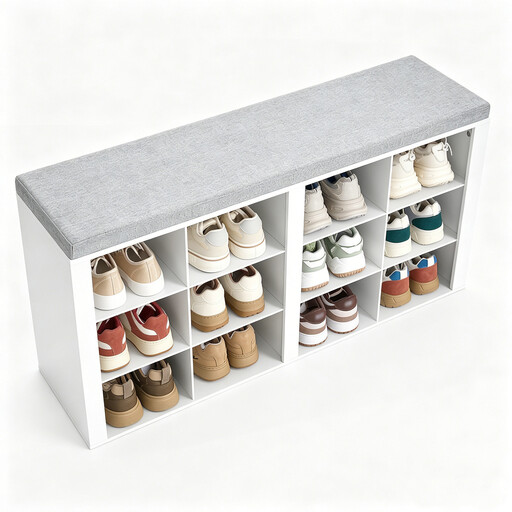
Why it suits this profile: This shoe bench combines enclosed shoe storage with a seat. That is practical for families who want to put on their shoes in the hallway without adding a separate bench.
The shelves are height-adjustable, allowing you to adapt the layout for trainers, boots or heeled shoes. The dimensions are 104,5 x 30,5 x 49,5 cm.
12 storage compartments, removable cushion covers and a stated load capacity of 150 kg. The product description mentions an illustrated assembly guide.

Why it suits this profile: This shoe bench is suitable for anyone who wants to combine seating and shoe storage in a natural interior. The manufacturer states that it has room for slippers, clogs and shoes for both children and adults.
The maximum load of the bench is stated as 110 kg. This gives you a clear reference point rather than just a general claim about sturdiness.
Bamboo frame and shelves, dimensions of 90 x 34 x 45 cm and an assembly guide included. The product information states that it has FSC certification.
We have compiled a complete, up-to-date list of products that fully meet these strict selection criteria and the applicable European safety regulations.
An open rack is useful when shoes are worn every day and need to be well ventilated. The downside is that every pair remains visible. A closed shoe cabinet creates a tidier look in the living room or hallway, but requires more attention to the internal dimensions and air circulation.
A flip-door shoe cabinet is particularly useful if you want to store lots of pairs out of sight. Check whether the doors open far enough and whether tall shoes will touch the top. A model such as the HaluPeit Narrow Shoe Cabinet has adjustable and removable shelves, a drawer and space for up to 12 pairs according to the product description. The dimensions are 60 x 24 x 104,5 cm. The supplied anti-tip device must be attached to the wall as indicated.
For a large collection, a tall rack may be more practical. The 5five Shoe Rack White Metal and Plastic states that it has room for 30 pairs and measures 65,5 x 24,5 x 138 cm. As this model is not designed for sitting on, it is not a substitute for a shoe bench.
First measure the available wall width, then check the depth. Allow extra space for skirting boards, doors and movement. For a small hallway, a model approximately 24 to 30 cm deep may be suitable. Also check the actual width of the shelves, particularly if you have larger shoe sizes.
Place the rack on a level surface, distribute the weight evenly and attach any supplied anti-tip device to the wall when recommended. A tall model with lots of shoes at the top may be more heavily weighted towards the front. Use the stated load capacity per shelf and for the furniture as a whole as your limit.
Its lifespan depends on the material, assembly, moisture and load. A metal shoe rack may be suitable for regular use, while wood and fibreboard should be kept dry. Tighten the fittings securely after assembly and check them periodically. Only use the furniture for its intended purpose: storing shoes and, in the case of a shoe rack with a bench, sitting within the stated maximum load.
