
Vandaag of morgen in huis

Kwaliteit gegarandeerd

Welkomstaanbiedingen ontgrendelen: GRATIS bezorging | Tot 80% korting | Gratis 30 dagen JoyPlus-proefperiode
Download de app
Shoes left lying around quickly take up space, especially in a narrow hallway or a household with several family members. A good shoe organiser helps keep pairs neatly stored, but not every solution suits every home. If you only consider the number of compartments or a low price, you may run into practical problems later.
A shoe rack with room for twenty pairs sounds appealing, but the compartments may be too small for high-top trainers, women’s shoes or ankle boots. So don’t just check the number of compartments; also check the internal dimensions of each compartment. When storing shoes, usable capacity matters more than the stated total number of pairs.
A shoe cabinet for the hallway may be too deep for a narrow passageway. A hanging shoe organiser may be unsuitable if there is very little space between the door and the wall. Before buying, measure the width, height and depth of the area. Also allow for skirting boards, door handles and sufficient space to walk through.
Stackable shoe boxes and modular shoe racks need to remain securely stacked. With a tall model, a level surface is important. Check whether the assembly instructions are clear and whether the material is suitable for everyday use. A cheap construction that wobbles or quickly falls apart offers little benefit.
A single storage box measuring 33,5 x 23,2 x 14,3 cm provides a useful reference point for low-cut shoes and many trainers. Measure your largest pair before ordering. Pay particular attention to the shoe length and heel height. For boots or high-top shoes, adjustable shelves are often more practical than fixed boxes.
If you’re looking for a shoe rack for the hallway, you should also consider its overall depth. A shallow model keeps the passageway clear. In a bedroom, walk-in wardrobe or dressing room, the available height is often more important, making vertical shoe storage an efficient option.
Many shoe organisers are made from polypropylene, ABS plastic, metal, mesh or board material. Plastic boxes are easy to wipe clean and protect shoes from dust. Mesh allows air to circulate, but does not keep out dust as completely. Board material often works better with furniture-style interiors, but requires extra attention to assembly and load capacity.
You should treat product information about ventilation or load capacity as a manufacturer’s product specification. According to the product descriptions from the relevant brands, some models are designed for air circulation or a specified load. Actual suitability depends on use, the surface they stand on and the assembly.
A transparent front makes it easier to find a pair without opening every box. A shoe cabinet with compartments creates a tidier look in the hallway, while a hanging shoe organiser makes the most of vertical space. Adjustable shelves are useful when a household stores different types of shoes.
Also consider the layout:
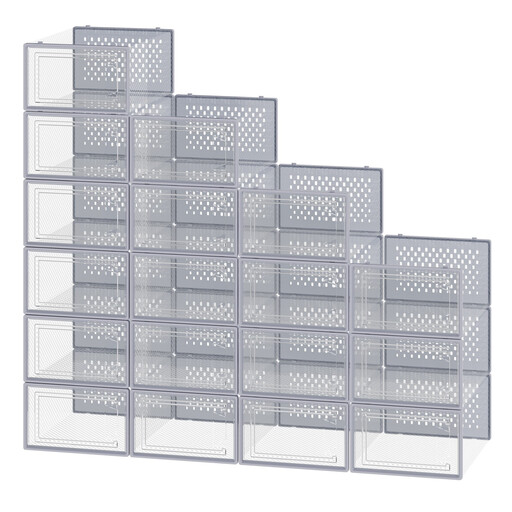
Why it suits this profile: The set contains 18 individual boxes and is suitable for anyone who wants to keep several pairs neatly stored in a wardrobe, hallway or dressing room.
The dimensions of each box are known in advance. This allows you to compare the shoe length and height before ordering, rather than relying solely on the number of boxes.
PP plastic, transparent doors and a stackable design. Assembly is carried out according to the instructions supplied.
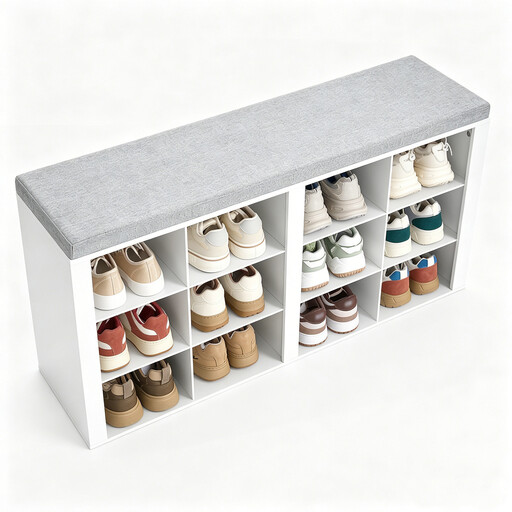
Why it suits this profile: This piece of furniture combines a shoe cabinet with a bench, making it ideal for households that want a fixed place to sit while putting on their shoes.
The 12 compartments are complemented by height-adjustable shelves. This means the layout is not limited to low-cut shoes.
Dimensions of 30,5 x 104,5 x 49,5 cm, a removable cushion cover and a stated load capacity of 150 kg according to the product description.

Why it suits this profile: The vertical design makes use of the door’s height and is intended for hallways, wardrobes and unused corners where floor space is limited.
You don’t need to install a wide cabinet. However, check the door width, available clearance and weight per compartment beforehand.
24 compartments, a metal frame, mesh fabric and a stated size of approximately 7 x 48 x 171 cm. According to the description, the organiser is foldable and can be assembled without tools.
Read the instructions before assembling a modular shoe organiser. Secure click-together plastic boxes carefully and do not force components during assembly or disassembly. Place a tall shoe rack on a level surface and only use an over-the-door model on a door that is suitable for the additional load.
Store shoes clean and dry. Allow wet shoes to air before placing them in a closed box. With mesh models, you can remove dust using a soft cloth or brush. Check connections, shelves and door hooks regularly, especially when the shoe organiser is used daily by several family members.
We’ve put together a complete, up-to-date list of products that fully meet these strict selection criteria and the applicable European safety regulations.
That depends on the model. Measure the area and compare it with the product’s external dimensions. For boxes, you should also check the shoe length and height for each pair. Leave extra room to walk through in a hallway.
Not always. Low-cut trainers and shoes often fit more easily than tall boots or large walking shoes. Check the internal dimensions and, if you store different types of shoes, choose adjustable shelves or a combination of solutions.
Wipe plastic and board material with a soft, slightly damp cloth. Mesh can be carefully vacuumed or cleaned with a damp cloth. Allow every component to dry completely before putting your shoes back.
