
Mostly ironing collars
You mainly want to tidy up the collars and other small areas of one or a few shirts. In that case, an iron that’s easy to handle matters more than a large water tank.


For a few shirt collars, a regular steam iron is often more practical; if you have a pile of shirts or stubborn creases, a steam generator with a separate tank may be a better fit. The Consumers’ Association recommends considering ease of handling and adjustable steam when ironing collars, too: a high steam output alone won’t tell you how smooth a collar will be. Always follow the care label, and make sure you have space for the base and its maintenance.
You mainly want to tidy up the collars and other small areas of one or a few shirts. In that case, an iron that’s easy to handle matters more than a large water tank.
When changing over your wardrobe, you might iron several shirts in a row and want to refill the water less often. A steam generator does need extra space, though.
You iron different fabrics and want to adjust the temperature and steam to suit the instructions on each garment’s care label.
Best for: ironing one or a few shirts now and then, and having limited storage space.
Keep in mind: it has a smaller tank than a steam generator; check whether it can smooth out your creases well enough.
Best for: ironing several shirts in a row and wanting to refill the tank less often.
Keep in mind: the separate base takes up extra space and may not fit well on a standard ironing board.
Best for: regularly ironing larger loads or a variety of fabrics that can be ironed.
Keep in mind: programmes and steam output vary by model and don’t replace the care label.
| What to consider | What should you check? | Who should pay extra attention? |
|---|---|---|
| Control when ironing collars | Check the shape and weight of the hand unit, and whether the steam can be adjusted. | If you mostly iron collars and small areas, you’ll want to position the iron precisely and control the finish. Around 36% of consumers prioritise control when ironing collars. |
| Getting through a pile of laundry | Check the tank capacity, how it’s refilled, the weight and the dimensions. Compare continuous steam output separately from the steam boost. | When ironing several shirts in a row, fewer interruptions matter, provided the base can be placed somewhere practical. Around 29% of consumers say their main priority is getting through their ironing. |
| Different fabrics | Read the care labels and compare the temperature and steam settings for the exact model. | If you iron a variety of fabrics, you’ll want to adjust the settings to suit each garment. Around 21% of consumers put this flexibility first. |
| Space and maintenance | Measure the available space for setting up and storing the appliance, and check the manual for descaling instructions and any consumable parts. | If storage and maintenance are important factors, a compact option may be more practical than a generator with a separate base. Around 14% of consumers say space and maintenance are their main concerns. |
Continuous steam and a short burst of steam are different specifications. The iron’s shape and ease of handling also matter when you’re ironing small areas.
Compare the steam specifications separately, and check the soleplate tip and adjustability for collar work, too.
A separate base takes up space and may be too large or heavy for a standard ironing board.
Measure in advance where the base can stand securely and where you can store the appliance.
The Consumers’ Association points out that anti-scale systems slow limescale build-up, but maintenance is still needed. The process varies from one appliance to another.
Follow the manual for the exact model and check whether it needs cleaning, rinsing or replacement parts.
With models that use replaceable cassettes or cartridges, periodic replacement may be part of the maintenance routine.
The range includes the PSG3000/20, a steam generator worth comparing if you iron several shirts at a time.
According to Tefal, the Express Essential SV6115E0 has a separate, refillable tank, which may be useful for longer ironing sessions.
The CareStyle 5 IS5249BK is a steam generator with programmes for different fabrics.
This selection includes steam generators for longer ironing sessions and a regular steam iron for precise work on collars.
 No image available
The removable 1,4 l tank is designed for longer ironing sessions.
According to the product information, the temperature can be adjusted to suit the fabric type.
The product name lists 2400 W and a steam boost of 350 g.
 No image available
The 1.800 ml tank and temperature settings for different fabric types are useful for longer sessions with a mix of fabrics.
The product details list a Durilium AirGlide soleplate and Calc Clear.
 No image available
The removable 1,8 l tank is designed for longer ironing sessions.
The product name lists an ECO setting; the product details mention a self-cleaning function and anti-scale technology.
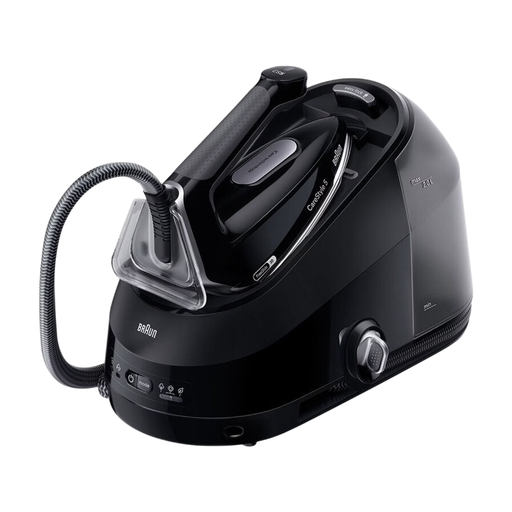 No image available
The 2-litre tank and automatic fabric adjustment are useful for longer sessions with a variety of fabrics that can be ironed.
The product details list iCare. The steam distribution cannot be adjusted.
 No image available
This is a regular steam iron, not a steam generator. The narrow soleplate tip is highlighted as useful for precise ironing around collars.
The product information lists variable steam and temperature settings for different fabrics.
First, check the care label: a crossed-out iron symbol means you shouldn’t iron the garment, and a warning against steam still applies when using a steam generator. Philips recommends starting with the collar in its step-by-step ironing guide.
It depends on the board, as well as the generator’s dimensions and weight. The Consumers’ Association warns that a generator may be too large or heavy for a standard ironing board; check in advance where the base can stand securely.
The Consumers’ Association says that irons are generally designed for tap water, but the model’s manual should always take precedence. Tefal advises against using vinegar or descaling products in the water tank of its steam generators.
For products bought online, ACM ConsuWijzer says there is generally a statutory cooling-off period of up to 14 days after delivery, with some exceptions. Before trying the product, check the information about unpacking, use and returns, too.
The applicable EU product rules and CE marking are relevant to electrical appliances. The Netherlands Enterprise Agency explains which product groups are covered by CE rules; a CE statement on a sales page is not, in itself, an independent safety check.