
Skippers who want to see more around them
Want more horizontal screen space on a single monitor, provided their simulator displays 21:9 effectively. LG Netherlands and Xiaomi publish specifications for ultrawide monitors with this aspect ratio.


An ultrawide monitor could be right for you if your particular simulator displays 21:9 effectively and you want more horizontal screen space on a single display. A 16:9 monitor may be a better choice if the game doesn’t support ultrawide properly, or if desk space, readability and your computer’s connections are more important. Before buying, check the game settings, your computer’s video output and how much room the monitor takes up, including its stand.
Want more horizontal screen space on a single monitor, provided their simulator displays 21:9 effectively. LG Netherlands and Xiaomi publish specifications for ultrawide monitors with this aspect ratio.
Prioritise a practical resolution and a readable interface over simply having a larger screen. Samsung Netherlands and LG Netherlands publish specifications for QHD and ultrawide models.
Need to make sure the monitor’s width, stand and connections suit their desk and computer. When checking a model’s dimensions, remember to allow for the space taken up by the stand.
A good fit if: your simulator displays 21:9 effectively and you want more horizontal space for the view from your vessel.
Bear in mind: the desk space required and the higher resolution. LG Netherlands lists different maximum settings via HDMI and DisplayPort for the 34GN850-B.
A good fit if: you prefer a conventional aspect ratio, or your game’s interface doesn’t display properly on an ultrawide screen.
Bear in mind: you won’t get the extra horizontal space of 21:9. Samsung Netherlands lists the Odyssey G5 G55C as a 32-inch QHD monitor.
A good fit if: you’re specifically looking for a QD-OLED screen as well as effective ultrawide display support.
Bear in mind: Dell Netherlands specifies 280 Hz for the Alienware AW3426DW, but that figure alone doesn’t prove it will benefit your simulator.
| Consideration | What to look for | Who is this important to? |
|---|---|---|
| Horizontal view | Check whether the simulator displays 21:9 effectively and measure the available desk width. | If I want more horizontal screen space for the view from my vessel on a single monitor, I’ll first check how it looks in my game. Around 36% of consumers prioritise a wider horizontal view. |
| Control readability | Check the native resolution and how the game scales its interface. | I want to be able to read instruments and controls clearly, so I look beyond screen size alone. Around 29% of consumers put readability first. |
| Size and connection | Measure the space available, including room for the stand, and check which display settings the connection you use supports. | If my desk or computer outputs limit my choice, I’ll compare dimensions and ports before buying. Size and connectivity are the main priorities for around 21% of consumers. |
| Display technology in dark scenes | Compare the display technology and the conditions for your intended use with static interface elements. | If I often sail through dark scenes, I’ll take display technology into account without assuming that one specification determines how my game will look. Around 14% of consumers consider this their top priority. |
The monitor’s aspect ratio doesn’t tell you whether your game displays the view from your vessel and its controls properly in 21:9.
Check the aspect ratio and where interface elements appear in the specific simulator before making the extra width a deciding factor.
According to LG Netherlands, the LG 34GN850-B has different maximum resolution, colour and Hz combinations via HDMI and DisplayPort. So the highest figure listed won’t necessarily apply to every connection.
Compare the specification for the port you’ll use with your computer’s output. If that connection doesn’t support your preferred display setting, you may need a different cable or connection.
The monitor’s width and depth, including its stand, help determine whether it will fit in the space you have planned.
Measure the available space and compare it with the model’s dimensions, including the stand.
LG Netherlands specifies the UltraGear 34GN850-B as a 34-inch ultrawide model with an IPS panel and 3440 × 1440 pixels.
The Odyssey G5 G55C LS32CG552EUXEN is Samsung’s 32-inch example of a conventional QHD monitor.
The Philips Evnia 34M2C3500L/00 is a 34-inch curved model with a Fast VA panel and 3440 × 1440 pixels.
The Alienware AW3426DW is a 34-inch ultrawide QD-OLED model.
Xiaomi publishes global product specifications for the G34WQi; the specification page isn’t specific to the Netherlands.
These Joybuy products are ultrawide monitors for a single-screen setup. Before choosing a wider screen, check that your simulator supports 21:9 effectively.
 Image unavailable
A good fit if you’re looking for a curved ultrawide screen, provided your simulator displays 21:9 effectively.
34 inches; WQHD; VA panel; 1800R curvature; 120 Hz.
 Image unavailable
A good fit if you’re looking for a curved 21:9 screen; check that your simulator displays this aspect ratio properly.
34 inches; Fast VA; 3440 × 1440; up to 180 Hz via DisplayPort and 100 Hz via HDMI.
 Image unavailable
A good fit if you want to display multiple sources on a single screen, provided your simulator supports 21:9.
34 inches; 3440 × 1440 pixels.
 Image unavailable
A good fit if you specifically want QD-OLED and your simulator also displays 21:9 effectively.
34 inches; 3440 × 1440 pixels; QD-OLED.
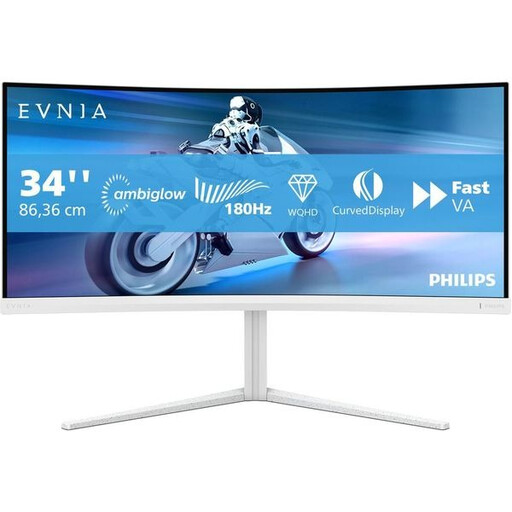 Image unavailable
A good fit if you’re looking for a curved ultrawide screen and want to adjust your viewing position; check how it displays in your game.
34 inches; UWQHD; VA panel; 180 Hz.
No. Monitor specifications don’t confirm that your game displays the view from your vessel and its controls correctly in 21:9. Check the settings and documentation for the specific simulator you play.
Use a connection that your monitor’s specifications say supports the setting you want, then select the appropriate resolution and refresh rate in your computer settings. LG Netherlands lists different maximum settings via HDMI and DisplayPort for the 34GN850-B, so the highest figure won’t necessarily apply to every connection.
Check that the screen and stand fit in the measured space and are stable. Follow the instructions for the model you bought when cleaning and maintaining it.
For a standard online purchase, you generally have a statutory 14-day cooling-off period after delivery, as explained by ACM ConsuWijzer. You’re also covered by the statutory guarantee: the seller must provide a product that, under normal use, does what you could reasonably expect.
The European Commission classifies computer monitors as electronic displays covered by EU energy labels. The scale runs from A to G; check the product information for the exact version, too.