
Detail photographer
You want to fill the frame with ridges, patterns or other small parts of a shell. Magnification, working distance and precise focusing are important things to compare. (Canon Netherlands, Nikon Netherlands and Sony Netherlands.)


Choose a compact camera with a built-in close-up mode if you want to photograph whole shells and the occasional detail without changing lenses. An interchangeable-lens camera with a suitable macro lens gives you more choice over magnification. Compare both the magnification and the space in front of the lens for your lighting, and bear in mind that macro photography requires extra equipment and has a shallower depth of field.
You want to fill the frame with ridges, patterns or other small parts of a shell. Magnification, working distance and precise focusing are important things to compare. (Canon Netherlands, Nikon Netherlands and Sony Netherlands.)
You photograph shells under lamps and want to assess colours and light surfaces carefully. White balance and the positioning of the light are therefore worth considering. (Canon Netherlands.)
You want to capture both a whole shell and the occasional detail without lots of separate accessories. Compare a built-in close-up mode with the options offered by a separate lens, and check what’s included in your chosen kit. (OM SYSTEM and Canon Netherlands.)
| What to consider | What should you check? | Who is this important for? |
|---|---|---|
| Magnifying small details | Compare the maximum magnification of the specific lens and the space in front of it at your preferred shooting distance. Canon lists a maximum of 0.16× with autofocus for the RF-S 18-45mm at 45 mm; the separate RF 35mm F1.8 MACRO IS STM offers a maximum of 0.5×. | If I want to fill the frame with shell patterns, I focus on magnification and how much room is left for my lamp. Around 31% of consumers give photographing small details top priority. |
| Controlling colour and light | Check the white balance and, if you want to adjust colours later, whether the model supports RAW shooting. Assess how the light falls with a test shot, and check whether a light guide is included in your chosen kit. | If I want to assess a shell’s colour and how the light falls under artificial lighting, I look at the white balance and how I can position the light. Around 25% of consumers prioritise colour and lighting. |
| Keeping the whole shell in focus | Check whether the camera offers focus bracketing and how the sequence is combined. A stable setup helps limit movement during test shots. | If I want a stationary shell to be sharp from front to back, I look at the focusing options and whether I can set up the camera steadily. Around 25% of consumers prioritise sharpness across several areas. |
| Choosing a complete kit | Check the contents of the exact kit and the lens specifications. With an interchangeable-lens camera, the body, kit lens and macro lens may be separate items; OM SYSTEM lists the LG-1 in the TG-7 Micro Adventure Kit. | If I want to get started without lots of separate accessories, I want to know in advance which lens and lighting are actually included in the kit. Around 19% of consumers prioritise simple, complete equipment. |
A kit zoom lens isn’t automatically suitable for filling the frame with the smallest shell details. Maximum magnification varies by lens and setting.
Compare the magnification of the exact lens in the kit with the size of the detail you want to photograph. Canon lists a maximum of 0.16× with autofocus for the RF-S 18-45mm at 45 mm, compared with a maximum of 0.5× for the separate RF 35mm F1.8 MACRO IS STM.
A different lamp position or lens may be needed if your current lighting doesn’t fit.
An accessory included with a special kit won’t necessarily come with the camera on its own.
Check the contents of the exact version you’re choosing. OM SYSTEM lists the LG-1 light guide in the TG-7 Micro Adventure Kit.
You may need to buy a light accessory separately if it isn’t included in your chosen kit.
According to OM SYSTEM, the Tough TG-7 has built-in macro modes. The Micro Adventure Kit comes with an LG-1 light guide; check that this is included with the version you choose.
The EOS R50 is an APS-C interchangeable-lens camera with focus bracketing. Canon describes separate RF lenses with different magnifications.
The Z50II uses the Z mount. Nikon lists several compatible Z macro lenses, including the NIKKOR Z MC 50mm f/2.8.
According to Sony, the α6700 is an APS-C camera with an E-mount. Sony states that the separate FE 90mm F2.8 Macro G OSS is also compatible with APS-C cameras with an E-mount.
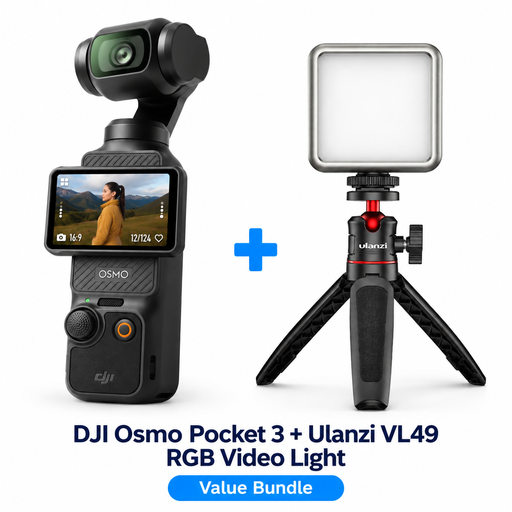
This selection includes a camera with extra lighting for product photography. Check that the bundle suits your preferred close-up mode and lighting setup.
 No image available
A bundle with a camera and an RGB LED video light, for anyone looking for extra lighting for product photography.
No. Choose the magnification to suit the composition you want. Photographing a whole shell and capturing a small surface detail call for different things, so compare the maximum magnification of the specific lens and the working distance available.
Start with a stable camera, take a test shot and assess the white balance. If needed, change the direction or softness of the light. If the composition still isn’t close enough, compare the magnification and compatibility of a different lens or camera.
Keep the shell and camera still, and check the depth of field with test shots. If your chosen camera has focus bracketing, also check how the sequence is combined; bracketing doesn’t automatically mean the camera will produce a single composite image itself.
No. According to the Dutch government, there is no fixed statutory guarantee period in the Netherlands. You’re entitled to a product that is fit for purpose; if there’s a fault, the seller must provide an appropriate solution. Consider any extra guarantee offered separately from this legal right.
When you buy from a business at a distance, you generally have a 14-day cooling-off period, with some exceptions. The Dutch government also distinguishes between buying from a business and buying from a private seller. Check which situation applies to your purchase.