
Scanners of bound scores
You want to capture pages without breaking the binding and check the notes near the spine. CZUR describes book flattening for its ET series, while the ScanSnap SV600 features book image correction.


For bound scores that are used regularly, a contactless book scanner with book correction is the more practical choice. For loose sheets, an A3 document camera may be suitable, or an A4 scanner if everything fits within A4. Make a test scan of the smallest notes and the area near the spine, and bear in mind that text OCR is not the same as music notation recognition.
You want to capture pages without breaking the binding and check the notes near the spine. CZUR describes book flattening for its ET series, while the ScanSnap SV600 features book image correction.
You mainly scan loose parts or larger sheets, so you choose a scanner based on its capture size and ability to capture paper lying flat. Canon Netherlands lists A3 support for the IRIScan Desk 6 Pro.
You want files to be easy to find, access arrangements to be clear and the rights for the scores to be checked before sharing. The Dutch Data Protection Authority provides guidance on access management when an organisation processes personal data.
Start with the original: is it bound, loose and large, or do you need to edit the notation later? Then decide how scans will be stored in the shared archive and who will be able to open them.
Best for: regularly scanning bound scores without breaking the binding.
Bear in mind: space, suitable software and checking the correction; the features listed do not prove that every score will be reproduced perfectly.
Best for: loose A3 or A4 sheets that you want to capture in a single shot.
Bear in mind: how flat the sheets lie, lighting and detail; according to CZUR, the CZUR Shine 800 A3 Pro is designed for flat, loose pages, rather than book scanning like the ET series.
Best for: loose pages that fit within A4, or bound pages where a flat scan close to the book’s edge is important.
Bear in mind: a large sheet won’t fit in a single A4 scan; for the Plustek OpticBook 4800, also check that the exact version and Windows support are right for your studio computer.
| What to consider | What should you check? | Who should pay extra attention? |
|---|---|---|
| Bound pages and the area near the spine | Make a test scan of a double-page spread and check the smallest notes near the binding; check the book correction feature on the exact model. | When I scan bound scores, I want to be able to read the notes near the spine without damaging the binding. Around 33% of consumers say this is their top priority. |
| Size of loose sheets | Measure the largest sheet you want to scan in one go and compare it with the stated capture area. | When scanning large loose parts, I don’t want to split up anything that can fit in a single shot. Around 27% of consumers say the size of loose sheets is their top priority. |
| Readable or editable notation | Test a page with small notes and accidentals; decide whether a scan is enough or whether you need separate OMR software. | If I want to check or edit the notes accurately, I need to know what the scan and any music recognition software each do. Around 20% of consumers put this first. |
| Shared archive and access permissions | Agree where files will be stored, who can open them and what permissions apply to the intended sharing. | For a shared studio archive, I want to find and share files according to clear arrangements. Around 20% of consumers say their archive workflow is their top priority. |
A large capture size doesn’t, by itself, tell you how a scanner handles a curved, bound page. In its own product comparison, CZUR distinguishes between models with book flattening and the Shine 800 A3 Pro, which is designed for flat, loose pages.
Check both the size and type of original, and make a test scan of the area near the spine.
Positioning and checking the pages, and rescanning if needed, takes extra time in the studio.
Text and PDF output is not the same as converting a score into editable music notation. Canon describes text and file features, while Opuscan describes music recognition software separately.
Decide whether you need a readable scan or editable notes, and test the result with one of your own scores before choosing software.
The Dutch government distinguishes between a copy for personal use and distribution. Auteursrecht.nl specifically states that permission from the rights holders is needed to make copies of sheet music for an entire choir.
Check the rights for the specific edition and intended use before adding scans to a shared archive.
CZUR describes its ET series as suitable for book scans with flattening, and the Shine 800 A3 Pro as designed for flat, loose pages.
The Dutch product information describes the SV600 as a contactless overhead scanner for books and fragile originals.
Canon Netherlands describes the IRIScan Desk 6 Pro as a document camera that supports A3 sizes and several file formats.
The Epson Perfection V39II is an A4 flatbed scanner for documents and photos.
The OpticBook 4800 with eBookScan is a book-edge flatbed scanner; Plustek lists a 2 mm book edge for this version.
These product options are mainly aimed at loose A4 and A3 sheets and a shared scanning workflow. The CZUR Shine 800 A3 Pro is designed for flat, loose pages; if you’re scanning bound scores, check separately that your chosen scanner is suitable.
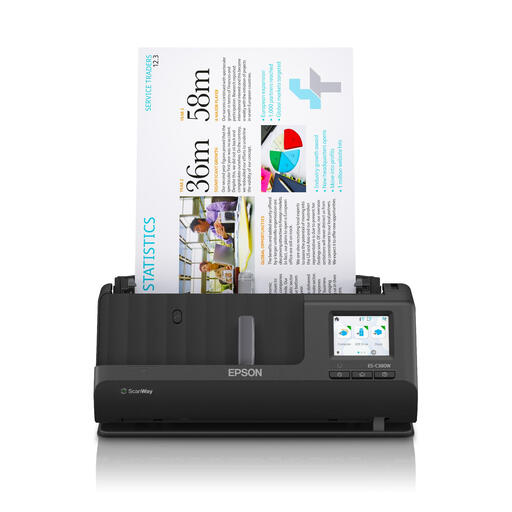 No image available
An option for loose A4 scores and a studio where users want to scan to shared destinations.
A4; 600 × 600 DPI; Wi-Fi and touchscreen; network and cloud scan destinations. Automatic double-sided scanning is not supported.
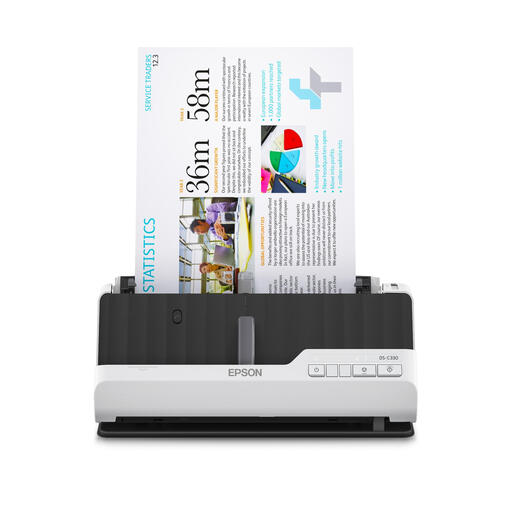 No image available
Worth considering for loose A4 pages and booklets up to 5 mm thick.
A4; U-turn paper path and paper protection; the description lists PDF, JPG and TIFF output.
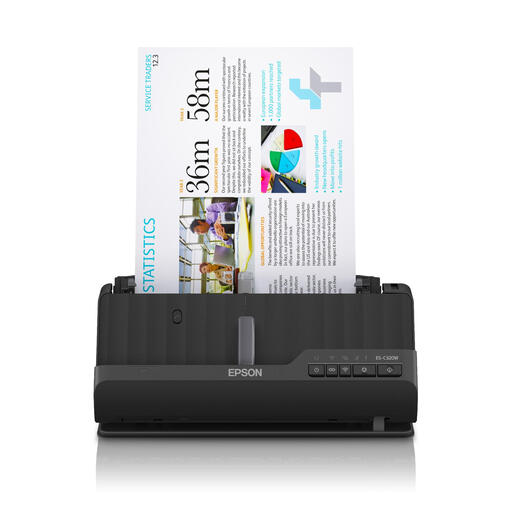 No image available
An option for loose A4 scores if you regularly process stacks of pages.
A4; 50-page document feeder; single-pass double-sided scanning; PDF, JPG or TIFF output.
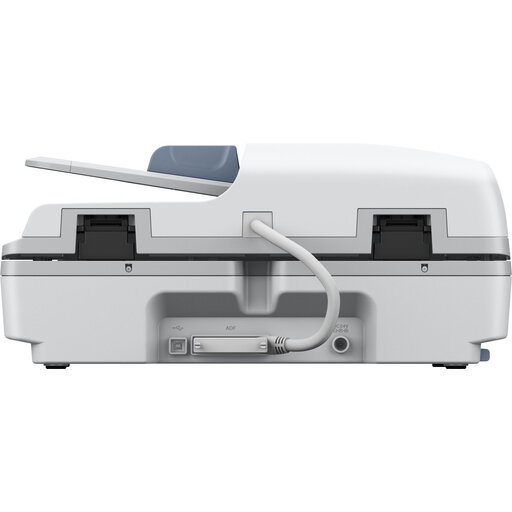 No image available
Worth considering for loose A4 scores if you want both a flatbed and a document feeder.
Flatbed and ADF; supports paper sizes up to A4. The network interface for shared network use is listed as optional.
 No image available
An option for capturing flat, loose scores up to A3; don’t confuse it with the book scanning and flattening offered by the CZUR ET series.
A3; USB connection; foot pedal.
The OCR feature listed does not prove that music notation can be recognised.
Not with the text OCR feature alone. Canon describes text and PDF output for the IRIScan Desk 6 Pro, while Opuscan separately describes software that converts scans into editable music notation. Before choosing software, test the edit you need using one of your own scans.
Check whether the scanner is designed for books and make a test scan of the area near the spine. CZUR describes book flattening for the ET series, and ScanSnap lists book image correction for the SV600; these features don’t guarantee that every small note will be easy to read.
Yes, if the pages you want to scan fit within the stated A4 capture area. Measure the largest sheet beforehand; for loose sheets larger than A4, a model with a larger capture size, such as A3, is another option.
Not automatically. The Dutch government states that a copy for personal use must not be distributed or made public; Auteursrecht.nl explains that permission from the rights holders is needed to make copies of sheet music for an entire choir. Check the rights for the specific edition and intended use.
Agree how files will be named and stored, and who will be able to open them. If the studio processes personal data as an organisation, the Dutch Data Protection Authority recommends limiting access to people who need that information; this requirement does not automatically apply to every score.