
Vandaag of morgen in huis

Kwaliteit gegarandeerd

Welkomstaanbiedingen ontgrendelen: GRATIS bezorging | Tot 80% korting | Gratis 30 dagen JoyPlus-proefperiode
Download de app
An LED motion sensor light can automatically illuminate a dark hallway, staircase, cupboard, driveway or front door. Yet many people buy a light that disappoints in practice. The sensor may respond too slowly, the battery may run out quickly, or the light may not be suitable for rain.
The main pitfalls usually have less to do with the number of LEDs and more to do with the combination of sensor range, brightness, power supply and installation. Use the checks below to compare products more effectively and avoid a disappointing purchase.
A manufacturer may quote a range of several metres, but where you position the light also affects how well the sensor responds. A sensor will generally behave differently when someone walks straight towards the light than when they move across its detection zone. So check the detection angle as well as the range.
For a hallway or staircase, a range of around 3 to 5 metres is often practical. A wider angle can be useful for a driveway or garden. Also check whether the light only switches on in the dark or can respond during the day too.
A solar-powered outdoor motion sensor light needs direct sunlight to charge its built-in battery. Under a balcony, in a deeply shaded spot or on a north-facing wall, it may receive less sunlight. Product descriptions sometimes state a number of hours of light or activations, but this depends on sunshine hours, the season, temperature and usage.
So check where the solar panel will be positioned. A light with an adjustable panel gives you more placement options than one with a fixed panel.
Check the IP rating. IP44 protects against splashing water and is mainly suitable for sheltered outdoor locations. Under the classification, IP65 offers greater protection against dust and water jets. Neither rating means you can place a light underwater.
So don’t use a light with a lower IP rating in an exposed spot where it will be subject to prolonged rain or direct water jets.
Look for:
Sensor lighting for a hallway or staircase doesn’t need to be extremely bright. Reliable detection and a short switch-off time are often more important.
Lumens indicate the amount of light produced. A compact LED night light with 20 to 35 lumens is designed for orientation lighting. A higher light output may be more comfortable for a cupboard, worktop or dark corridor. For a garden or driveway, light distribution and an adjustable lamp head are also important.
Colour temperature is measured in kelvins:
A dimmable LED light or a model with several colour temperatures is useful if you plan to use one light in different locations. Do check that the dimming settings are actually listed in the product specifications.
A wireless LED light runs on batteries, a built-in rechargeable battery or solar power. A rechargeable cupboard light with USB-C is practical indoors, but needs charging from time to time. Check the stated battery capacity, charging port and operating time in sensor mode.
Magnets, adhesive strips or a mounting plate are useful in rented homes. Before installation, check that the surface is flat, clean and suitable. For outdoor lights, screws and wall plugs are often more secure than tape alone. And “wire-free lighting” doesn’t automatically mean that no installation is needed.
The products below have been selected based on information that can be checked in the supplied product descriptions. Any performance claims are based on information from the manufacturer or seller; actual operating time may vary depending on the situation.
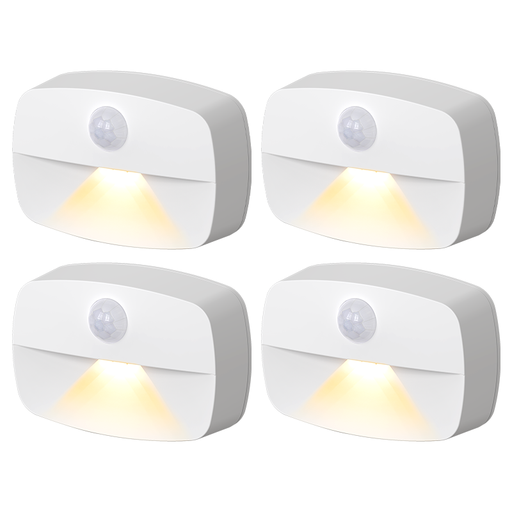
Why it suits this type of buyer: Four compact lights offer an easy way to add automatic lighting to several dark spots around the home, such as a hallway, cupboard, toilet or staircase.
The product description states a detection angle of 120°, a range of 13–20 ft and a 20-second switch-off time. According to the description, the lights are intended for indoor use, not damp outdoor locations.
Four lights per pack, 35 lumens, warm white light at 2800–3200 K and installation with double-sided tape. AAA batteries are not included.

Why it suits this type of buyer: This solar wall light is designed for a fixed position by an entrance, patio or garden wall. It combines automatic operation with two light settings.
The product information explicitly states an IP44 rating. Direct water jets or submersion aren’t suitable for this rating, so a sheltered wall is a more sensible location.
According to the product description, the light produces 400 lumens per light source and has a motion sensor, a daylight sensor and two settings.

Why it suits this type of buyer: For a large garden, garage, driveway or yard, an adjustable light with several heads is more practical than a small night light.
The product specifications state a detection distance of 60 ft, an angle of 180° and three light settings. The IP65 rating is specified for outdoor use; the solar panel needs direct sunlight.
According to the product description, it has 302 LEDs, 3000 lumens, three adjustable heads and a built-in 1800 mAh battery.
We’ve put together a complete, up-to-date list of products that meet these strict selection criteria and the applicable European safety regulations.
Position the light where the sensor can detect people moving through the area, for example opposite the doorway or at an angle beside it. Avoid obstacles such as tall cupboards. After installation, check that the light doesn’t switch on whenever there’s a small movement outside the area you want it to cover.
It depends on battery capacity, brightness, temperature and how often the light switches on. A light with a larger battery may run for longer, but a manufacturer’s stated figure isn’t a guarantee for every home. Also check the charging time and use a suitable USB charger.
A solar light doesn’t use electricity from the mains while charging. Its performance does depend on receiving enough sunlight. Clean the panel regularly and don’t place the light somewhere that will be shaded for long periods by trees, walls or canopies.
