
Vandaag of morgen in huis

Kwaliteit gegarandeerd

Welkomstaanbiedingen ontgrendelen: GRATIS bezorging | Tot 80% korting | Gratis 30 dagen JoyPlus-proefperiode
Download de app
A sensor night light can be useful in a bedroom, nursery, hallway or toilet. It switches on automatically when it gets dark or when movement is detected. However, not all models are designed in the same way. Choose the wrong one and the light could be too bright, the sensor might stay on during the day, or the lamp may not fit your socket.
Joybuy Product Recommendation Officer helps you assess the key differences without taking marketing claims at face value.
A motion-sensor night light responds to movement within a certain range. A model with just a light sensor switches on automatically when the surroundings get dark. That doesn’t necessarily mean it only comes on when someone walks past.
A light sensor may be enough for a dark hallway. For trips to the toilet at night or a child getting out of bed, motion detection may be more practical. So check which type of sensor is listed in the product information.
A low wattage means lower electricity use, but it doesn’t tell you directly how much light the lamp gives off. Check the luminous flux in lumens too. A 0.5-watt lamp with 20 lumens gives off a different amount of light from a 1-watt LED night light with 40 lumens.
For a bedroom, a little soft light is often enough. In a hallway or by the stairs, a brighter light can help you see obstacles.
Colour temperature is measured in Kelvin (K). A warm white night light at around 2800 to 3200 K looks more yellow than a model at 4000 to 4500 K. A 6500 K lamp gives off cooler, daylight-like white light.
Also check whether dimming is mentioned. A dimmable night light gives you more control beside the bed, but not every sensor light has a dimming function.
For a motion sensor, the range and light conditions matter. One of the available models specifies activation at an ambient light level of up to 20 lux and a motion detection range of 3 to 5 metres. Lux indicates how much ambient light is present. The lower the threshold, the darker it needs to be before the automatic function is activated.
Also consider where you place it. A sensor may not respond as well if furniture, doors or curtains block its view.
These features are useful to consider when choosing a night light for a bedroom or nursery:
For example, one product lists 20 lumens, a colour temperature of 4000 to 4500 K and stepless touch dimming. Another model lists 20 lumens and 2800 to 3200 K. These figures help you compare options without relying on general terms such as “soft” or “comfortable”.
A plug-in night light is ready to use straight away and doesn’t need charging. A battery-powered model gives you more freedom over where you place it, but you’ll need to replace or recharge the batteries. For a plug-in model, check that the voltage is suitable for use in the Netherlands. The available models list ratings including 100-240 V or 230 V.
Several products list ABS and ABS+PC as materials. This tells you something about the construction, but it doesn’t automatically mean the lamp is suitable for damp areas. If no IP rating is listed, keep the lamp away from direct contact with water and use it indoors in line with the product instructions.
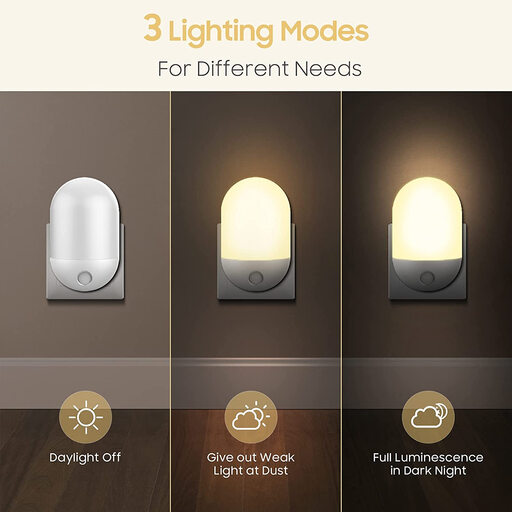
Why it suits this buyer: This plug-in model is a good choice if you want a light that comes on automatically in the dark and don’t want to use batteries or a charging cable.
The product listing clearly specifies a light sensor and 2800-3200 K. So you won’t have to assume it has a motion sensor or gives off cool white light.
0.5 W power, warm white light and a listed voltage of 110-220 V. The product name states that it’s suitable for a bedroom, nursery and hallway.
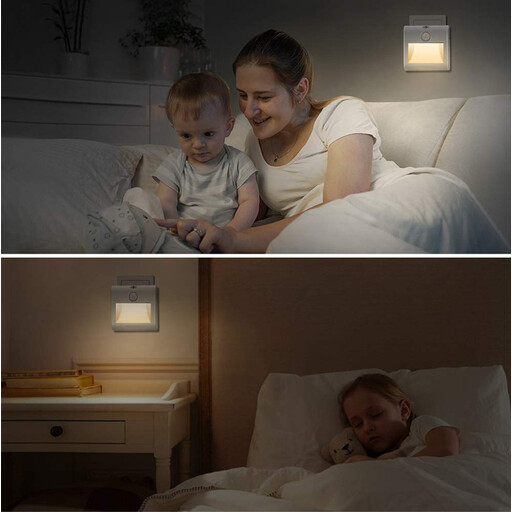
Why it suits this buyer: A set of two lights, motion detection and dimming is a good combination for households that want the same controls in several rooms.
The specifications list two modes, a sensor range of 3-5 metres and a threshold of up to 20 lux. The dimming function is also clearly described.
Stepless touch dimming with memory function, 20 lumens, 1 W power and 100-240 V compatibility. Supplied as a set of 2.
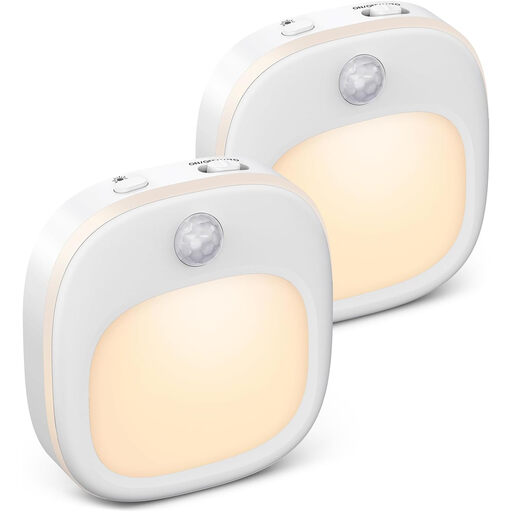
Why it suits this buyer: A battery-powered set gives you more flexibility if there isn’t a suitable socket nearby, for example in a hallway, cupboard or toilet.
The product name explicitly lists battery power, motion detection, five dimming levels and three colour temperatures. You can tailor the light to the room and time of day.
Set of 2, five dimming levels and three colour temperatures. The battery-powered design means you don’t have to place the lights by a socket.
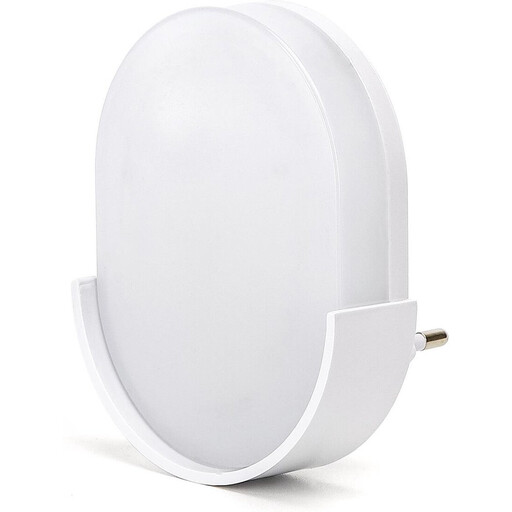
Why it suits this buyer: This plug-and-play model is designed for anyone who wants a fixed night light with a day-and-night sensor, without the need for batteries or charging.
The specifications list 40 lumens, 6500 K, 1 W and a light sensor. So you’ll know in advance that this isn’t a warm white night light.
40 lumens, 230 V, a 120-degree beam angle and a stated energy use of 0.5 kWh per 1000 hours. Designed for indoor use.
We’ve put together a complete, up-to-date list of products that meet these strict selection criteria and the applicable European safety regulations.
It depends on how you plan to use it. A light sensor switches on as soon as it gets dark. A motion sensor only responds when someone moves within its range. A light sensor can be useful for steady ambient lighting, while motion detection may be better for short trips around the house at night.
Energy use depends on the wattage and how long the light is on. A 0.5-watt model uses less electricity than a 1-watt model when both are used continuously. With a battery-powered model, battery capacity and how often the light switches on also make a difference. Check the stated wattage and, where available, the energy use per 1000 hours.
Keep a plug-in light clear of bedding, curtains and water. Keep cords out of children’s reach and use a battery-powered model only as directed in the instructions provided. A night light is supplementary lighting; always check whether the product is intended for indoor use only and follow the manufacturer’s safety warnings.
