
Vandaag of morgen in huis

Kwaliteit gegarandeerd

Welkomstaanbiedingen ontgrendelen: GRATIS bezorging | Tot 80% korting | Gratis 30 dagen JoyPlus-proefperiode
Download de app
A sensor night light can be useful in a baby’s room, child’s room, bedroom, hallway, bathroom or cupboard. The light switches on automatically when it gets dark or when someone walks past. However, many models look similar, while differences in the sensor, brightness and power supply can make a noticeable difference in everyday use.
The most common buying mistakes arise from three pitfalls:
A light sensor night light switches on when the ambient light falls below a certain level. This works well in a fixed position near a socket, such as in a hallway or baby’s room. Some models state the switching threshold in lux. A lower lux value generally means that it needs to be darker before the light responds.
A plug-in model with a light sensor is practical if you do not want to replace or recharge batteries. Do check that the design does not block a socket and that the light is not too bright for a bedroom.
A motion sensor night light switches on when the sensor detects movement, often within a specified range. This is suitable for routes used at night, such as hallways, stairs or the way to the bathroom. In a child’s room, it can be useful when you need light briefly without having to search for a switch.
Check the stated detection distance and light conditions. Many models only switch on when it is dark. A motion sensor in a light room will therefore not always activate.
Brightness is usually expressed in lumens. For subtle orientation lighting in a bedroom, a low light output may be sufficient. For a cupboard, kitchen worktop or dark hallway, more light is more practical.
Colour temperature is measured in kelvin (K):
A dimmable night light gives you extra control. Check whether all light settings can be dimmed. Some products only offer stepless dimming for warm white, while RGB colours have fixed settings or an automatic colour cycle.
A rechargeable night light works without a permanent socket, so it can be placed on a shelf, bedside table or cupboard wall. Check the battery capacity, USB voltage and stated usage time. A model with a 500 mAh battery is compact, but may need charging more often than a model with 1100 mAh.
A plug-in light does not need charging breaks. With a stated power rating of, for example, 0.3 W or 1 W, energy consumption remains limited, but always check the actual product label and supply voltage.
Check the dimensions and mounting method before ordering. A wide light will not fit in every cupboard, while magnetic mounting only works properly on a suitable surface. If you are using adhesive strips, the surface must be clean, dry and flat.
Many models are made from ABS and metal. This says something about the construction, but does not automatically mean that the light is suitable for damp areas. Do not use a standard night light in the shower or anywhere it could get wet, unless the manufacturer explicitly states a suitable protection rating.
When using a light in a baby’s room or child’s room:
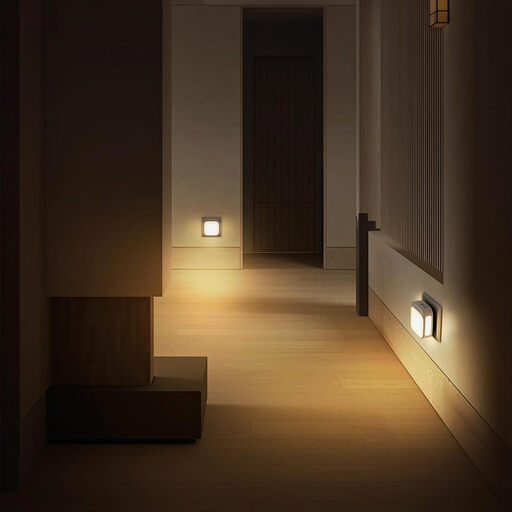
Why it suits this profile: Two compact lights with light sensors are useful for areas such as a hallway and baby’s room. They plug into the mains and, according to the product specification, use 0.3 W.
The product information clearly states that it has an automatic light sensor, warm white light and stepless dimming from 10% to 100%. You therefore do not have to rely solely on a general marketing term.
2-pack, 20 lm, 2800–3000 K warm white, 0.3 W and suitable for 110–240 V according to the product specification.
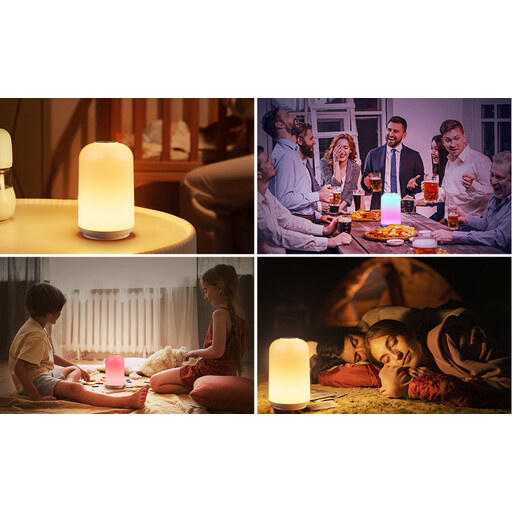
Why it suits this profile: This rechargeable night light offers several lighting options for a bedroom, baby’s room or child’s room, without a fixed connection to a socket.
The specifications separately list warm white, RGB colours, a light sensor and stepless dimming for warm white. This makes it clearer which function belongs to each light setting.
12 SMD LEDs, 40 lm, 2600–2800 K warm white, RGB with 7 colours, USB charging via 5 V–1 A and a sensor value of up to 40 lux according to the product information.

Why it suits this profile: The slim design is intended for cupboard interiors, shelves and kitchens. Two lights make it possible to illuminate several dark areas automatically.
The product details state that it has a PIR motion sensor with a range of 3–5 metres and a physical length of 40 cm. This allows you to check the fit and performance against your space before buying.
61 LEDs, three colour temperatures, a built-in 1100mAh battery, USB charging and a thickness of 10 mm according to the product description.
We have put together a complete, up-to-date list of products that fully meet these strict selection criteria and the applicable European safety regulations.
It depends on how you plan to use it. A light sensor can provide soft orientation lighting throughout the night as soon as it gets dark. A motion sensor usually stays off until someone moves. When choosing a night light for a baby’s room, always check the brightness and place it out of the child’s reach.
Consumption depends on the power rating and the number of hours it is switched on. A 0.3 W light uses less energy during prolonged use than a 1 W model, but the final cost depends on your energy tariff. With rechargeable models, charging frequency and battery capacity also play a part.
The usage time per charge varies depending on the battery, light setting and sensor activity. A motion-sensor model only comes on when movement is detected, so it may perform differently from a light that stays on continuously. Check the stated usage time, charging voltage and warnings for the USB charger before ordering.
