
Vandaag of morgen in huis

Kwaliteit gegarandeerd

Welkomstaanbiedingen ontgrendelen: GRATIS bezorging | Tot 80% korting | Gratis 30 dagen JoyPlus-proefperiode
Download de app
A sensor light can automatically illuminate a dark hallway, entrance, wardrobe or garden path. Even so, a purchase can sometimes disappoint in practice. A light may be too dim for a driveway, insufficiently resistant to moisture outdoors or constantly switch on whenever a pet walks past.
The main pitfalls are usually not related to appearance, but to the combination of sensor, power supply and intended location.
An LED light with a high lumen output does not automatically provide sufficient light everywhere. The positioning, beam angle and direction of the light also affect the result. For a bedside table, 20 to 40 lumens is often focused and gentle enough. For a garage, driveway or larger area of the garden, a higher light output makes more sense.
An outdoor light with a motion sensor must be suitable for the conditions at its installation point. An IP44 outdoor light is protected against splashing water, but not every direct jet of water. A light with IP65 offers a higher level of protection against dust and water jets under the IP classification. Also check whether the housing is installed in a sheltered position and whether the solar panel receives enough daylight.
A mains-powered light does not have a battery that needs charging, but it does use electricity. A solar outdoor light does not need to be connected to the mains, but its performance depends on the amount of sunlight available. A rechargeable LED light can be positioned flexibly, but needs to be connected to a USB charger regularly. The cheapest option is therefore not always the most convenient in the long term.
Pay attention to the difference between a motion sensor and a light sensor:
For a cupboard, hallway or staircase, a short sensor range is often sufficient. For a driveway or back garden, a longer range may be more practical. The product information for the ultra-thin cupboard lights, for example, states a PIR range of 3 to 5 metres. A sensor light with a long range can switch on unnecessarily often if it is directed towards a busy pavement or road.
Lumens indicate how much light a lamp produces. Wattage mainly indicates energy consumption and is not a direct measure of brightness. For orientation lighting in a bedroom or nursery, warm light around 2800 to 3200 K is often better suited to the purpose. Neutral or cool light may be more practical for a kitchen worktop.
A night light with a light sensor producing 20 lumens is designed to make a dark room subtly visible. An outdoor model producing 400 or 1000 lumens is more suitable for an entrance, façade or area of the garden. In addition to the lumen output, consider where the light falls: a high light output is of little use if the lamp only illuminates a small section of the ground.
Choose the power supply based on the installation location:
When installing without drilling, check that the adhesive strip is suitable for the surface. With a magnetic light, the mounting plate must be firmly secured. A light with IP44 is not the same as fully waterproof outdoor lighting; installing it under a canopy may therefore be the wiser option.
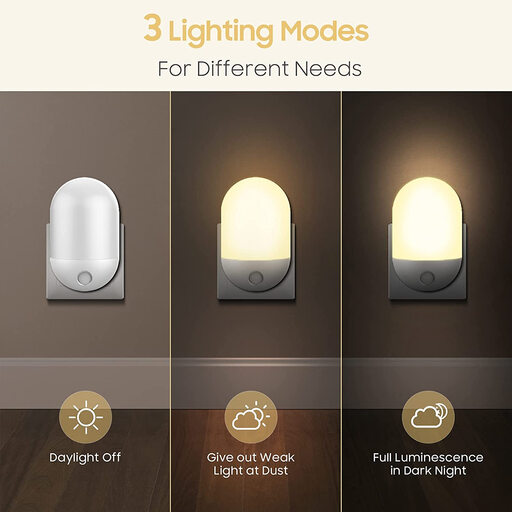
Why it suits this profile: This compact sensor light is designed for a bedroom, nursery or hallway where gentle orientation lighting is preferred without a battery or complicated installation.
The product information states 20 lumens and warm white light of 2800-3200 K. This makes it clear that the model is intended for subtle indoor lighting rather than a driveway or large room.
0.5 W, 20 lumens, warm white light and a 110-220 V connection according to the product information.

Why it suits this profile: This model is ideal for homeowners and tenants looking for outdoor lighting without fixed wiring for an entrance, patio or façade.
The product information lists an integrated dusk sensor, motion sensor, solar power and IP44. However, be sure to install the light where the panel receives enough direct sunlight.
1000 lumens, warm white light of 3000 K, two lighting modes and IP44 according to the product specification.

Why it suits this profile: The long, slim design is practical for kitchen cupboards, storage cupboards, wardrobes and shelves where additional light is regularly needed.
The product description mentions PIR detection at 3-5 metres, USB charging and drill-free tape installation. According to the same information, the light is not intended for damp locations.
61 LEDs, three colour temperatures, a built-in 1100 mAh battery and a length of 40 cm according to the product specifications.
We have put together a complete, up-to-date list of products that fully meet these strict selection criteria and the applicable European safety regulations.
Position an indoor light so that it does not shine directly into your eyes. For a cupboard light, check that the door, hinges or contents do not obstruct the sensor range. Outdoors, the mounting surface must be sturdy and the light must not be able to fall.
For models with USB or lithium batteries, it is advisable to follow the supplied charging requirements. Clean sensors and solar panels with a soft cloth. Do not use aggressive cleaning products on outdoor lights, and do not treat an IP44 model as fully waterproof outdoor lighting.
That depends on the type. A motion sensor, often a PIR sensor, responds to changes in heat and movement within the detection area. A light sensor responds to the brightness of the surroundings. Some outdoor lights use both: the dusk sensor determines when the light may become active, while the motion sensor determines when the light switches on.
The lifespan varies by model and usage. Product information for some integrated LED lights states a lifespan of 10,000 or 25,000 hours. This is a quoted product specification, not a guarantee for every usage situation. With rechargeable models, the battery may wear out before the LED itself.
A sensor light usually uses less energy than a light that stays on continuously, as it only switches on when movement or darkness is detected. Consumption depends on wattage, light output and how long the light remains on each time it is activated. A solar outdoor light does not use electricity from the mains, whereas a 230 V light does. Therefore, do not look only at the price; consider the power supply and expected usage too.
