
Breakfast lovers looking to choose organic
You want to be able to tell whether rusks are genuinely organic, rather than judging by the presence of seeds. Look for the EU organic logo, the control code and details of the organic ingredients.


If organic is a must for you, choose rusks with seeds and check the organic labelling on the pack. If wholegrain, seeds and fibre are your main priorities, you can also compare regular multiseed rusks. Seeds don’t automatically make rusks organic, so check the allergens and salt content too, as well as whether baker’s salt is listed if that matters to you.
You want to be able to tell whether rusks are genuinely organic, rather than judging by the presence of seeds. Look for the EU organic logo, the control code and details of the organic ingredients.
You’re looking for seed rusks and want to know which flour they contain. Compare the ingredients and fibre per 100 g, then check the serving size.
You want to know which grains, seeds and other allergens the rusks contain. If bread or rusks also play a part in your iodine intake, check whether baker’s salt is listed. According to the Voedingscentrum, its use is not compulsory.
First decide whether verifiable organic labelling is essential for you. Then compare the ingredients and nutritional information of rusks that meet this requirement, or of regular multiseed rusks if organic isn’t a must.
| What to consider | What to check on the label | Who it matters to |
|---|---|---|
| Organic origin | Check the EU organic logo, the control code and which ingredients are labelled organic. Skal Biocontrole states that the EU organic logo is compulsory on prepacked organic consumer products in the EU. | If I want to eat organic, I need to be able to verify the product’s origin; a name mentioning seeds isn’t enough. For around 37% of consumers, verifiable organic origin comes first. |
| Wholegrain, seeds and fibre | Check the type of flour and the seed ingredients. Compare fibre per 100 g, then check the serving size. | I’m looking for rusks with grains and seeds that suit my preferences, and want to compare fibre figures on a like-for-like basis. Around 36% of consumers give these ingredients top priority. |
| Allergens, salt and baker’s salt | Read the allergen information, compare salt per 100 g and, if you have a question about iodine, check whether baker’s salt is mentioned. | If an allergy or a question about salt or iodine is relevant to me, I want to be able to check the pack before choosing. For around 27% of consumers, this matters more than the other points to consider. |
Seeds and wholemeal flour don’t, in themselves, tell you anything about how a product was produced.
For prepacked organic rusks, check the EU organic logo, the control code and the ingredients on the pack.
Seed rusks may contain gluten-containing cereals, sesame or egg, among other allergens. Organic labelling doesn’t change that.
Read the allergen information on the pack you’re buying, even if you’ve had the product before.
According to the Voedingscentrum, bakers don’t have to use baker’s salt. So the word ‘organic’ doesn’t tell you whether the rusks contain iodised salt.
If the use of baker’s salt matters to your choice, check the pack or ask the manufacturer or baker.
Comparing per serving can give you a misleading impression if the serving sizes aren’t the same.
Compare salt and fibre per 100 g first, then use the serving size to assess your own portion.
Albert Heijn lists both organic labelling and wholemeal wheat flour and seeds for AH Biologisch Wholegrain Multiseed Rusks.
PLUS Wholegrain Rusks with Seeds are a regular option for anyone wanting to compare products made with wholemeal flour and seeds.
Bolletje describes its High-Fibre Multiseed Rusks as rusks made with a variety of seeds.
Jumbo Organic Wholegrain Rusks are an example of organic wholegrain rusks with no seeds in the ingredients shown.
You can assess these seed rusks by their pack size and, if you have a preference for organic products or questions about allergens, by checking the latest ingredients and labelling on the pack.
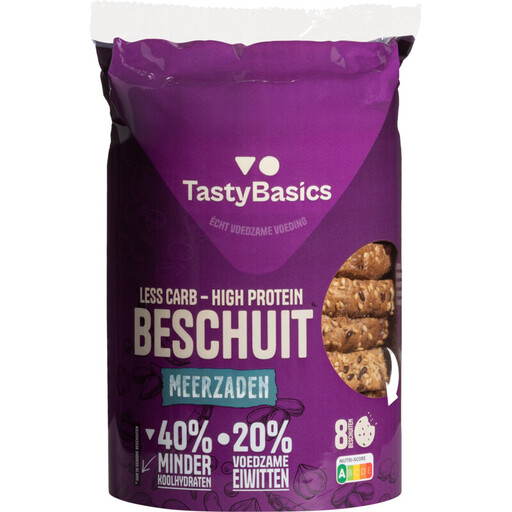 No image available
For anyone looking for multiseed rusks who wants to check the organic labelling on the pack.
Pack size: 184 g. Also check the latest ingredients and allergen information if they’re relevant to your choice.
 No image available
For anyone looking for seed rusks who wants to choose a pack of 10.
Check the organic labelling on the pack and, if wholegrain is essential to you, see which flour is listed in the ingredients.
For prepacked organic rusks, check the EU organic logo, the control code and details of the organic ingredients. Skal Biocontrole states that the EU organic logo is compulsory for prepacked organic consumer products in the EU.
No. Seeds and wholemeal flour don’t prove that a product is organic. If this is a requirement for you, check the organic labelling on the specific pack you’re considering.
Not on the basis of organic labelling alone: according to the Voedingscentrum, using baker’s salt isn’t compulsory. Check whether baker’s salt is listed on the pack or ask the manufacturer or baker.
Always read the latest allergen information. The variants discussed here list gluten-containing cereals, sesame or egg, among other allergens, but ingredients vary by product. So check the pack of the variant you choose.
Seal the pack tightly and follow the storage instructions on the packaging. The product information for the rusks discussed recommends storing them in a cool, dry, dark place.