
Festival-goer who wants to top their rusks
If you want to eat before setting off or take rusks with you for later, consider the size and keep the pack dry and well sealed. You can take any toppings that might make the rusks damp separately.


Choose a seeded rusk with a size and packaging suited to how you plan to top and carry it. Compare the seed mix and nutritional values per 100 g, but above all, check the allergens before buying: the varieties discussed contain sesame and cereals containing gluten, and some also contain egg.
If you want to eat before setting off or take rusks with you for later, consider the size and keep the pack dry and well sealed. You can take any toppings that might make the rusks damp separately.
A seed mix won’t tell you how much fibre or protein a rusk contains. Compare the nutritional information for each variety on the same basis, such as per 100 g, and check the serving size too.
Sesame and cereals containing gluten are found in the multiseed rusks discussed here; several varieties also contain egg. If you have an allergy or follow a vegan diet, check the current ingredients and allergen information.
First, decide how you want to eat and carry your rusks. Nutritional values, the seed mix and the ingredients can then help you distinguish between the varieties.
| What to consider | What to check | Who it matters to |
|---|---|---|
| Size and carrying | Check the size of each rusk and how to keep an opened pack dry and sealed while carrying it. | I want to be able to top a rusk without it getting damp on the way. This ease of use is the top priority for around 25% of consumers. |
| Fibre and protein | Compare fibre, protein and salt per 100 g; check the weight of each rusk too. | If fibre or protein is your main consideration, the nutritional information is more useful than the name of the seed mix. Around 31% of consumers prioritise this criterion. |
| Seeds and wholegrain | Check which seeds are listed, whether a percentage is given and whether the rusks are wholegrain. | I want to know which seeds are in my rusks and whether they’re wholegrain; this composition matters most to around 25% of consumers. |
| Allergens and dietary requirements | Check the current ingredients list and allergen information for sesame, cereals containing gluten and egg. | If I have an allergy or follow a vegan diet, I don’t want to rely on the front of the pack alone. Checking the ingredients is decisive for around 19% of consumers. |
Bolletje lists sunflower seeds, linseeds, sesame seeds and pumpkin seeds, among others. PLUS says its wholegrain rusks contain over 25% seeds. The name alone doesn’t show you these differences.
If the seed mix is what will determine your choice, compare the ingredients lists and any percentages on the pack.
The varieties discussed contain sesame and cereals containing gluten; TastyBasics, AH Biologisch and PLUS also list egg. A vegan label doesn’t mean a product is free from sesame or wheat.
If you have a relevant allergy, check the current allergen information on the pack before buying.
According to the RIVM, Dutch iodine policy focuses, among other things, on iodised salt in bread. This doesn’t tell you what type of salt is used in a particular rusk.
If iodine is important to you when buying, check the ingredients information or ask the manufacturer.
For Bolletje High-Fibre Multiseed Rusks, PLUS advises keeping the rusks in a dark, dry and sealed place after opening. Moisture-rich toppings can make them soft before you eat them.
Seal an opened pack well and keep these toppings separate until you’re ready to eat.
These brands offer the multiseed and wholegrain varieties discussed here. Compare the specific packaging: the features of one rusk don’t automatically apply to other products from the same brand.
High-Fibre Multiseed is an extra-large rusk containing sunflower seeds, linseeds, sesame seeds and pumpkin seeds, among other ingredients.
Multiseed Rusks are an option if you want to compare fibre and protein per 100 g.
Wholegrain Multiseed Rusks combine an organic wholegrain recipe with linseeds, sesame seeds and sunflower seeds.
Wholegrain Rusks with Seeds are a large wholegrain variety, which PLUS lists as containing over 25% seeds.
These two multiseed rusks suit different priorities for a snack around festival time: Bolletje offers an extra-large size, while with TastyBasics you can take the stated fibre and protein content into account. Check the ingredients for both and keep any opened pack dry and well sealed.
 Image unavailable
The extra-large size is useful if you want to top the rusks before setting off.
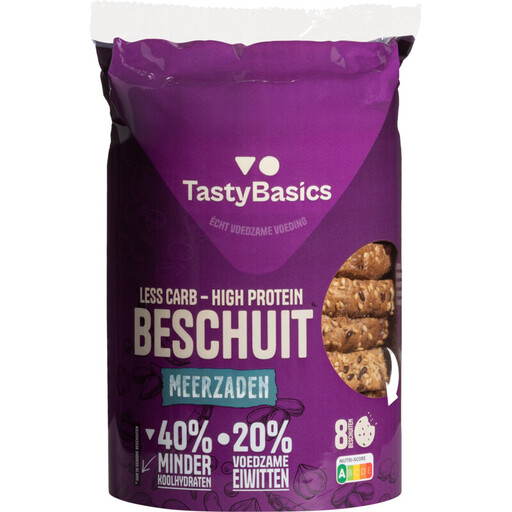 Image unavailable
This variety is worth considering if you mainly compare fibre and protein per 100 g when choosing.
No, you can’t tell from the name. According to the RIVM, Dutch iodine policy focuses, among other things, on iodised salt in bread, but that doesn’t confirm what type of salt is used in a particular rusk. Check the ingredients information or ask the manufacturer if iodine is important to you.
Always check for sesame and cereals containing gluten; some of the varieties discussed also contain egg. Read the current ingredients and allergen information for the product you’re buying, as recipes can change.
Albert Heijn and PLUS list Bolletje High-Fibre Multiseed as vegan. The rusks do contain wheat and sesame, so check the current packaging for this variety too if you need to avoid any ingredients.
Take the pack with you unopened or seal it well if it’s already been opened, and keep it dry. Take any toppings that might make the rusks damp separately and add them just before you eat.