
If wholemeal and fibre matter to you
If you want wholemeal rusks for lunch, look beyond the seeds on the packaging. Compare the wholemeal labelling, ingredients and fibre per 100 g.


If you’re mainly looking for wholemeal rusks for a university lunch, choose a variety explicitly labelled as wholemeal and compare the fibre per 100 g. If you’re after rusks with a variety of seeds for a plant-based lunch, check the ingredients for egg. ‘Seeded’ doesn’t automatically mean wholemeal, and wheat and sesame are still important allergens to look out for.
If you want wholemeal rusks for lunch, look beyond the seeds on the packaging. Compare the wholemeal labelling, ingredients and fibre per 100 g.
The varieties reviewed contain gluten-containing cereals and sesame; some also contain egg. Check the packaging of the rusks you choose, especially if they’re served without their packaging in the canteen.
You want a variety of seeds and kernels, but no egg. PLUS lists Bolletje Vezelrijk Meerzaden as vegan; check the label and ingredients of the specific variety when you buy it.
First decide whether wholemeal ingredients, allergens or a plant-based seed mix matter most for your lunch. Then compare the packaging of the varieties that meet your requirements.
| What to consider | What to check when buying | Who is this important for? |
|---|---|---|
| Wholemeal ingredients and fibre | Look for an explicit wholemeal label and compare the fibre per 100 g. Also check which types of flour are listed in the ingredients. | If I want wholemeal rusks, I don’t just go by the seeds on the packaging; around 42% of consumers put this need first. |
| Allergens | Check each pack for gluten-containing cereals, sesame and egg. If the rusks are served without their packaging, ask for the allergen information. | If I have an allergy, I want to know whether I can eat the rusks I’ve chosen before lunch; around 33% of consumers give this the highest priority. |
| Seed mix and plant-based options | Compare the seeds listed and, if you’re choosing a plant-based option, check the ingredients for egg. | For my lunch, I’m looking for a variety of seeds and kernels, possibly without animal ingredients; this is the main priority for around 25% of consumers. |
Rusks can contain a variety of seeds without being labelled as 100% wholemeal. So, if you’re specifically looking for wholemeal rusks, you could end up choosing the wrong variety.
Look for a wholemeal label on the packaging, and also check the types of flour and the fibre per 100 g.
Even seeded rusks labelled as vegan can contain wheat and sesame. Other varieties reviewed also contain egg.
Read the allergen information on the specific packaging, and make sure it’s available before purchase if the rusks are served in a canteen.
According to the Netherlands Nutrition Centre, the use of baker’s salt isn’t compulsory. The word ‘salt’ on a pack of rusks doesn’t tell you whether iodised baker’s salt has been used.
If you want to know whether this applies to a specific product, check the packaging or ask the manufacturer.
Worth considering if you want to compare a seeded variety with rusks explicitly labelled as wholemeal.
Offers both an organic wholemeal seeded rusk and a standard seeded rusk.
Offers, among other options, spelt rusks with seeds and kernels, as well as a luxury seeded rusk.
A seeded rusk worth comparing if nutritional values per 100 g are your main priority.
Lists an artisan multigrain rusk weighing 230 g. ‘Multigrain’ and ‘seeded’ aren’t the same product description.
These two rusks are options for a lunch where seeds are part of your product choice. Check each pack to make sure the ingredients and nutritional information meet your requirements for wholemeal ingredients, fibre and allergens.
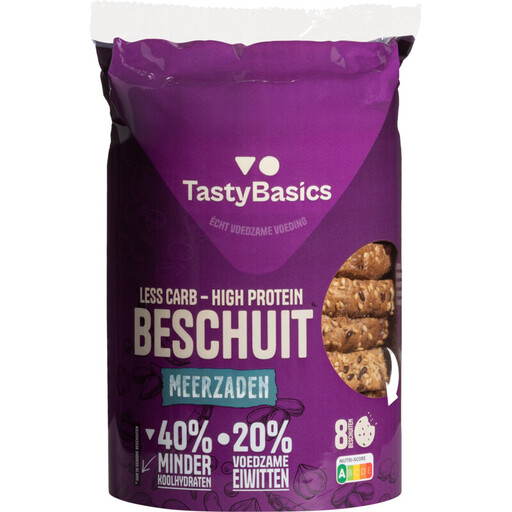 No image available
An option if you’re looking for seeded rusks for lunch. Before they’re served in a canteen, check the packaging for egg, sesame and gluten-containing cereals.
 No image available
An option if a variety of seeds matters to you when choosing lunch. Check the exact variety for vegan and wholemeal labelling, and for allergens such as wheat and sesame.
No. The presence of seeds doesn’t tell you whether the flour used is wholemeal. Jumbo explicitly labels Bolletje Donker Volkoren as 100% wholemeal; for any other variety, check its own wholemeal labelling and ingredients.
At the very least, check whether your chosen variety contains gluten-containing cereals, sesame or egg, as these are present in the rusks reviewed. The Netherlands Food and Consumer Product Safety Authority stresses that consumers must be able to access allergen information before buying. So make sure the information for the variety being served is available.
No, don’t assume they are: spelt is a type of wheat. For the spelt rusk with seeds and kernels reviewed, PLUS lists spelt flour as wheat; check the allergen information on the specific pack.
Once opened, store rusks in a dry place in a well-sealed container. The product information reviewed for Bolletje and PLUS also recommends storing them somewhere dark; follow the instructions on the pack you buy.