
Home workers comparing fibre content
You’re looking for seeded rusks and want to know how much fibre they contain. Compare the nutritional information per 100 g, and consider what you’ll put on your rusks for lunch, too.


When choosing seeded rusks for your work-from-home lunch, don’t rely on the ‘multiseed’ name alone. Decide whether you’re looking for a wholemeal base, a variety of seeds or a particular protein content. Then compare the nutritional information per 100 g and check the ingredients and allergens. A higher seed content doesn’t, by itself, mean the rusks are wholemeal.
You’re looking for seeded rusks and want to know how much fibre they contain. Compare the nutritional information per 100 g, and consider what you’ll put on your rusks for lunch, too.
You want wholemeal flour to be part of the base, not just seeds on or in the rusks. Check the ingredients list and the proportion of wholemeal flour, if stated.
You need to avoid certain ingredients or want to compare salt content. Check the current allergen information for each product and compare salt on the same basis: per 100 g.
First decide what matters most for your work-from-home lunch: the flour base, the mix of seeds or a particular nutritional value. Then compare specific products using their labels. A multiseed name doesn’t tell you how much wholemeal flour, fibre or salt they contain.
| What to consider | What to check when buying | Who it matters to |
|---|---|---|
| Fibre | Compare fibre per 100 g in the nutritional information, rather than relying on a description on the front of the pack. | For my lunch, I want to know how much fibre different seeded rusks contain. About 27% of consumers put this comparison first. |
| Allergens and ingredients | Read the current ingredients list and allergen information, paying particular attention to sesame, egg and cereals containing gluten if you need to avoid them. | If I need to avoid an ingredient, the rusks I choose must suit my dietary requirements. For about 33% of consumers, this is their main concern. |
| Wholemeal flour and seeds | Check which flour has been used and look for stated percentages of wholemeal flour and seeds. | As well as seeds, I want a recognisable wholemeal base, so visible seeds aren’t my only guide. About 20% of consumers prioritise this combination. |
| Nutritional values and portion size | Compare protein, sugars, fat and salt per 100 g, then check the values per portion for the number of rusks you eat. | As I might have several rusks for lunch, I want both a fair product comparison and a clear idea of my portion. About 20% of consumers give this their highest priority. |
Wheat flour may be the first ingredient in multiseed rusks. The type of flour used and the seeds added therefore answer different questions.
Check the flour in the ingredients list before choosing a wholemeal variety. Then compare the fibre per 100 g.
The seeded rusks examined list ingredients such as sesame and cereals containing gluten; some varieties also include egg in the ingredients list.
Check the allergen information on the pack every time you buy, even if you’ve bought the product before.
Rusks can vary in weight per piece, so the value per rusk isn’t always a good basis for comparing two products.
Compare the nutritional information per 100 g first, then consider how many rusks you have in your own lunch portion.
The name ‘rusk’ doesn’t tell you which salt has been used in a particular product.
If iodised baker’s salt is one of your criteria, check the ingredients list for the rusks in question.
These brands offer specific rusk varieties you can compare. A brand name alone doesn’t tell you about the ingredients or nutritional value of every variety.
A useful option if you want to compare Bolletje Vezelrijk Meerzaden with a dark wholemeal variety from the same brand.
A useful option if you’re mainly comparing protein and fibre per 100 g in multiseed rusks.
A useful option if you want to compare wholemeal rusks with seeds against a seeded variety made with wheat flour.
Albert Heijn’s category overview includes AH Meerzadenbeschuit and AH Biologisch Volkoren Beschuit Meerzaden, among other products.
These two products are multiseed rusks for anyone looking to compare seeds and nutritional values for a work-from-home lunch. If a wholemeal base or avoiding certain allergens is important to you, check the ingredients list for the variety you choose.
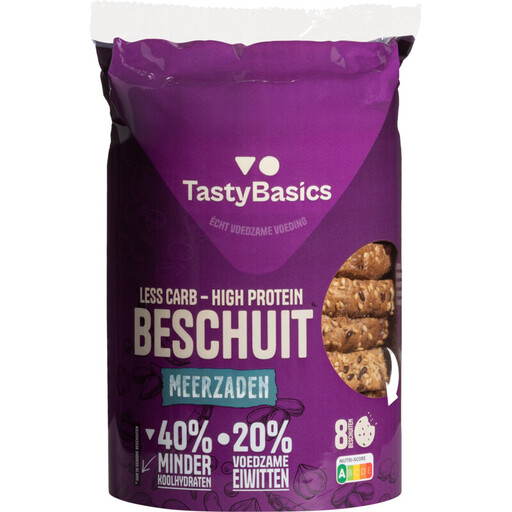 Image unavailable
An option if you’re looking for multiseed rusks for lunch and want to compare protein and fibre content. The pack contains 184 g; for a comparison with other rusks, check the nutritional information per 100 g.
Check the current packaging if you need to avoid egg, sesame or cereals containing gluten, or if the proportion of wholemeal flour matters to your choice.
 Image unavailable
An option if you want to stock up on multiseed rusks for several lunches. The pack contains 10 rusks; compare the nutritional information per 100 g if fibre or salt is important to you.
If you have a wheat or sesame allergy, check the current packaging. If you specifically want wholemeal rusks, check the flour base in the ingredients list.
No. Seeds don’t tell you which flour makes up the base. In the Bolletje multiseed variety examined, wheat flour is first in the ingredients list, while PLUS states that its wholemeal rusks with seeds contain 49% wholemeal wheat flour. So check the ingredients of the variety you want to buy.
Look out for sesame and cereals containing gluten; some of the varieties examined also contain egg. Always read the current packaging for the specific product. The Netherlands Food and Consumer Product Safety Authority explains that allergens required to be declared must be clearly indicated in the ingredients list.
First compare fibre, protein, sugars, fat and salt per 100 g. Then check the weight and number of rusks in your own lunch portion. Values per piece aren’t directly comparable when the pieces weigh different amounts.
No, don’t assume that applies to every rusk. Check the ingredients list for the specific product if iodised baker’s salt is one of your criteria.
Keep opened rusks in a dry, sealed container to maintain their crisp texture. Also check the storage instructions on the packaging of the product you buy.