Who might be interested in seeded rusks?

Buffet planner looking to offer a mix of seeds

You’re looking for rusks that contain seeds and kernels, rather than plain rusks to serve as a base for toppings. Check which seeds are in your chosen variety, and remember to include sesame in the information for guests.

Organiser responsible for allergen information

You’re serving unpackaged rusks on platters and want guests to know which allergens they contain before choosing. The varieties reviewed contain wheat or other cereals containing gluten, as well as sesame; some also contain egg. According to the Netherlands Food and Consumer Product Safety Authority, businesses serving unpackaged food must inform consumers about the allergens it contains.

Host looking to compare fibre content

You want to look beyond names such as ‘multiseed’ or ‘artisan’. PLUS’s product information lists 10 g of fibre per 100 g for the Bolletje multiseed rusks reviewed, and 5.2 and 5.8 g per 100 g respectively for two PLUS varieties. Always compare like for like, using the same unit, and check the ingredients too.

What should you look for when choosing?

For a buffet, first decide how guests will access allergen information for unpackaged rusks. Then compare the seed mix, fibre content and how many you’ll need for the platters.

What to consider What to check before buying Who it matters to
Allergen information Read the ingredients and allergen information on the pack you buy. Decide how guests can access this information for each variety served unpackaged. If I’m offering guests a choice of different rusks, I want to be able to clearly show which allergens each platter contains. This information is a top priority for around 42% of consumers.
Seed mix and fibre Check which seeds are listed in the ingredients and compare fibre per 100 g. Separately check whether a product is labelled wholemeal. I want to offer rusks with a noticeable mix of seeds and compare their fibre content. This is the top priority for around 33% of consumers.
Quantity and presentation Check the pack size, best-before date and storage instructions. Shortly before buying, check availability at your chosen shop. For the buffet, I want to have enough rusks ready without opening all the packs too early. This practical preparation matters most to around 25% of consumers.

Common mistakes

  • Assuming ‘multiseed’ means ‘wholemeal’ or ‘gluten-free’

    A seed mix doesn’t tell you which types of flour have been used. The Bolletje and PLUS seeded rusks reviewed list wheat or other cereals containing gluten.

    Check whether the product is labelled wholemeal, read the full ingredients list and check the allergens separately. Don’t assume anything from the product name.

  • Serving unpackaged rusks without clear allergen information

    The products reviewed contain sesame and wheat, and some also contain egg. According to the Netherlands Food and Consumer Product Safety Authority, food businesses serving unpackaged food must inform consumers about the allergens it contains.

    Prepare information for each platter using the pack you’re serving. If you’re providing the information verbally, make sure it’s readily available and display a clear notice telling guests where to ask for it.

  • Waiting until the day of the buffet to look for your chosen variety

    Availability of a particular type of rusk can vary by shop and over time. A product listing alone isn’t enough to plan the quantity you need without preparing in advance.

    Check stock at your chosen shop before buying, and keep unopened packs in reserve if rusks are a regular part of the buffet.

  • Assuming the product category tells you whether iodised baker’s salt is used

    The agreement published in the Government Gazette in 2008 encourages the use of iodised salt in bread and bread substitutes. It doesn’t tell you which salt was used in an individual pack of rusks.

    If you want to provide information about iodine at the buffet, check the label or ask the manufacturer about the specific variety you’ve chosen.

Brands to compare

Bolletje

The Vezelrijk Meerzaden Beschuit reviewed is an option if you’re specifically looking for a mix of sunflower seeds, linseeds, sesame seeds and pumpkin seeds.

  • PLUS lists 10 g of fibre per 100 g for this variety.
  • The product information lists wheat, cereals containing gluten and sesame. Don’t use these rusks as an alternative for guests who need to avoid these ingredients.

PLUS

The luxe naturelbeschuit met zaden and the speltbeschuit met zaden en pitten are two different varieties to compare for their ingredients and nutritional values.

  • PLUS lists 5.2 g of fibre per 100 g for the luxe naturel variety and 5.8 g per 100 g for the spelt variety.
  • The information for both varieties lists wheat or other cereals containing gluten, egg and sesame. Spelt rusks are not a gluten-free alternative.

TastyBasics

TastyBasics multiseed rusks are another variety to consider alongside other seeded rusks.

  • Albert Heijn lists a product called TastyBasics Beschuit meerzaden.
  • Before serving at your buffet, check the ingredients, nutritional information and allergens on the packaging of the variety you buy.

Seeded rusks at Joybuy

These two packs are options to compare when choosing seeded rusks for your buffet. Check the allergens on each pack you choose before finalising the information for your platters.

Bolletje multiseed rusks, pack of 10

Bolletje multiseed rusks, 10 pieces

Seeded rusks to serve as a separate option at the buffet.

The pack contains 10 pieces. According to the Joybuy product information, these rusks contain wheat and sesame; check the current pack before displaying allergen information beside the platter.

View at Joybuy
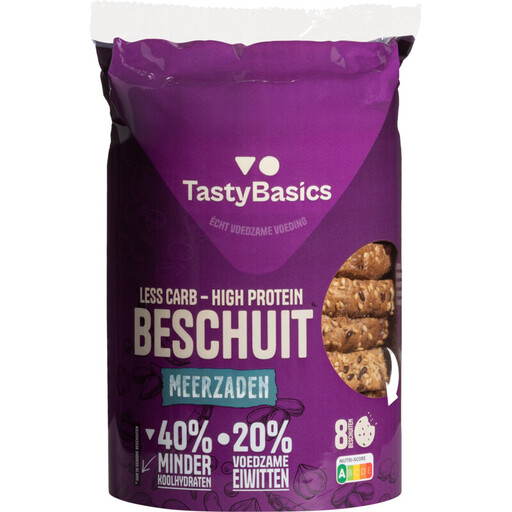
TastyBasics multiseed rusks, 184 g pack

TastyBasics multiseed rusks, 184 g

A second seeded rusk to consider if you want to tailor your buffet selection to the ingredients.

The pack is labelled 184 g. Check the ingredients and allergens on the pack you buy before serving this variety.

View at Joybuy

Frequently asked questions

Does allergen information need to be available for unpackaged rusks at a wedding buffet?

If a food business serves unpackaged rusks, guests must be able to get information about the allergens they contain. According to the Netherlands Food and Consumer Product Safety Authority, this can be provided in writing or, under certain conditions, verbally. In that case, the information must be readily available and a visible notice must tell guests where to find it. Use the details on the packaging of the actual variety being served for each option.

Are seeded rusks suitable as a gluten-free or sesame-free option?

Don’t assume they are based on the name ‘multiseed’. The Bolletje multiseed rusks reviewed list wheat and sesame; the PLUS varieties reviewed also list wheat or other cereals containing gluten and sesame, and contain egg too. Assess any alternative separately using its current label.

Can I assume Dutch rusks contain iodised baker’s salt?

No. Don’t assume which salt has been used based on the product category. The agreement published in the Government Gazette in 2008 encourages the use of iodised salt in bread and bread substitutes, but doesn’t describe the ingredients of the rusks you’ve chosen. Check the label or ask the manufacturer if you need product information about this.

How should I store rusks until the buffet begins?

Follow the storage instructions on the pack you buy. Keep packs sealed until you need the rusks and reseal any opened pack, so you don’t have to put them all out on the platters at once.
