When stocking up on seeded rusks, base your choice on the ingredients, nutritional information and best-before date shown, not just the name on the front of the pack. Compare fibre per 100 g if that matters to you, check for relevant allergens, and keep opened packs tightly sealed in a cool, dry, dark place. A seed mix alone tells you nothing about the iodine content of a particular rusk.
Who are these choices relevant to?
Stock-up shoppers who want to keep their rusks crisp
If you buy several packs at once, it’s important to check that the packaging is intact and note the best-before date. Once opened, the pack should be sealed properly. Voedingscentrum provides storage advice for opened rusks; always follow the instructions on the packaging too.
Shoppers comparing seeds and fibre
The name ‘multiseed’ doesn’t tell you which seeds are included or how much fibre the product contains. Compare the ingredients and nutritional information per 100 g, and check whether you’re looking for a wholemeal or spelt variety.
Shoppers who need to check ingredients
If you have an allergy or another reason to avoid certain ingredients, the current label is the deciding factor. Seeded rusks may contain wheat, egg or sesame, for example; check for any cross-contamination warnings too.
What should you look for when stocking up?
First, decide how many unopened packs you can store and which ingredients matter to you. Then compare the seeds and nutritional information of the varieties that meet your needs.
| What to consider | What to check when buying | Who it matters to |
|---|
| Crispness |
Check the best-before date and choose an intact pack. Store an opened pack according to the instructions on the packaging. |
If I buy several packs, I don’t want an opened one to go soft before I’ve finished it. For around 40% of consumers, keeping rusks crisp is the top priority. |
| Seeds and fibre |
Compare the ingredients, stated percentages of seeds and fibre per 100 g; check whether wholemeal or spelt suits your preference. |
I choose rusks specifically for their seeds or grain, and want to be able to compare varieties. This composition matters most to around 30% of consumers. |
| Allergens |
Read the current ingredients list, highlighted allergens and any cross-contamination warnings. |
If I need to avoid an ingredient, a suitable label takes priority over my preference for a particular seed mix. This is the first thing around 20% of consumers consider. |
| Iodine information |
Check product-specific information; don’t infer the iodine content of rusks from information about bread. |
I want to know what the packaging actually says about the ingredients, without treating bread and rusks as the same thing. This is the top question for around 10% of consumers. |
Common mistakes
-
Assuming ‘multiseed’ means a fixed amount of fibre
Bolletje Meerzaden lists 10 g of fibre per 100 g, while the PLUS seeded varieties described list 5.2 g and 5.8 g per 100 g. The product name alone doesn’t make this difference clear.
Compare the nutritional information per 100 g and check which seeds are listed in the ingredients.
-
Opening several packs at once
Opened rusks can go soft or stale. Voedingscentrum recommends keeping opened rusks in a kitchen cupboard for a month; their quality also depends on how well you seal and store the pack.
Ideally, open one pack at a time and follow the storage advice on the packaging.
-
Overlooking allergens because the focus is on seeds
The seeded rusks described may contain wheat, egg and sesame, among other ingredients. Preferring a certain fibre content or seed mix doesn’t replace checking the ingredients.
Read the current label every time you buy, including any cross-contamination warnings.
-
Assuming rusks provide the same iodine as bread
Voedingscentrum explains the role of iodised baker’s salt in bread in the Netherlands. This doesn’t tell you how much iodine a particular pack of rusks provides.
For rusks, rely on the product-specific information on the packaging, not a general statement about bread.
Brands and retailers to consider
Bolletje
The Meerzaden and Donker Volkoren rusks reviewed offer different points of comparison if you’re considering seeds, fibre or a wholemeal base.
- Meerzaden lists 10 g of fibre per 100 g; Donker Volkoren is described as 100% wholemeal and contains 5.8% seeds.
- These details apply to the varieties named. For Meerzaden, check the current label for ingredients including wheat and sesame.
PLUS
The seeded and spelt varieties reviewed can be compared using their listed ingredients and nutritional information.
- The standard seeded variety lists 5.2 g of fibre per 100 g; the spelt variety lists 5.8 g per 100 g.
- The varieties reviewed list ingredients including wheat, egg and sesame. Check the current label for each product.
Jumbo
Jumbo’s product information for Bolletje Vezelrijk Meerzaden lists the seed mix and gives instructions for storing the product after opening.
- The information is useful for comparing ingredients and storage advice for this Bolletje variety.
- This is information about a Bolletje product, not a seeded rusk made under the Jumbo own-brand label.
Albert Heijn
Albert Heijn lists products including AH Biologisch Volkoren beschuit meerzaden and Bolletje Sesam Beschuit.
- The product names help distinguish a wholemeal multiseed variety from a sesame variety.
- Check the current packaging to compare ingredients, allergens and nutritional information.
Lidl
Lidl lists Ambachtelijk beschuit meergranen in a 230 g pack.
- The product name and pack size give you a starting point when looking for multigrain rusks.
- Check the packaging for the grains, any seeds, allergens and nutritional information for this product.
Aldi
Aldi has a category for rusks, toast and crackers.
- The category is a useful starting point if you’re looking for rusks in store.
- Check in store whether seeded rusks are available and what the label says.
Seeded rusks at Joybuy
These two multiseed rusks are worth comparing for their pack sizes and suitability for keeping in stock. Before buying, check the best-before date and the current ingredients on the packaging.
 Image unavailable
Bolletje Multi-Seed rusks, 10 pieces
An option if you’re looking to buy seeded rusks in packs of 10.
If you need to avoid wheat or sesame, it’s important to check the current label. Seal the pack tightly after opening and store it according to the instructions on the packaging.
View at Joybuy
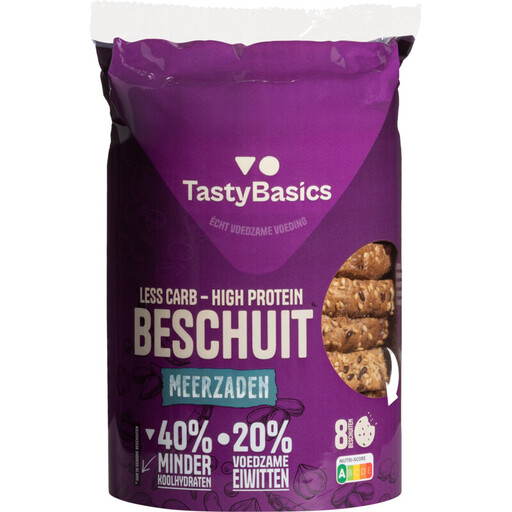 Image unavailable
TastyBasics Multiseed rusks, 184 g
An option if you’re looking for multiseed rusks in a pack with a stated weight of 184 g.
Check the current label if you need to avoid wheat, egg or sesame. Seal the pack tightly after opening and follow the storage advice.
View at Joybuy
Frequently asked questions
How long can I keep opened rusks?
Voedingscentrum recommends keeping opened rusks in a kitchen cupboard for a month. Seal the pack tightly and follow the storage advice on the packaging; if the rusks go soft or taste stale, their quality has deteriorated.
Should I check for sesame and gluten in seeded rusks?
Yes, if you need to avoid these ingredients: the seeded rusks discussed may contain sesame and wheat, among other ingredients. Read the current ingredients list and check for any cross-contamination warnings. The Netherlands Food and Consumer Product Safety Authority explains how allergens must be shown on labels.
Do seeded rusks automatically provide iodine?
No, you can’t tell from the seed mix. Voedingscentrum discusses iodised baker’s salt in bread in the Netherlands; check the information for the specific rusks before drawing any conclusions.
Is online product information enough when buying several packs?
Use online information to compare varieties, but check the current packaging before stocking up. Ingredients, allergens and nutritional information can change; the best-before dates on the packs you buy will also help you decide how many to keep in stock.


