What should you look for when choosing?
When choosing seeded rusks for a secondary school lunch, start with the factor that matters most to you. Wholegrain content, allergens and everyday practicality each call for a different check of the packaging.
| What to consider |
What to check when buying |
Who it matters to |
| Wholegrain and fibre |
Look for an explicit wholegrain claim and compare fibre per 100 g. ‘Multiseed’ is not the same as ‘wholegrain’. |
I want to choose a wholegrain base and see how much fibre the rusks contain. For around 40% of consumers, this combination is the most important factor when choosing a lunch option. |
| Allergens and school guidelines |
Read the allergen information and any ‘may contain’ statement on the current packaging; check with the school about its guidelines if needed. |
If a pupil needs to avoid certain ingredients, I want to know before packing whether this variety and its topping are suitable. For roughly 30% of consumers, this check comes first. |
| Taste and practicality |
Check which seeds are listed, the size and the storage instructions; think about which topping you’d like to pack with them. |
The pupil should enjoy eating the rusks, and lunch should be easy to pack. This is the main consideration for around 30% of consumers. |
Brands and retailers to compare
Compare specific varieties of rusks rather than treating an entire brand as one nutritional choice. The differences below apply to the products mentioned.
Bolletje
Bolletje offers wholemeal and multiseed rusks, among other varieties. Check each one for the qualities you’re looking for.
- According to its product information, Bolletje Vezelrijk Meerzaden Beschuit contains a range of seeds and kernels, and 10 g of fibre per 100 g.
- Wheat flour is listed first among the ingredients for this variety; the product information lists wheat and sesame.
Albert Heijn
AH Biologisch Volkoren beschuit meerzaden is a useful point of comparison if you’re looking for both wholegrain and seeds.
- Albert Heijn lists wholemeal wheat flour, linseed, sesame seeds and sunflower seeds for this variety, along with 11 g of fibre per 100 g.
- Check the allergens on the current packaging, too. Organic and wholegrain labels don’t tell you whether a product is suitable for someone with an allergy.
PLUS
At PLUS, you can compare wholemeal seeded rusks with luxury plain rusks with seeds without assuming they’re equivalent.
- PLUS states that its wholemeal variety contains 49% wholemeal wheat flour and 10,6 g of fibre per 100 g.
- The luxury plain variety contains 5,2 g of fibre per 100 g and does not list wholemeal flour as its first ingredient. Check the allergens for each variety separately.
Jumbo
Here, Jumbo is a retailer where you can compare individual Bolletje rusk varieties, rather than a rusk brand.
- Jumbo lists several different varieties, including Bolletje Volkoren, Donker Volkoren and Vezelrijk Meerzaden.
- Check the ingredients and current availability for the specific pack you choose.
ALDI / Goud Gebakken
ALDI lists Goud Gebakken wholemeal and plain rusks. These product types aren’t automatically seeded rusks.
- The wholemeal and plain varieties give you separate options to compare if you’re also considering products without seeds.
- Don’t use nutritional information for multiseed crackers as information about rusks: crackers are a different type of product.
Seeded rusks at Joybuy
These two seeded rusks are options to consider for a school lunch with a suitable topping. For each variety, check its wholegrain status, nutritional information and allergens separately, and make sure it meets the school’s guidelines.
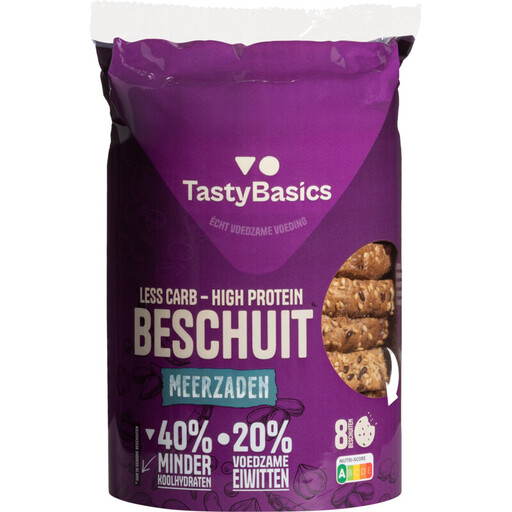 Image unavailable
TastyBasics Multiseed Rusks, 184 g
Seeded rusks to pair with a suitable lunch topping. Check that the ingredients and allergens are suitable for the pupil and meet the school’s guidelines.
Pack: 184 g. Only compare fibre values with other products if the nutritional information uses the same basis of measurement.
View at Joybuy
 Image unavailable
Bolletje Multi-Seed Rusk, 10 pieces
An option to consider if you want seeds in your rusks and plan to add a suitable lunch topping. If wholegrain is your priority, check that it’s explicitly stated on the packaging for this variety.
Pack: 10 pieces. Check the current allergen information before packing, and bear the school’s guidelines in mind.
View at Joybuy
Frequently asked questions
Are seeded rusks automatically wholegrain?
No. Seeds alone don’t tell you whether a product is wholegrain. Check the product description and ingredients for the variety you’ve chosen, and compare the fibre content separately using the same basis of measurement, such as per 100 g.
Which allergens should I check in seeded rusks?
At the very least, check the allergen information on the exact pack. The seeded rusks reviewed here list wheat and sesame; some varieties also list egg, oats or barley. Check for any ‘may contain’ information, too, and follow the school’s guidelines.
How can I keep rusks crisp until lunchtime?
Once opened, store the pack in a dry, sealed place, following the storage instructions for the AH and PLUS varieties reviewed here. If you’re using a moist topping, you can pack it separately and add it to the rusks at lunchtime.
Do all rusks contain iodine?
No. The rules for baker’s salt don’t mean that every rusk contains iodine. The Netherlands Food and Consumer Product Safety Authority explains that iodine compounds may be present in bread, bread substitutes and other bakery products through the use of baker’s salt, at a maximum of 65 mg of iodine per kg of salt. You can’t use this to determine whether a specific rusk contains iodine, or how much.


