
Picnickers who care about seeds and fibre
You’re looking for rusks with a clearly listed mix of kernels and seeds. The ingredients list and stated fibre per 100 g make it easier to compare different options.


Choose seeded rusks for your picnic in the park based on what matters most to you: the seed mix and stated fibre content, a wholegrain or organic label, or the nutritional values per 100 g. If you have allergies, always check the current packaging. Keep the rusks dry while transporting them, put any toppings that need to be chilled in a cool bag, and add them just before eating.
You’re looking for rusks with a clearly listed mix of kernels and seeds. The ingredients list and stated fibre per 100 g make it easier to compare different options.
You want a clear wholegrain or organic label, without assuming that it tells you whether the product contains gluten, sesame or egg.
You might be bringing cheese or egg mayonnaise and want to keep the rusks dry. Toppings that need to be chilled will also need a cool bag.
First, decide which feature matters most for your picnic. Then compare the ingredients and nutritional values on the same basis, and check how to transport your chosen toppings.
| What to consider | What to look for | Who it matters most to |
|---|---|---|
| Seeds and fibre | Compare the seed mix in the ingredients list and the stated fibre per 100 g. | I want to see the kernels and seeds in the ingredients and compare rusks with the same fibre content. This combination is a top priority for around 40% of consumers. |
| Transport and toppings | Take the rusks with you dry and in a well-sealed pack; use a cool bag for toppings that need to be chilled. | If I’m taking moist toppings or ones that need to be chilled, I want to add them in the park without the rusks going soft or the toppings warming up. This is the main priority for around 20% of consumers. |
| Allergens | Read the current allergen information, especially for sesame, wheat or other cereals containing gluten, and egg. | I’m also buying for someone who needs to avoid certain ingredients, so I don’t want to rely on the product name. Checking allergens is the top priority for an estimated 20% of consumers. |
| Wholegrain, organic and nutritional values | Look for a clear wholegrain or organic label and compare the nutritional values per 100 g. | When choosing, I want to know whether the product is explicitly labelled wholegrain or organic, or how its nutritional profile compares with another rusk. Around 20% of consumers give this the highest priority. |
Ingredients vary from one product to another. The options described here include sesame, wheat or other cereals containing gluten, and egg.
Read the current ingredients and allergen information on the packaging, especially if you’re buying for several people.
Moist toppings can make rusks less crisp. Toppings that need to be chilled must also stay cool during transport; the Netherlands Nutrition Centre recommends using a cool bag.
Pack the rusks dry, take the toppings separately and add them just before eating.
A seed mix on its own doesn’t tell you what flour has been used or whether a product is organic. Nutritional values also vary between the rusks described here.
Check the product description and ingredients list, and compare the nutritional values per 100 g.
The baker’s salt use agreement, published in the Government Gazette in 2008, is about encouraging its use. It doesn’t confirm which type of salt is used in any individual rusk.
Check the ingredients list or ask the manufacturer for product-specific information if the type of salt is relevant to your choice.
These examples relate to the specific rusk varieties mentioned, not the full range from each brand. Always check the current packaging before buying.
According to the product information, Bolletje High-Fibre Multiseed contains sunflower seeds, linseed, sesame and pumpkin seeds.
Albert Heijn’s product information describes both AH Multiseed Rusks and AH Organic Wholegrain Multiseed Rusks.
TastyBasics Multiseed Rusks are an option to compare based on the stated protein and fibre per 100 g.
Jumbo Robust Spelt Rusks are made with spelt and contain sunflower seeds, pumpkin seeds, sesame and linseed, among other ingredients.
PLUS Wholegrain Rusks with Seeds are made with 49% wholemeal wheat flour and over 25% seeds and kernels.
These two multiseed rusks are a good match if you want to compare the seed mix and stated nutritional values for a picnic in the park. Take them with you dry, and check the packaging if allergens are important to your choice.
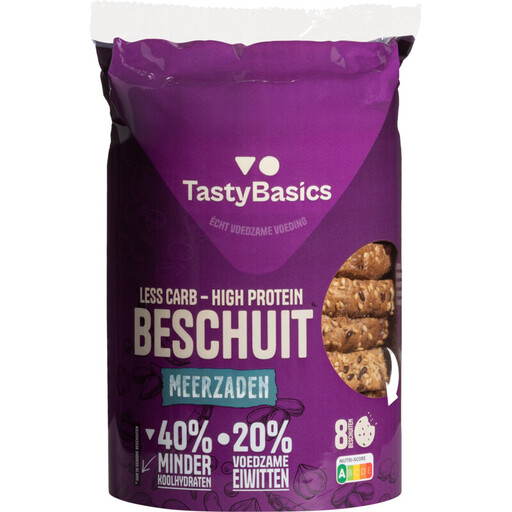 Image unavailable
An option if you’re looking for seeded rusks for your picnic and want to compare the protein and fibre per 100 g.
 Image unavailable
An option if you’re looking for rusks with several types of seeds for your picnic and want to include the fibre content in your comparison.
If you’re having them with moist toppings, it’s best to take the rusks separately and add the toppings just before eating, so they stay crisp. The Netherlands Nutrition Centre recommends using a cool bag for food that needs to be kept chilled.
It depends on the specific product: several varieties discussed here contain sesame and wheat or other cereals containing gluten. Always read the current allergen information on the packaging.
No, the name doesn’t automatically tell you what type of flour has been used or how the product was made. AH Organic Wholegrain Multiseed Rusks explicitly states both attributes; for other products, check their own labelling and ingredients list.
Check the ingredients list or ask the manufacturer about the specific rusks. The baker’s salt use agreement in the 2008 Government Gazette describes efforts to encourage its use, but doesn’t tell you which type of salt is in each individual product.