
Office lunchers looking for seeds and fibre
You want rusks with seeds and kernels you can recognise. Compare the ingredients and the stated fibre content per 100 g.


Choose seeded rusks for your office lunchbox based on the types of seeds they contain and their fibre content. If a wholemeal base matters to you, look specifically for wholemeal flour on the label. When stocking a shared lunch cupboard, always check the allergens: the varieties covered here contain sesame and cereals containing gluten, and some also contain egg. Keep an opened pack sealed and somewhere dry to help the rusks stay crisp.
You want rusks with seeds and kernels you can recognise. Compare the ingredients and the stated fibre content per 100 g.
You’re buying rusks for a shared lunch cupboard and need to check whether a variety contains sesame, egg or cereals containing gluten.
You’re specifically looking for wholemeal flour or an organic option, and don’t want to assume either from the words ‘with seeds’ alone.
Start with what matters most for your lunchbox: the seeds, allergens in a shared supply, or the precise claims on the label.
| What to consider | What to check | Who it matters to |
|---|---|---|
| Seeds and fibre | Check which seeds and kernels are listed, and compare the fibre content per 100 g. | I want recognisable seeds and kernels in my lunchbox, and I also want to know how much fibre the rusks contain. For around 33% of consumers, this combination is the deciding factor. |
| Allergens | Check the latest ingredient and allergen information for sesame, egg and cereals containing gluten. | If colleagues are sharing the same lunch supplies, I want to know who each variety is suitable for. Checking allergens is the top priority for around 42% of consumers. |
| Wholemeal and labelling | Check whether wholemeal flour and any organic claims appear on the exact product; compare the salt content per 100 g. | I’m specifically looking for a wholemeal or organic option and don’t want to rely on the product name alone. For around 25% of consumers, checking the label is most important. |
The multiseed rusks discussed here contain sesame and cereals containing gluten; some varieties also list egg on the label. The product name alone doesn’t tell you enough about allergens.
Check the current packaging every time you buy. If someone needs to avoid certain ingredients, provide a separate, clearly labelled alternative.
Seeded rusks don’t automatically have a wholemeal base. An organic claim also doesn’t tell you what type of salt has been used.
Check the ingredients for the exact variety. If you want to know whether it contains iodised salt, look for an explicit mention of baker’s salt or iodised salt.
Moisture can make rusks lose their crisp texture, which is a problem if you want a pack to last through several lunch breaks.
Seal the pack tightly after use and store it somewhere dry, out of direct sunlight.
Bolletje High-Fibre Multiseed Rusks are worth considering if you want to compare the types of seeds in your lunchbox rusks.
TastyBasics Multiseed Rusks are worth considering if you’re looking for wholemeal flour and specific nutritional values in a multiseed rusk.
PLUS Wholemeal Rusks with Seeds are a supermarket own-brand option if you’re looking for a wholemeal base with seeds and kernels.
These products are a good fit if you’re looking for seeded rusks for your lunchbox. If you’re stocking a shared office cupboard, compare the ingredients and allergens on the packaging you buy.
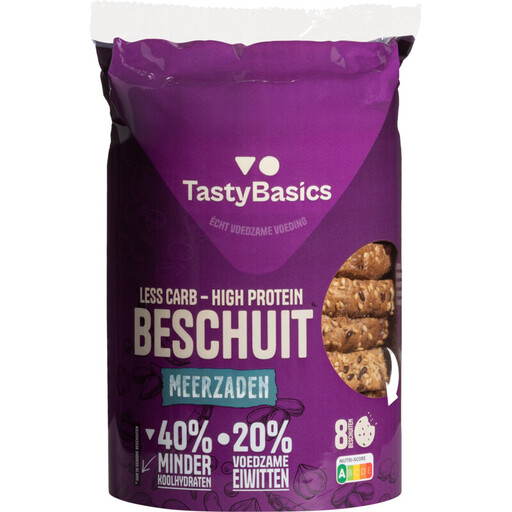 Image unavailable
An option to consider if you’re looking for seeds and a wholemeal base for your lunchbox. Check the current packaging for ingredients and allergens, particularly egg, sesame and cereals containing gluten.
 Image unavailable
If you want a variety of seeds in your lunchbox, Bolletje lists sunflower seeds, linseed, sesame seeds and pumpkin seeds in this 10-piece pack. Jumbo states that it contains 10 g of fibre per 100 g. If you’re adding it to a shared supply, check the current label for sesame and cereals containing gluten.
No. According to the product information from Albert Heijn and PLUS, the varieties discussed from those brands list wholemeal flour on the label, while wheat flour is first on the ingredients list for Bolletje High-Fibre Multiseed Rusks. So check the flour used in the exact variety you’re considering.
At the very least, check for sesame and cereals containing gluten; some of the varieties discussed also list egg. Read the current packaging for every product you add to the office cupboard.
Store an opened pack somewhere dry and seal it tightly, for example in an airtight container. Keep the rusks out of direct sunlight and away from moisture too.
No. You can’t tell from ‘with seeds’ or from the word ‘salt’ alone. The Netherlands Nutrition Centre says that using baker’s salt in bread is not compulsory; for a specific rusk, check whether the packaging explicitly mentions baker’s salt or iodised salt.