
If fibre is your main priority
You're looking for a crunchy rusk to enjoy later in the evening and comparing the fibre content per 100 g, rather than relying on a claim on the front of the pack.


When choosing seeded rusks for a late-night snack, don't judge them by the seeds you can see alone. Compare the ingredients and nutritional values per 100 g, too. Prioritise fibre, protein or organic ingredients if they matter to you, and if you have an allergy, always check the current packaging for sesame, cereals containing gluten and egg, among other things.
You're looking for a crunchy rusk to enjoy later in the evening and comparing the fibre content per 100 g, rather than relying on a claim on the front of the pack.
You choose rusks mainly for the seeds. The ingredients list shows you which types they contain; if you have a sesame allergy, it's especially important to check.
You might want to compare protein and salt, look for organic ingredients or take allergens into account. In that case, the information for the specific variety matters more than your general impression of the packaging.
First check for any ingredients you need to avoid, then compare the features that matter most for your late-night snack. The Netherlands Nutrition Centre recommends comparing the nutritional values of similar products per 100 g.
| What to consider | What to check | Who it matters to |
|---|---|---|
| Fibre | Compare the fibre per 100 g and check the ingredients list to see whether wholemeal flour is used. | If I have rusks late in the evening, I mainly want to compare how much fibre each variety contains. Fibre is the top priority for around 33% of consumers making this choice. |
| Seeds and texture | Check which seeds are listed and whether their proportion is stated; look out for sesame, too. | I choose rusks for the seeds and a hearty crunch, not just for the name on the pack. Around 27% of consumers making this choice prioritise seeds and texture above all else. |
| Nutritional values | Compare protein, salt, energy and sugars per 100 g across similar rusks. | When choosing a variety in the evening, I mainly want to weigh up its nutritional values. For around 20% of consumers, this is their main concern when buying. |
| Allergens and ingredients | Check the current ingredients list for sesame, cereals containing gluten and egg, among other things. | If I need to avoid certain ingredients, suitability comes before my preference for seeds or fibre. For around 20% of consumers, checking this is the priority when making this choice. |
A claim such as ‘high in fibre’ doesn't tell you how two rusks compare on other nutritional values. That's why the Netherlands Nutrition Centre recommends comparing similar products per 100 g.
Compare the nutrition tables side by side and check the salt, energy and ingredients, too.
The varieties described contain sesame and cereals containing gluten; some also contain egg. The presence of seeds alone doesn't tell you whether a product is suitable if you have an allergy or follow a vegan diet.
Check the ingredients and clearly highlighted allergens on the packaging of the variety you're buying.
According to the Netherlands Nutrition Centre, bread does not have to be baked with baker's salt. So don't assume rusks contain iodised baker's salt without checking the label.
Check the current packaging to see whether baker's salt or iodised salt is explicitly listed among the ingredients.
Bolletje High-Fibre Multiseed rusks are worth considering if fibre and a range of seeds matter to you.
At AH, you can compare an organic wholemeal multiseed rusk with other varieties.
TastyBasics offers multiseed rusks that you can compare with other varieties if protein is an important factor for you.
PLUS Wholemeal Seeded Rusks are an own-brand option if you want to compare wholemeal ingredients and the proportion of seeds.
These two multiseed rusks are worth considering if you're mainly looking for a crunchy seeded rusk for a late-night snack. Compare the variety and packaging if fibre, protein or allergens are important to your choice.
 No image available
An option if you're mainly after seeded rusks for a late-night snack. The pack contains 10 rusks; check the packaging for the nutritional values and allergens for this variety.
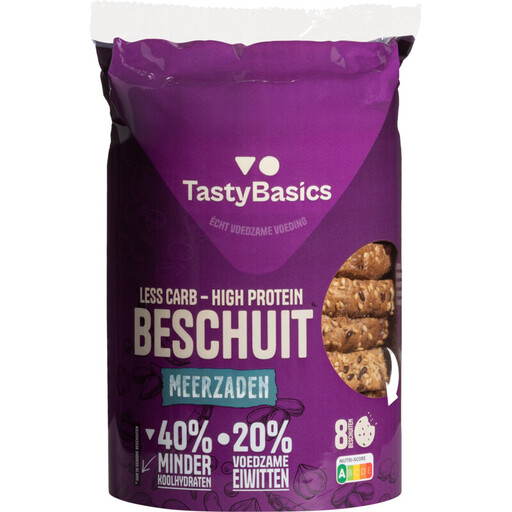 No image available
A variety to compare if you're looking at fibre and protein as well as seeds. The 184 g variety listed by PLUS contains 11 g of fibre and 20 g of protein per 100 g; if you have an allergy, check the current packaging for cereals containing gluten, egg and sesame, among other things.
Not just because they contain seeds. Compare the nutritional values per 100 g of similar rusks, then consider how much you eat and what you put on them.
Yes, if these allergens are relevant to you: the varieties described here list sesame and cereals containing gluten, and some also contain egg. Check the current packaging for the specific variety.
No, don't assume they do. According to the Netherlands Nutrition Centre, bread does not have to be baked with baker's salt. Check the packaging to see whether baker's salt or iodised salt is listed as an ingredient.
Keep the rusks dry and in a well-sealed pack. Bolletje says its High-Fibre Multiseed rusks should be stored in a dark, dry place in a sealed pack once opened. For other varieties, follow the storage instructions on the packaging.