What should you look for when choosing?
First decide whether you’re mainly looking for rusks to top, a wholemeal base or a suitable option for your guests. Then check how many you need and whether the variety you’ve chosen is available.
| What to consider |
What to check when buying |
Who it matters to |
| Texture and toppings |
Check the size and number of rusks, and think about which toppings you want to serve. |
If I want to add generous toppings to my rusks, I look for a size that works well. For around 33% of consumers, texture and toppings are said to be the main reason for choosing. |
| Fibre and wholegrain |
Look for the word ‘wholemeal’ if you want a wholemeal base, and compare the fibre content per 100 g in the nutrition table. |
If you mainly want to compare fibre content, the word ‘multiseed’ on its own isn’t enough. For around 25% of consumers, fibre or wholegrain is said to be the priority. |
| Allergens |
Read the allergen information on the current packaging, including any warnings relevant to your guests. |
If a guest has a food allergy, I need to know whether the rusks I’ve chosen are suitable before serving them. Allergens are said to be the first consideration for around 25% of consumers. |
| Quantity and availability |
Check the pack size and the number of rusks per pack, and see whether the variety is available from your chosen shop. |
For a group, I want to be able to serve enough rusks without relying on one hard-to-find variety. Around 17% of consumers are said to prioritise quantity and availability. |
Brands to compare
These brands offer seeded rusk varieties that you can compare for a coffee break. Check the current packaging for each product: a brand name alone doesn’t tell you what’s in every variety.
Bolletje
Bolletje describes its Vezelrijk Meerzaden Beschuit as a variety containing sesame seeds, pumpkin seeds, sunflower seeds and linseed.
- A clearly named seed mix makes it easy to see which variety you’re comparing.
- The product name is no substitute for checking the nutritional information and allergens on the packaging.
Albert Heijn
Albert Heijn lists products including AH Meerzadenbeschuit and AH Biologisch Volkoren Beschuit Meerzaden.
- The different product names help you distinguish between a multiseed variety and one that’s explicitly wholemeal.
- Compare the ingredients, fibre content and allergens on each individual pack; don’t assume they’re the same as those of another AH variety.
PLUS
PLUS lists luxury plain rusks with seeds and wholemeal rusks with seeds as separate varieties.
- According to PLUS product information, the wholemeal variety contains over 25% seeds.
- Check availability at your chosen branch; PLUS displays this information for each shop.
TastyBasics
Albert Heijn and Jumbo both have product pages for TastyBasics Beschuit Meerzaden.
- You can compare the same named multiseed variety at both retailers.
- Check the packaging for the latest ingredients, nutritional information and allergens.
Seeded rusks at Joybuy
These two Joybuy products are multiseed rusks, ideal if you want to serve a seeded variety with your coffee. Before choosing, compare the pack sizes, nutritional information and allergens, especially if you’re serving several guests.
 No image available
Bolletje multiseed rusks, 10 pieces
A multiseed variety to consider if you want to serve rusks with a selection of toppings.
The product name states that the pack contains 10 pieces. Check the current packaging for ingredients and allergens; if you’re looking for wholemeal rusks, don’t rely on the word ‘multiseed’ alone.
View on Joybuy
 No image available
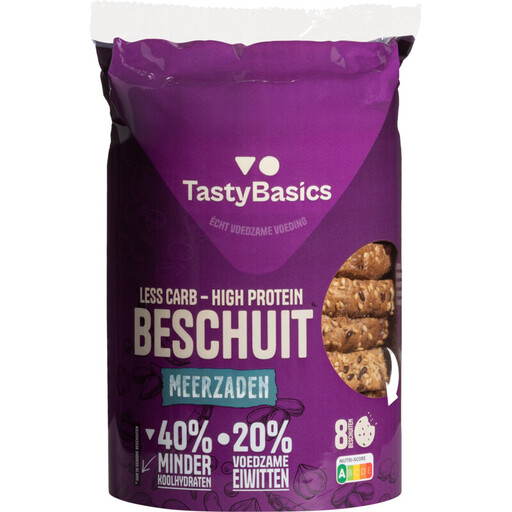
TastyBasics multiseed rusks, 184 g
A multiseed variety to compare if you’re looking for rusks to serve with your coffee.
The product name states that the pack weighs 184 g. Check the number of rusks if you’re planning portions for guests, and read the current packaging for ingredients and allergens.
View on Joybuy
Frequently asked questions
Are seeded rusks automatically wholemeal?
No. The words ‘with seeds’ don’t confirm that the rusks have a wholemeal base. Look for ‘wholemeal’ on the packaging and read the ingredients if that’s your main criterion. If you want to compare fibre content, also check the value per 100 g in the nutritional information.
How should I store an opened pack of multiseed rusks?
After opening, store Bolletje Vezelrijk Meerzaden Beschuit in a cool, dry, dark place in a sealed container; Jumbo gives this storage advice for that variety. For another pack of rusks, follow the instructions on its own packaging. Add toppings just before serving to stop the rusks going soft.
What should I check if a guest has a food allergy?
Read the allergen information on the packaging of every pack of rusks you plan to serve. According to the Netherlands Food and Consumer Product Safety Authority, this information must appear on the label of prepacked products. Check the pack you’ve bought again, even if you’ve already read the product information online.
Do rusks always contain iodine from baker’s salt?
No. It can’t be assumed that baker’s salt is used in every rusk. The Netherlands Nutrition Centre says that baker’s salt contains more iodine than table salt, but bakers aren’t required to use it. Check the ingredients on the specific pack or ask the manufacturer which salt was used.


