
Fans of texture and presentation
If you’re topping small rusks for a dinner party, visible seeds and kernels can make a difference to how they look. Check the listed ingredients rather than relying on a dark colour or the words ‘multigrain’.


If you want to serve small topped bites with visible seeds, choose rusks whose ingredients actually list seeds and kernels. If wholemeal or fibre matters more to you, compare the pack’s claims and the nutritional values per 100 g. Whatever you choose, check that the allergens are suitable for everyone at the table.
If you’re topping small rusks for a dinner party, visible seeds and kernels can make a difference to how they look. Check the listed ingredients rather than relying on a dark colour or the words ‘multigrain’.
If the grain content matters to you, compare the nutritional values per 100 g and check what the packaging says about wholemeal ingredients. Seeds alone don’t make a rusk wholemeal.
Your choice for guests also depends on the ingredients. Check the current information for each variety, including wheat, gluten-containing cereals, sesame and, where relevant, egg, as well as any warnings that matter to your guests.
First, decide what matters most for your topped bites: the texture of the seeds, the grain content or ingredients that suit everyone. Then compare the details on the packs. ‘Multigrain’, visible seeds and ‘wholemeal’ don’t mean the same thing.
| What to consider | What to check when buying | Who is this most important for? |
|---|---|---|
| Texture and size | Which seeds and kernels are listed in the ingredients? Is the size right for the toppings you want to serve? | When I’m making small bites, I want the seeds to be visible and the rusk to work with my toppings. For around 50% of consumers, this combination of texture and presentation comes first. |
| Fibre and wholemeal content | Compare fibre per 100 g and check any wholemeal claim against the ingredients list. | The grain content matters more to me than the amount of visible seeds. Around 30% of consumers prioritise fibre and a verifiable wholemeal claim. |
| Allergens | Read the current allergen information, paying particular attention to wheat, gluten-containing cereals, sesame and, where relevant, egg. | When I’m serving others, I need to know whether the ingredients are suitable for them. Avoiding relevant allergens is the first requirement for around 20% of consumers. |
Seeded rusks may list wheat flour as their first ingredient. The Voedingscentrum distinguishes between seeds in a product and the composition of the grain flour used.
Check whether the current packaging describes the product as wholemeal, and also read the ingredients list and fibre value per 100 g.
Seeded varieties may contain wheat and sesame; some also list egg among the ingredients. So you can’t assume that every product from a brand is suitable for everyone.
Ask your guests in advance which ingredients they need to avoid, then check the allergen information on the pack of the variety you choose.
Whether you can buy a particular type of rusk may depend on which shop you choose. This can be especially inconvenient if you’ve already planned your toppings around a particular size or variety.
Check your chosen shop and current availability before planning your menu around one product.
NBC / brood.net describes agreements between the government and the baking industry on iodised baker’s salt. The product category alone doesn’t tell you which type of salt has been used in a particular rusk.
If you want to know what a specific variety contains, check that product’s ingredients information.
These brands and shops give you a starting point for comparing rusk varieties. Always assess the specific product: a claim made about a range won’t necessarily apply to every pack.
PLUS describes Bolletje Vezelrijk Beschuit Meerzaden as a rusk containing, among other ingredients, sunflower seeds, linseed, sesame seeds and pumpkin seeds.
Albert Heijn lists an AH Biologisch Volkoren Beschuit Meerzaden in its range.
Jumbo’s rusk range includes plain, wholemeal, high-fibre and grain-and-seed varieties.
Lidl lists Ambachtelijk beschuit meergranen in a 230 g pack.
ALDI lists plain and wholemeal rusks in its range.
PLUS lists both Bolletje Vezelrijk Beschuit Meerzaden and PLUS Beschuit luxe naturel met zaden.
These products are worth considering if you’re looking for seeded rusks or a wholemeal variety to top. Pay particular attention to the product format of the TastyBasics option: check that it matches the type of rusk you want to serve.
 No image available
An option to consider if you’re looking for seeded rusks to top for a get-together. The product name states that there are 10 pieces; check the current ingredients and allergen information on the pack to make sure they’re suitable for everyone.
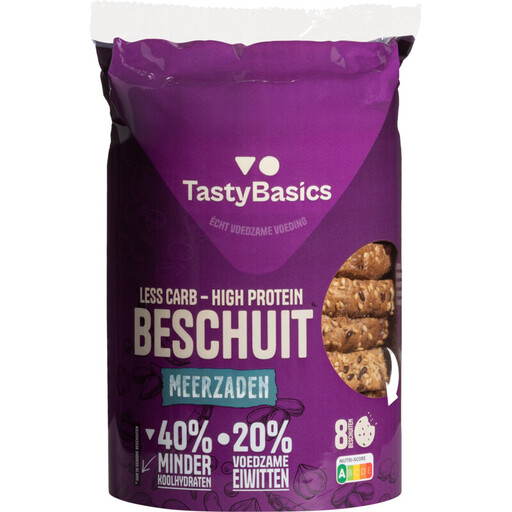 No image available
This multiseed option may be worth considering if you’re looking for something seeded to top. The pack contains 184 g; check the exact product format and current allergen information before buying.
 No image available
An option to consider if the wholemeal claim matters more to you than visible seeds. The product name states that there are 10 pieces; check the current pack for the grain content, seeds and allergen information.
Compare their nutritional values per 100 g so that differences in portion size don’t skew the comparison. The Voedingscentrum recommends comparing products per 100 g; also read the ingredients lists to see which seeds they contain.
No. Seeds and kernels don’t automatically make a rusk wholemeal. Check the wholemeal claim and ingredients list on the specific pack rather than relying on the colour or the word ‘multigrain’.
At the very least, check for wheat and sesame; depending on the variety, egg may also be relevant. Read the current packaging and any additional allergen warnings to make sure the rusks are suitable for everyone at the table.
Follow the storage instructions on the pack you’ve chosen and add the toppings just before serving. The product information for the Bolletje and PLUS varieties mentioned recommends storing them in a dry place and sealing the pack well after opening.