
Breakfast fans who keep an eye on wholemeal ingredients and fibre
You’re looking for crisp rusks for a weekend breakfast and want to check the wholemeal flour and fibre content, rather than judging by the seeds on the packaging.


For a weekend breakfast, choose seeded rusks according to what matters most to you. Check the flour and compare fibre per 100 g if wholemeal ingredients and nutritional value are your priorities, or look at the ingredients list if you’re mainly interested in particular seeds and texture. The name ‘multiseed’ alone doesn’t tell you how much wholemeal flour or fibre a rusk contains. When buying, check the allergens on the current packaging too.
You’re looking for crisp rusks for a weekend breakfast and want to check the wholemeal flour and fibre content, rather than judging by the seeds on the packaging.
You choose mainly by the seeds in the ingredients list, such as sunflower seeds, linseed, sesame or pumpkin seeds.
You want to know before buying whether a variety fits your diet. For the Bolletje and PLUS rusks discussed here, allergens include cereals containing gluten and sesame; the PLUS wholemeal variety also contains egg.
Decide what matters most for your weekend breakfast. Then compare similar rusks by checking their ingredients and nutritional information per 100 g. Always read the current packaging for allergen details.
| What to consider | What to check | Who it matters to |
|---|---|---|
| Wholemeal ingredients and fibre | Check which flour is listed in the ingredients and compare the fibre per 100 g. | When I eat rusks for breakfast, I want to see whether I’m choosing a wholemeal variety and how much fibre it contains. This is said to be the main consideration for around 40% of consumers. |
| Seeds and texture | Check which seeds are listed and look at their proportions if this information is on the packaging. | For my weekend breakfast, I’m mainly looking for seeded rusks with flavours and textures I enjoy. This is said to be the top priority for around 30% of consumers. |
| Ingredients and allergens | Check the ingredients list and allergen information on the current packaging. | Before buying, I need to check whether the ingredients fit my diet. Around 30% of consumers are expected to make this their first priority. |
Seeds don’t tell you which flour has been used or how much fibre the rusks contain. PLUS states that its wholemeal seeded rusks contain 10,6 g of fibre per 100 g, while its premium plain seeded rusks contain 5,2 g per 100 g.
Compare the flour in the ingredients list and the nutritional information for the varieties you’re considering, always per 100 g.
A seed mix may contain sesame. The varieties discussed here also contain cereals with gluten, and the PLUS wholemeal variety contains egg.
Read the ingredients and allergen information on the packaging before choosing a variety that needs to meet your requirements.
According to the Netherlands Nutrition Centre, using baker’s salt in bread is not compulsory. So don’t assume it has been used in seeded rusks either without checking the label.
Check the ingredients list if baker’s salt is important to your choice.
Ingredients and allergen information can change, as Albert Heijn notes in its product information.
Use the online description to compare varieties, then check the packaging again before use.
Bolletje describes its Fibre-Rich Multiseed Rusks as extra-large rusks containing sunflower seeds, linseed, sesame and pumpkin seeds, among other ingredients.
Albert Heijn lists both multiseed rusks and organic wholemeal multiseed rusks under its own brand.
Jumbo lists Bolletje Fibre-Rich Multiseed Rusks with sesame, pumpkin seeds, sunflower seeds and linseed.
PLUS lists both premium plain seeded rusks and wholemeal seeded rusks. According to PLUS, the wholemeal variety contains over 25% seeds.
Lidl lists artisan multigrain rusks in a 230 g pack. ‘Multigrain’ isn’t the same as a product that specifically lists seeds.
Alongside regular rusks, ALDI also lists wholemeal rusks in its product range overview.
These two rusks are a good fit for a weekend breakfast with seeds. Pack sizes differ, so compare the current nutritional information and allergen details before choosing.
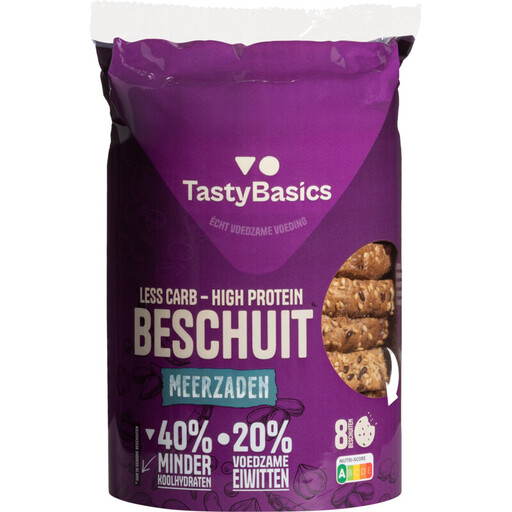 Image unavailable
An option if you’re looking for seeded rusks for a weekend breakfast. Before choosing, check the current packaging for the grains and seeds used, as well as allergen information.
 Image unavailable
An option if you’re looking for a 10-piece pack of multiseed rusks for a weekend breakfast. If the ingredients are important to your choice, read the current ingredients and allergen information.
It depends on the product, so check the ingredients and allergens on the current packaging. Bolletje lists wheat and sesame in its Fibre-Rich Multiseed Rusks. The PLUS wholemeal variety discussed here contains wheat, barley, oats, egg and sesame, among other ingredients.
No. The name ‘multiseed’ doesn’t tell you how much fibre a rusk contains. Compare the nutritional information per 100 g: PLUS lists 10,6 g of fibre per 100 g for its wholemeal seeded rusks and 5,2 g per 100 g for its premium plain seeded variety.
No. If baker’s salt matters to your choice, check whether it’s listed in the ingredients. The Netherlands Nutrition Centre says that using baker’s salt in bread isn’t compulsory, so don’t assume it’s present based on the product name.
Follow the storage instructions on the packaging and seal it securely after opening. For the varieties discussed here, PLUS recommends storing them somewhere cool, dry and dark.