
Vandaag of morgen in huis

Kwaliteit gegarandeerd

Welkomstaanbiedingen ontgrendelen: GRATIS bezorging | Tot 80% korting | Gratis 30 dagen JoyPlus-proefperiode
Download de app
A scrubbing brush with a long handle is useful for floors, patios, garages, tiles and grouting. However, not every floor brush is suitable for intensive scrubbing. The handle may be too short, the bristles may be too soft or the grip may become slippery as soon as it gets wet.
If you only look at the price or an eye-catching product photo, you risk buying a brush that quickly becomes misshapen or does not offer enough grip. Use the following checkpoints to compare models more practically and avoid making the wrong purchase.
“Long handle” does not, by itself, tell you very much. Always check the total length and see where the grip is positioned. A handle of around 35 to 40 cm may be suitable for spot cleaning, but a longer broom handle may be more comfortable for large floors.
A hand brush with a handle that is too short will still force you to bend deeply. Also consider the weight: a heavy brush can become tiring during prolonged use, while a model that is too lightweight may feel less stable when scrubbing firmly.
A stiff scrubbing brush is designed for ingrained dirt, mud and build-up. That does not mean that stiff bristles are safe for every surface. They can cause scratches on varnished wood, delicate plastics, polished surfaces or glass.
Therefore, use a sturdy brush mainly on suitable tiles, concrete, grouting, patio boards in accordance with the care instructions, and other robust surfaces. If in doubt, test it on an inconspicuous area first.
Water and cleaning product can get onto the handle during cleaning. A brush with an anti-slip handle will generally give you more control than a completely smooth plastic handle. Also check that the bristles are closely packed and firmly secured in the head.
Marketing terms such as “heavy-duty” are not enough to assess quality. Instead, look at verifiable details: material, bristle length, dimensions, handle construction and care instructions.
For household use, a handle measuring 35 to 40 cm is a practical mid-range size for bathroom tiles, small patios and localised stains, for example. A 36 cm model allows you to work in a slightly more upright position than with an ordinary hand brush.
Pay attention to the difference between the length of the shaft, the length of the handle and the total product length. Some models only state one of these measurements.
Polypropylene, often referred to as PP, is widely used for cleaning brushes. The material is moisture-resistant and, according to the product information for the 36 cm model, suitable for contact with cleaning products. The stated 29 mm-long, stiff PP bristles are designed for more intensive scrubbing.
A dense brush head covers more surface area with each stroke. For grouting, a narrow, targeted head may sometimes be more convenient than a wide floor brush. So choose based on the task:
A TPR rubber layer on the handle can, according to the product specifications, provide a softer feel and more grip when used wet. This is practical for longer cleaning jobs, but also check that the brush feels comfortable in your hand.
Rinse the brush after every use, remove dirt from the bristles and allow it to dry completely. Ideally, store it upright in a dry, well-ventilated place. Replace the brush when the bristles are visibly bent or coming loose. Do not use it on extremely hot surfaces and always follow the instructions on the cleaning product packaging.

Why it suits this profile: This double-ended work brush is designed for everyday cleaning in areas including the kitchen, bathroom and garage. It is a good choice for anyone who wants to tackle different surfaces with one compact brush.
The product information mentions several areas and surfaces of use, allowing you to check in advance whether the brush is suitable for your cleaning task. This model is not a replacement for a long handle when cleaning large floors.
Double-brush design, plastic construction and suitability for kitchens, bathrooms, garages, tiles and other surfaces.
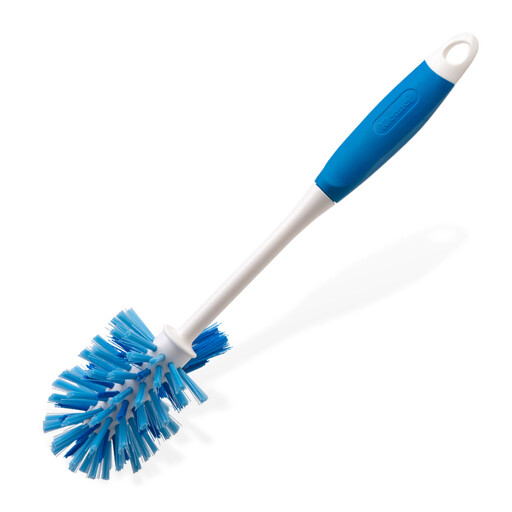
Why it suits this profile: The combination of a 36 cm handle, a wide head and a TPR grip is well suited to households that want to clean floors, tiles, patios and grouting with one sturdy brush.
The length, 29 mm bristle length and TPR handle are clearly specified. This means you do not have to rely solely on terms such as “sturdy” or “comfortable”.
36 cm-long handle, dense 29 mm PP bristles, TPR rubber for grip and a plastic construction that, according to the product information, is resistant to moisture and cleaning products.

Why it suits this profile: This set is designed for precise, localised cleaning, such as grouting, edges and stubborn dirt where a wide floor brush is less manoeuvrable.
The product name specifies a double-sided design and a combination of nylon, stainless steel and copper-plated steel wire. Choose the side that suits the surface and test it on a small area first.
Three different brush materials in one set and a double-sided design for targeted cleaning tasks.
We have put together a complete, up-to-date list of products that fully meet these strict selection criteria and the applicable European safety regulations.
Yes, provided that the brush head is sufficiently narrow and the bristles are not too coarse for the tile. A wide floor brush works well on larger surfaces, but a brush for patios and grouting or a double-sided detail brush is more practical for narrow joints. Always test a small area first.
Rinse the bristles thoroughly with water after use. Remove sand, hair and cleaning product residue by hand. Allow the brush to dry upright or in a well-ventilated place. Do not leave it wet for long periods in a sealed bucket or cupboard.
Its lifespan depends on how often it is used, the surface, the cleaning products used and how it is stored. A brush will not last as long if it is constantly left standing in water or used on a rough surface. Replace it when the bristles become flattened, come loose or no longer pick up dirt effectively.
